eBook - PDF
Textile Terminologies in the Ancient Near East and Mediterranean from the Third to the First Millennnia BC
- 465 pages
- English
- PDF
- Available on iOS & Android
eBook - PDF
Textile Terminologies in the Ancient Near East and Mediterranean from the Third to the First Millennnia BC
About this book
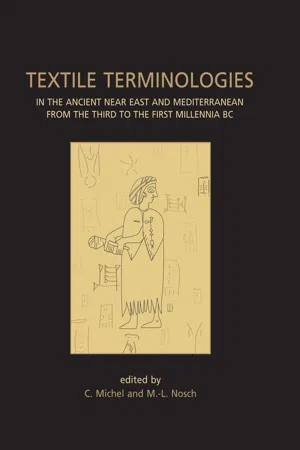
Written sources from the ancient Near East and eastern Mediterranean, from the third to the first millennia BC, provide a wealth of terms for textiles. The twenty-two chapters in the present volume offer the first comprehensive survey of this important material, with special attention to evidence for significant interconnections in textile terminology among languages and cultures, across space and time. For example, the Greek word for a long shirt, khiton , ki-to in Linear B, derives from a Semitic root, ktn . But the same root in Akkadian means linen, in Old Assyrian a garment made of wool, and perhaps cotton, in many modern languages. These and numerous other instances underscore the need for detailed studies of both individual cases and the common threads that link them. This example illustrates on the one hand how connected some textiles terms are across time and space, but it also shows how very carefully we must conduct the etymological and terminological enquiry with constantly changing semantics as the common thread. The survey of textile terminologies in 22 chapters presented in this volume demonstrates the interconnections between languages and cultures via textiles.
Information
Subtopic
Ancient HistoryIndex
HistoryTable of contents
- Cover
- Acknowledgements and research frameworks for the investigation of textile terminologiesin the 3rd and 2nd millennia BC
- Textile Terminologies
- 1 Synonymic Variation in the Field of Textile Terminology: A study in diachronyand synchrony
- 2 The Basics of Textile Tools and Textile Technology: From fi bre to fabric
- 3 Textile Terminologies and Classifi cations: Some methodological and chronological aspects
- 4 Weaving in Mesopotamia during the Bronze Age: Archaeology, techniques, iconography
- 5 Cloths – Garments – and Keeping Secrets. Textile classifi cation and cognitive chainingin the ancient Egyptian writing system
- 6 The ‘linen list’ in Early Dynastic and Old Kingdom Egypt: Text and textile reconciled
- 7 Clothing in Sargonic Mesopotamia: Visual and written evidence
- 8 Textiles in the Administrative Texts of the Royal Archives of Ebla (Syria, 24th century BC)with Particular Emphasis on Coloured Textiles
- 9 Les noms sémitiques des tissus dans les textes d’Ebla
- 10 New Texts Regarding the Neo-Sumerian Textiles
- 11 The Colours and Variety of Fabrics from Mesopotamia during the Ur III Period (2050 BC)
- 12 The Textiles Traded by the Assyrians in Anatolia (19th–18th centuries BC)
- 13 Tools, Procedures and Professions: A review of the Akkadian textile terminology
- 14 Les textiles du Moyen-Euphrate à l’époque paléo-babylonienne d’après un ouvrage récent
- 15 Linen in Hittite Inventory Texts
- 16 Textile Terminology in the Ugaritic Texts
- 17 The Terminology of Textiles in the Linear B Tablets, including Some Considerationson Linear A Logograms and Abbreviations
- 18 Mycenaean Textile Terminology at Work: The KN Lc(1)-tablets and the occupationalnouns of the textile industry
- 19 Les textiles néo-assyriens et leurs couleurs
- 20 Textile Terminology in the Neo-Babylonian Documentation
- 21 Garments in Non-Cultic Context (Neo-Babylonian Period)
- 22 Some Considerations about Vedic, Avestan and Indoiranian Textile Terminology
Trusted by 375,005 students
Access to over 1.5 million titles for a fair monthly price.
Study more efficiently using our study tools.
Frequently asked questions
Yes, you can cancel anytime from the Subscription tab in your account settings on the Perlego website. Your subscription will stay active until the end of your current billing period. Learn how to cancel your subscription
No, books cannot be downloaded as external files, such as PDFs, for use outside of Perlego. However, you can download books within the Perlego app for offline reading on mobile or tablet. Learn how to download books offline
Perlego offers two plans: Essential and Complete
- Essential is ideal for learners and professionals who enjoy exploring a wide range of subjects. Access the Essential Library with 800,000+ trusted titles and best-sellers across business, personal growth, and the humanities. Includes unlimited reading time and Standard Read Aloud voice.
- Complete: Perfect for advanced learners and researchers needing full, unrestricted access. Unlock 1.5M+ books across hundreds of subjects, including academic and specialized titles. The Complete Plan also includes advanced features like Premium Read Aloud and Research Assistant.
We are an online textbook subscription service, where you can get access to an entire online library for less than the price of a single book per month. With over 1.5 million books across 990+ topics, we’ve got you covered! Learn about our mission
Look out for the read-aloud symbol on your next book to see if you can listen to it. The read-aloud tool reads text aloud for you, highlighting the text as it is being read. You can pause it, speed it up and slow it down. Learn more about Read Aloud
Yes! You can use the Perlego app on both iOS and Android devices to read anytime, anywhere — even offline. Perfect for commutes or when you’re on the go.
Please note we cannot support devices running on iOS 13 and Android 7 or earlier. Learn more about using the app
Please note we cannot support devices running on iOS 13 and Android 7 or earlier. Learn more about using the app
Yes, you can access Textile Terminologies in the Ancient Near East and Mediterranean from the Third to the First Millennnia BC by Cécile Michel, Marie-Louise Nosch, Cécile Michel,Marie-Louise Nosch, Marie-Louise Nosch, Cécile Michel in PDF and/or ePUB format, as well as other popular books in History & Ancient History. We have over 1.5 million books available in our catalogue for you to explore.