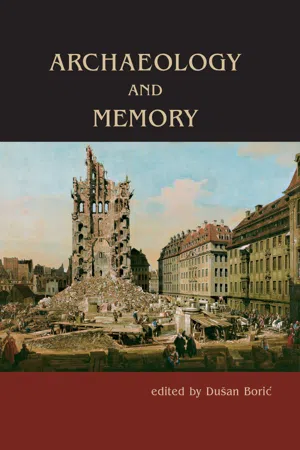
Memory can be both a horrifying trauma and an empowering resource. From the Ancient Greeks to Nietzsche and Derrida, the dilemma about the relationship between history and memory has filled many pages, with one important question singled out: is the writing of history to memory a remedy or a poison? Recently, a growing interest in and preoccupation with the issue of memory, remembering and forgetting has resulted in a proliferation of published works, in various disciplines, that have memory as their focus. This trend, to which the present volume contributes, has started to occupy the dominant discourses of disciplines such as sociology, philosophy, history, anthropology and archaeology, and has also disseminated into the wider public discourse of society and culture today. Such a condition may perhaps echo the phenomenon of a melancholic experience at the turn of the millennium.
Archaeology and Memory seeks to examine the diversity of mnemonic systems and their significance in different past contexts as well as the epistemological and ontological importance of archaeological practice and narratives in constituting the human historical condition. The twelve substantial contributions in this volume cover a diverse set of regional examples and focus on a range of prehistoric and classical case studies in Eurasian regional contexts as well as on the predicaments of memory in examples of the archaeologies of 'contemporary past'. From the Mesolithic and Neolithic burial chambers to the trenches of World War I and the role of materiality in international criminal courts, a number of contributors examine how people in the past have thought about their own pasts, while others reflect on our own present-day sensibilities in dealing with the material testimonies of recent history. Both kinds of papers offer wider theoretical reflections on materiality, archaeological methodologies and the ethical responsibilities of archaeological narration about the past.
eBook - PDF
Archaeology and Memory
About this book
Information
Subtopic
ArchaeologyIndex
Social SciencesTable of contents
- Cover
- List of Contributors
- 1. Introduction: Memory, archaeology and the historical condition
- 2. The diversity and duration of memory
- 3. Happy forgetting? Remembering and dismembering dead bodies at Vlasac
- 4. Forgetting and remembering the digital experience and digital data
- 5. Layers of meaning: Concealment, containment, memory and secrecy in the British EarlyBronze Age
- 6. Constructing the warrior: Death, memory and the art of warfare
- 7. Memory and microhistory of an empire: Domestic contexts in Roman Amheida, Egypt
- 8. The depiction of time on the Arch of Constantine
- 9. Archaeology and memory on the Western front
- 10. Terra incognita: Th e material world in international criminal courts
- 11. YugoMuseum: Memory, nostalgia, irony
- 12. Memory, melancholy and materiality
Trusted by 375,005 students
Access to over 1.5 million titles for a fair monthly price.
Study more efficiently using our study tools.
Frequently asked questions
Yes, you can cancel anytime from the Subscription tab in your account settings on the Perlego website. Your subscription will stay active until the end of your current billing period. Learn how to cancel your subscription
No, books cannot be downloaded as external files, such as PDFs, for use outside of Perlego. However, you can download books within the Perlego app for offline reading on mobile or tablet. Learn how to download books offline
Perlego offers two plans: Essential and Complete
- Essential is ideal for learners and professionals who enjoy exploring a wide range of subjects. Access the Essential Library with 800,000+ trusted titles and best-sellers across business, personal growth, and the humanities. Includes unlimited reading time and Standard Read Aloud voice.
- Complete: Perfect for advanced learners and researchers needing full, unrestricted access. Unlock 1.5M+ books across hundreds of subjects, including academic and specialized titles. The Complete Plan also includes advanced features like Premium Read Aloud and Research Assistant.
We are an online textbook subscription service, where you can get access to an entire online library for less than the price of a single book per month. With over 1.5 million books across 990+ topics, we’ve got you covered! Learn about our mission
Look out for the read-aloud symbol on your next book to see if you can listen to it. The read-aloud tool reads text aloud for you, highlighting the text as it is being read. You can pause it, speed it up and slow it down. Learn more about Read Aloud
Yes! You can use the Perlego app on both iOS and Android devices to read anytime, anywhere — even offline. Perfect for commutes or when you’re on the go.
Please note we cannot support devices running on iOS 13 and Android 7 or earlier. Learn more about using the app
Please note we cannot support devices running on iOS 13 and Android 7 or earlier. Learn more about using the app
Yes, you can access Archaeology and Memory by Dusan Boric in PDF and/or ePUB format, as well as other popular books in Social Sciences & Archaeology. We have over 1.5 million books available in our catalogue for you to explore.