- 159 pages
- English
- PDF
- Available on iOS & Android
eBook - PDF
Dogs and People in Social, Working, Economic or Symbolic Interaction
About this book
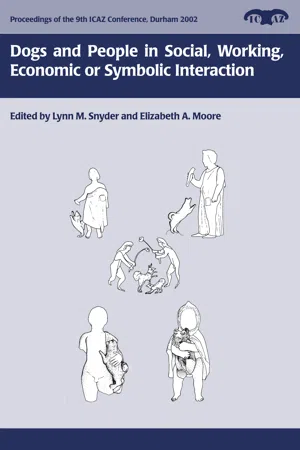
This, the final title to be published from the sessions of the 2002 ICAZ conference, focuses on the role of man's best friend. As worker or companion, the dog has enjoyed a unique relationship with its human master, and the depth and variety of the papers in this fascinating collection is a testament to the interest that this symbiotic arrangement holds for many scholars working in archaeology today. The book covers an eclectic range of subjects, such as considering dogs as animals of sacrifice and animal components of ancient and modern religious ritual and practice; dogs as human companions subject to loving care, visual/symbolic representation, deliberate or accidental breed manipulation; as working dogs; and finally as co-inhabitors of uman dwelling paces and co-consumers of human food resources. While many of the papers in this volume have a predominant focus, they also demonstate that the relationships between humans and dogs are rarely , if ever singular or simple. Instead these relationships are complex, often combining the practical, the ideological and the symbolic.
Information
Subtopic
ArchaeologyIndex
Social SciencesTable of contents
- Preface
- Introduction
- 1. History, Ethnography, and Archaeology of the Coast Salish Woolly-Dog
- 2. A Dwarf Hound Skeleton from a Romano-British Grave at York Road, Leicester, England, U.K., with a discussion of other Roman small dog types and speculation regarding their respective aetiologies
- 3. Food, Rituals? The Exploitation of Dogs from Eretria (Greece) During the Helladic and Hellenistic Periods
- 4. Artemis Pit? Dog Remains from a Well in the Ancient Town of Siracusa (Sicily)
- 5. In Sickness and in Health: Care for an Arthritic Maltese Dog from the Roman Cemetery of Yasmina, Carthage, Tunisia
- 6. What did the Bronze Age Dogs Eat? Coprolithic Analyses
- 7. What Do Dogs Mean? What Do Dogs Do? Symbolism, Instrumentality, and Ritual in Afro-Cuban Religion
- 8. Dog Sacrifice in the Ancient World: A Ritual Passage?
- 9. Bronze Age Dogs from Graves in Borger (Netherlands) and Dimini (Greece)
- 10. An Ethnoarcheological Study of Chase Hunting with Gundogs by the Aboriginal Peoples of Taiwan
- 11. Variability in Medieval Dogs from Hungary
- 12. Companions from the Oldest Times: Dogs in Ancient Greek Literature, Iconography and Osteological Testimony
- 13. Dog-wolf Hybrid Biotype Reconstruction from the Archaeological City of Teotihuacan in Prehispanic Central Mexico
- 14. The Sacrifice of Dogs in Ancient Italy
- 15. The Evidentiary Dog: A Review of Anthrozoological Cases and Archaeological Studies
Trusted by 375,005 students
Access to over 1.5 million titles for a fair monthly price.
Study more efficiently using our study tools.
Frequently asked questions
Yes, you can cancel anytime from the Subscription tab in your account settings on the Perlego website. Your subscription will stay active until the end of your current billing period. Learn how to cancel your subscription
No, books cannot be downloaded as external files, such as PDFs, for use outside of Perlego. However, you can download books within the Perlego app for offline reading on mobile or tablet. Learn how to download books offline
Perlego offers two plans: Essential and Complete
- Essential is ideal for learners and professionals who enjoy exploring a wide range of subjects. Access the Essential Library with 800,000+ trusted titles and best-sellers across business, personal growth, and the humanities. Includes unlimited reading time and Standard Read Aloud voice.
- Complete: Perfect for advanced learners and researchers needing full, unrestricted access. Unlock 1.5M+ books across hundreds of subjects, including academic and specialized titles. The Complete Plan also includes advanced features like Premium Read Aloud and Research Assistant.
We are an online textbook subscription service, where you can get access to an entire online library for less than the price of a single book per month. With over 1.5 million books across 990+ topics, we’ve got you covered! Learn about our mission
Look out for the read-aloud symbol on your next book to see if you can listen to it. The read-aloud tool reads text aloud for you, highlighting the text as it is being read. You can pause it, speed it up and slow it down. Learn more about Read Aloud
Yes! You can use the Perlego app on both iOS and Android devices to read anytime, anywhere — even offline. Perfect for commutes or when you’re on the go.
Please note we cannot support devices running on iOS 13 and Android 7 or earlier. Learn more about using the app
Please note we cannot support devices running on iOS 13 and Android 7 or earlier. Learn more about using the app
Yes, you can access Dogs and People in Social, Working, Economic or Symbolic Interaction by L. Snyder in PDF and/or ePUB format, as well as other popular books in Social Sciences & Archaeology. We have over 1.5 million books available in our catalogue for you to explore.