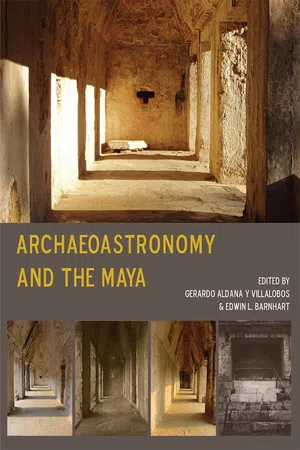
Archaeoastronomy and the Maya illustrates archaeoastronomical approaches to ancient Mayan cultural production. The book is contextualized through a history of archaeoastronomical investigations into Mayan sites, originating in the 19th century discovery of astronomical tables within hieroglyphic books. Early 20th century archaeological excavations revealed inscriptions carved into stone that also preserved astronomical records, along with architecture that was built to reflect astronomical orientations.
These materials provided the basis of a growing professionalized archaeoastronomy, blossoming in the 1970s and expanding into recent years. The chapters here exemplify the advances made in the field during the early 21st century as well as the on-going diversity of approaches, presenting new perspectives and discoveries in ancient Mayan astronomy that result from recent studies of architectural alignments, codices, epigraphy, iconography, ethnography, and calendrics. More than just investigations of esoteric ancient sciences, studies of ancient Mayan astronomy have profoundly aided our understanding of Mayan worldviews. Concepts of time and space, meanings encoded in religious art, intentions underlying architectural alignments, and even methods of political legitimization are all illuminated through the study of Mayan astronomy.
eBook - PDF
Archaeoastronomy and the Maya
- 177 pages
- English
- PDF
- Available on iOS & Android
eBook - PDF
Archaeoastronomy and the Maya
About this book
Information
Table of contents
- Contributors
- Foreword: The long and winding road to publication
- Glossary
- Introduction: Towards an archaeoastronomy 2.0?
- 1. Cosmic order at Chocolá: implications of solar observations of the eastern horizon at Chocolá, Suchitepéquez, Guatemala
- 2. Teotihuacan architectural alignments in the central Maya lowlands?
- 3. The astronomical architecture of Palenque’s Temple of the Sun
- 4. An oracular hypothesis: the Dresden Codex Venus Table and the cultural translation of science
- 5. Centering the world: zenith and nadir passages at Palenque
- 6. The many faces of Venus in Mesoamerica
- 7. Glyphs G and F: the cycle of nine, the lunar nodes, and the draconic month
- 8. Epilogue: Mayan astronomers at work
Trusted by 375,005 students
Access to over 1.5 million titles for a fair monthly price.
Study more efficiently using our study tools.
Frequently asked questions
Yes, you can cancel anytime from the Subscription tab in your account settings on the Perlego website. Your subscription will stay active until the end of your current billing period. Learn how to cancel your subscription
No, books cannot be downloaded as external files, such as PDFs, for use outside of Perlego. However, you can download books within the Perlego app for offline reading on mobile or tablet. Learn how to download books offline
Perlego offers two plans: Essential and Complete
- Essential is ideal for learners and professionals who enjoy exploring a wide range of subjects. Access the Essential Library with 800,000+ trusted titles and best-sellers across business, personal growth, and the humanities. Includes unlimited reading time and Standard Read Aloud voice.
- Complete: Perfect for advanced learners and researchers needing full, unrestricted access. Unlock 1.5M+ books across hundreds of subjects, including academic and specialized titles. The Complete Plan also includes advanced features like Premium Read Aloud and Research Assistant.
We are an online textbook subscription service, where you can get access to an entire online library for less than the price of a single book per month. With over 1.5 million books across 990+ topics, we’ve got you covered! Learn about our mission
Look out for the read-aloud symbol on your next book to see if you can listen to it. The read-aloud tool reads text aloud for you, highlighting the text as it is being read. You can pause it, speed it up and slow it down. Learn more about Read Aloud
Yes! You can use the Perlego app on both iOS and Android devices to read anytime, anywhere — even offline. Perfect for commutes or when you’re on the go.
Please note we cannot support devices running on iOS 13 and Android 7 or earlier. Learn more about using the app
Please note we cannot support devices running on iOS 13 and Android 7 or earlier. Learn more about using the app
Yes, you can access Archaeoastronomy and the Maya by Gerardo Aldana y Villalobos, Edwin L. Barnhart, Gerardo Aldana y Villalobos,Edwin L. Barnhart, Gerardo Aldana y V., Edwin L. Barnhart in PDF and/or ePUB format, as well as other popular books in Ciencias sociales & Historia de Latinoamérica y el Caribe. We have over 1.5 million books available in our catalogue for you to explore.