eBook - PDF
Children, Spaces and Identity
- 385 pages
- English
- PDF
- Available on iOS & Android
eBook - PDF
About this book
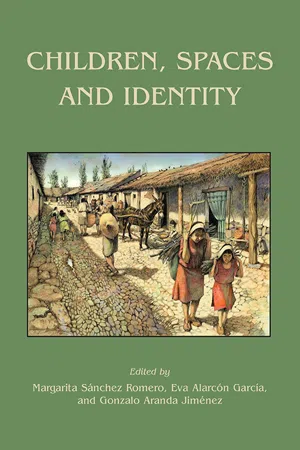
How do children construct, negotiate and organize space? The study of social space in any human group is fraught with limitations, and to these we must add the further limits involved in the study of childhood. Here specialists from archaeology, history, literature, architecture, didactics, museology and anthropology build a body of theoretical and methodological approaches about how space is articulated and organised around children and how this disposition affects the creation and maintenance of social identities. Children are considered as the main actors in historic dynamics of social change, from prehistory to the present day. Notions on space, childhood and the construction of both the individual and the group identity of children are considered as a prelude to papers that focus on analysing and identifying the spaces which contribute to the construction of children's identity during their lives: the places they live, learn, socialize and play. A final section deals with these same aspects, but focuses on funerary contexts, in which children may lose their capacity to influence events, as it is adults who establish burial strategies and practices. In each case authors ask questions such as: how do adults construct spaces for children? How do children manage their own spaces? How do people (adults and children) build (invisible and/or physical) boundaries and spaces?
Information
Subtopic
AnthropologyIndex
Social SciencesTable of contents
- List of contributors
- Acknowledgements
- 1. Children, Childhood and Space: Multidisciplinary Approaches to Identity
- 2. Steps to Children’s Living Spaces
- 3. Complexity, Cooperation and Childhood: An Evolutionary Perspective
- 4. Children as Potters: Apprenticeship Patterns from Bell Beaker Potteryof Copper Age Inner Iberia (Spain) (c. 2500–2000 cal BC)
- 5. Social Relations between Adulthood and Childhood in theEarly Bronze Age Site of Peñalosa (Baños de la Encina, Jaen, Spain)
- 6. Gender and Childhood in the II Iron Age: The Pottery Centreof Las Cogotas (Ávila, Spain)
- 7. Playing with Mud? An Ethnoarchaeological Approach to Children’sLearning in Kusasi Ceramic Production
- 8. Infantile Individuals: The Great Forgotten of Ancient Miningand Metallurgical Production
- 9. Learning to Be Adults: Games and Childhood on the Outskirtsof the Big City (San Isidro, Buenos Aires, Argentina)
- 10. Disabled Children and Domestic Living Spaces in Britain, 1800–1900
- 11. La evolución de los espacios de aprendizaje de la infancia a travésde los modelos pedagógicos
- 12. Montessori y el ambiente preparado: un espacio de aprendizaje paralos niños
- 13. Didactics of Childhood: The Case Study of Prehistory
- 14. Once upon a time… Childhood and Archaeology from the Perspectiveof Spanish Museums
- 15. Home to Mother: The Long Journey to not Lose one’s own Identity
- 16. Use of Molecular Genetic Procedures for Sex Determinationin ‘Guanches’ Children’s Remains
- 17. Salud y crecimiento en la Edad del Cobre. Un estudio preliminar de losindividuos subadultos de Camino del Molino (Caravaca de la Cruz,Murcia, España). Un sepulcro colectivo del III milenio cal. BC
- 18. Infant Burials during the Copper and Bronze Ages in the IberianJarama River Valley: A Preliminary Study about Childhoodin the Funerary Context during III–II millennium BC
- 19. Premature Death in the Vaccean Aristocracy at Pintia(Padilla de Duero/Peñafiel, Valladolid). Comparative Study of the FuneraryRituals of Two Little ‘Princesses’
- 20. Dying Young in Archaic Gela (Sicily): From the Analysis of theCemeteries to the Reconstruction of Early Colonial Identity
- 21. Maternidad e inhumaciones perinatales en el vicus romanorrepublicanode el Camp de les Lloses (Tona, Barcelona): lecturas y significados
- 22. Children and Funerary Space. Ritual Behaviours in the Greek Coloniesof Magna Graecia and Sicily
- 23. Children and Their Burial Practices in the Early Medieval Cemeteriesof Castel Trosino and Nocera Umbra (Italy)
- 24. La cultura lúdica en los rituales funerarios infantiles: los juegosde velorio
- 25. Compartiendo la experiencia de la muerte. El niño muerto y el niñofrente a la muerte
Trusted by 375,005 students
Access to over 1.5 million titles for a fair monthly price.
Study more efficiently using our study tools.
Frequently asked questions
Yes, you can cancel anytime from the Subscription tab in your account settings on the Perlego website. Your subscription will stay active until the end of your current billing period. Learn how to cancel your subscription
No, books cannot be downloaded as external files, such as PDFs, for use outside of Perlego. However, you can download books within the Perlego app for offline reading on mobile or tablet. Learn how to download books offline
Perlego offers two plans: Essential and Complete
- Essential is ideal for learners and professionals who enjoy exploring a wide range of subjects. Access the Essential Library with 800,000+ trusted titles and best-sellers across business, personal growth, and the humanities. Includes unlimited reading time and Standard Read Aloud voice.
- Complete: Perfect for advanced learners and researchers needing full, unrestricted access. Unlock 1.5M+ books across hundreds of subjects, including academic and specialized titles. The Complete Plan also includes advanced features like Premium Read Aloud and Research Assistant.
We are an online textbook subscription service, where you can get access to an entire online library for less than the price of a single book per month. With over 1.5 million books across 990+ topics, we’ve got you covered! Learn about our mission
Look out for the read-aloud symbol on your next book to see if you can listen to it. The read-aloud tool reads text aloud for you, highlighting the text as it is being read. You can pause it, speed it up and slow it down. Learn more about Read Aloud
Yes! You can use the Perlego app on both iOS and Android devices to read anytime, anywhere — even offline. Perfect for commutes or when you’re on the go.
Please note we cannot support devices running on iOS 13 and Android 7 or earlier. Learn more about using the app
Please note we cannot support devices running on iOS 13 and Android 7 or earlier. Learn more about using the app
Yes, you can access Children, Spaces and Identity by Margarita Sánchez Romero, Eva Alarcón García, Gonzalo Aranda Jiménez, Margarita Sánchez Romero,Eva Alarcón García,Gonzalo Aranda Jiménez, Margarita Sánchez Romero, Eva Alarcón Garcia, Gonzalo Aranda Jiménez in PDF and/or ePUB format, as well as other popular books in Social Sciences & Anthropology. We have over 1.5 million books available in our catalogue for you to explore.