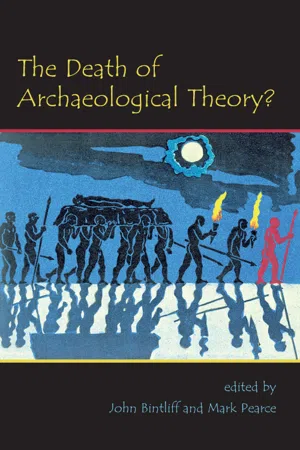
The Death of Archaeological Theory? addresses the provocative subject of whether it is time to discount the burden of somewhat dogmatic theory and ideology that has defined archaeological debate and shaped archaeology over the last 25 years. Seven chapters meet this controversial subject head on, also assessing where archaeological theory is now, and future directions.
John Bintliff questions what theory is and argues that archaeologists should be freed from 'Ideopraxists', or those who preach that a single approach or model is right to the exclusion of all others. Marc Pluciennik again questions what we mean by archaeological theory and argues that the role of intellectual fashion is underestimated. He predicts pressure from outside archaeology to redirect our dominant theories towards genetic and human impact theory. Kristian Kristiansen argues that theory cannot die, but it can change direction and sees signs of a retreat from the present post-modern and post-processual cycle towards a more science based, rationalistic cycle of revived modernity. To Mark Pearce the most striking thing about the present state of archaeological theory is that there is no emerging paradigm to be discerned; he proposes that Theory is not dead, but has instead become more eclectic and nuanced.
Two papers offer a different perspective from other areas of the world; Alexander Gramsch examines the issue from the German tradition and shows that in Central and Eastern Europe not only has Anglo-American Theory had limited impact, but current discussions on the future of method and theory offer a broader view of the discipline in which older traditions are seen to form the foundation. Kent Flannery and Joyce Marcus demonstrate that American archaeologists do not foresee the death of a genuinely archaeological theory (which they believe has never existed) but fear the real catastrophe would be the death of anthropological theory, because some anthropology today has become decidedly anti-scientific, rejecting not only the controlled comparison and contrast of cultures, but also the use of generalisation, both of which are crucial to theories and models and without which the longue durée will always be invisible.
- 97 pages
- English
- PDF
- Available on iOS & Android
eBook - PDF
The Death of Archaeological Theory?
About this book
Information
Subtopic
ArchaeologyIndex
Social SciencesTable of contents
- Cover
- 1 Introduction
- 2 The Death of Archaeological Th eory?
- 3 A New World Perspective on the ‘Death’of Archaeological Th eory
- 4 Theory, Fashion, Culture
- 5 Theory in Central European Archaeology: dead or alive?
- 6 Theory Does Not Die it Changes Direction
- 7 Have Rumours of the ‘Death of Th eory’ been Exaggerated?
Trusted by 375,005 students
Access to over 1.5 million titles for a fair monthly price.
Study more efficiently using our study tools.
Frequently asked questions
Yes, you can cancel anytime from the Subscription tab in your account settings on the Perlego website. Your subscription will stay active until the end of your current billing period. Learn how to cancel your subscription
No, books cannot be downloaded as external files, such as PDFs, for use outside of Perlego. However, you can download books within the Perlego app for offline reading on mobile or tablet. Learn how to download books offline
Perlego offers two plans: Essential and Complete
- Essential is ideal for learners and professionals who enjoy exploring a wide range of subjects. Access the Essential Library with 800,000+ trusted titles and best-sellers across business, personal growth, and the humanities. Includes unlimited reading time and Standard Read Aloud voice.
- Complete: Perfect for advanced learners and researchers needing full, unrestricted access. Unlock 1.5M+ books across hundreds of subjects, including academic and specialized titles. The Complete Plan also includes advanced features like Premium Read Aloud and Research Assistant.
We are an online textbook subscription service, where you can get access to an entire online library for less than the price of a single book per month. With over 1.5 million books across 990+ topics, we’ve got you covered! Learn about our mission
Look out for the read-aloud symbol on your next book to see if you can listen to it. The read-aloud tool reads text aloud for you, highlighting the text as it is being read. You can pause it, speed it up and slow it down. Learn more about Read Aloud
Yes! You can use the Perlego app on both iOS and Android devices to read anytime, anywhere — even offline. Perfect for commutes or when you’re on the go.
Please note we cannot support devices running on iOS 13 and Android 7 or earlier. Learn more about using the app
Please note we cannot support devices running on iOS 13 and Android 7 or earlier. Learn more about using the app
Yes, you can access The Death of Archaeological Theory? by John Bintliff, Mark Pearce, John Bintliff,Mark Pearce in PDF and/or ePUB format, as well as other popular books in Social Sciences & Archaeology. We have over 1.5 million books available in our catalogue for you to explore.