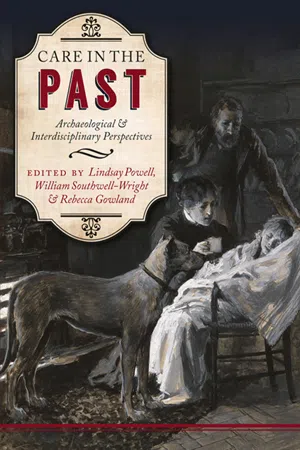
eBook - ePub
Care in the Past
Archaeological and Interdisciplinary Perspectives
- 208 pages
- English
- ePUB (mobile friendly)
- Available on iOS & Android
eBook - ePub
Care in the Past
Archaeological and Interdisciplinary Perspectives
About this book
Care-giving is an activity that has been practiced by all human societies. From the earliest societies through to the present, all humans have faced choices regarding how people in positions of dependency are to be treated. As such, care-giving, and the form it takes, is a central experience of being a human and one that is culturally mediated. Archaeology has tended to marginalise the study of care, and debates surrounding our ability to recognise it within the archaeological record have often remained implicit rather than a focus of discussion. These 12 papers examine the topic of care in past societies and specifically how we might recognise the provision of care in archaeological contexts and to open up an inter-disciplinary conversation, including historical, bioarchaeological, faunal and philosophical perspectives. The topic of 'care' is examined through three different strands: the provision of care throughout the life course, namely that provided to the youngest and oldest members of a society; care-giving and attitudes towards impairment and disability in prehistoric and historic contexts, and the role of animals as both recipients of care and as tools for its provision.
Information
Subtopic
ArchaeologyIndex
Social SciencesChapter 1
Foundations and Approaches to the Study of Care in the Past
Introduction
Care may be broadly defined as the provision of what is necessary in order to maintain another person’s state of health and welfare. Care provision for infants and children is regarded as normative and universal; care for the elderly is culturally more variable, though still an expected part of the dynamics of care across the life course. Care for those who are dependent as a consequence of physical and/or mental impairments arguably presents a more exceptional social challenge and has been highly historically variable. From the earliest humans to the present day, all groups have faced choices regarding the care, inclusion, or marginalisation of impaired individuals. Decisions regarding care-giving within any one society are contingent on a range of factors, such as environment, culture, and social structure, in addition to the nature of the impairment and the pre-existing identity of the sufferer. The question of care, both as an activity and as a social attitude towards those who require it (the “emotional” side of care), are of inherent interest to all people in all times. It is worth noting, that in this broad definition of care, it is important that we do not confine it to humans alone, but also encompass the care of animals. This book therefore aims to address a variety of these aspects of care in the past, through the adoption of a range of perspectives furnished from evidence that includes bioarchaeological, isotopic, faunal, philosophical and historical analyses.
In the developed world, questions surrounding care for the disabled, the elderly, their place in society, and social stigma and approbation surrounding people’s choices of child-rearing practices are matters of constant discussion and controversy, both within the media and wider society. These discussions contain aspects which are both practical, relating to the structure, environment, and economics of society, and facets which relate more widely to questions of emotion and ethics. The ability of past societies to provide forms of treatment that may signify care in its most immediate forms through practices of childbirth and rearing, medical treatment, and the treatment of the body in death, has become a subject of interest. Archaeologists have often shied away from looking at the significance of care, or have not felt comfortable with equating its provision with specific emotive or ethical states of being. Within some areas of archaeological expertise, such as prehistoric and hominid contexts, the provision of care-giving is one that is explicitly controversial and contested (see below, also Doat and Thorpe, this volume).
Whilst studies of birth, childhood, medical treatment, disability and old age are to be found in archaeology for all historical contexts and societies, the topic of care in and of itself has been less of a focus and has remained often only hinted at in discussions of topics to which it should be central. Whilst the editors of this volume all have different research interests in specific terms, we have all touched on and been interested in topics of care within archaeology. Care remains an under-analysed and poorly represented form of human behaviour within the archaeological literature. Through this edited book and the events that preceded it, we hoped to kick-start discussion on just how care-giving as a practice and a behaviour can be recognised archaeologically, historically, and in an interdisciplinary manner. The papers in this volume aim to contribute to such a dialogue.
The papers that comprise this book arose from two events organised in 2012. The first was a one-day conference entitled “Care in the Past: Archaeological and Interdisciplinary Dialogues” held at the College of St. Hild and St. Bede, Durham, where several of the papers in this volume were first presented. Following on from this, a session titled “Disability and Archaeology: Critical Perspectives and Inclusive Practices” was held at the 2012 Theoretical Archaeology Group (TAG) Meeting at the University of Liverpool. Additional papers by David Doat, Ellen Kendall, and Richard Thomas were commissioned. The volume has two aims: the first is to contribute towards the development of debates surrounding care-giving, utilising a range of archaeological evidence, and the second was to showcase the research of younger scholars working on the topic, alongside more established academics.
This introductory chapter outlines the context within which research regarding care in the past is currently situated, with a specific focus on two separate, albeit heavily intertwined strands: the treatment of people with impairments and disabilities in the past and their care, and the ways in which people at different points in the life course receive care, or evidence for the absence of care.
Care, impairment, and disability
One of the key debates within the topic of care and its archaeological recognition relates to the treatment of the physically and mentally impaired in past societies, and the degree to which we can recognise any past social stigma, disability, that arose from this. Archaeologists have tended to project modern ethnocentric ideas onto what it would have meant to be disabled in the past, which opened them up to criticism in terms of the often unfounded and overly imaginative conclusions that have been drawn (see Roberts 2000, 52–54; Roberts 2006, 424–425 for a discussion). Such flaws are to be avoided, but should not discourage the enterprise of looking at disability altogether as has largely been the case until recent years.
Traditionally, many archaeologists have been pessimistic about the possibility of identifying care as a form of emotional engagement from the physical evidence which we possess. Dettwyler (1991), in a highly-influential paper, advocated against archaeologists inferring attitudes of compassion towards disability from palaeopathological evidence. This work set the tone for much subsequent archaeological debate on the subject of care in the past, arguable discouraging further investigation (see Thorpe and Doat, this volume, for discussion on Dettwyler’s specific critiques). The arguments of Dettwyler, and those who have followed her lead, are that understanding disability requires us to reconstruct behaviour towards people from skeletal evidence alone; however, when attempting to infer an emotive concept such as compassion, it is all too easy to project our own ethnocentric and anachronistic conceptions onto this evidence, as well as our more emotive concerns surrounding care. Consequently, Dettwyler has argued that we need to differentiate between care and treatment of impairments, in a medical-functional sense, and compassion as a state of attitude towards the disabled person, and consider what would constitute evidence for these. Differentiating between genuine care and compassion for individuals and the act of simply keeping them alive is problematic through archaeological evidence alone (Roberts 2000, 55). This is a question that perhaps betrays contemporary attitudes towards the disabled; only if we see the impaired as requiring “compassion” to survive and contribute to their society do we see their existence in the past as heralding such an emotion (Dettwyler 1991, 376–377; Buikstra and Scott 2009, 40; see also Doat, this volume, for discussion of the relevance of compassion and mutual aid in this topic).
Sarah Tarlow’s (2000) work on the value of emotions in archaeological study also considers the question of disability. Tarlow’s analysis follows Dettwyler’s critical stance towards reading attitudes of compassion, similarly pointing out that care is not necessarily altruistic and nor are the disabled necessarily a drain on resources; assuming otherwise relies on the notions of ability and disability being a trans-historical given (Tarlow 2000, 726–727). When assessing the “compassion” of an individual being “allowed to live”, or their productivity, we have to be careful not to project our values and experiences regarding these topics onto the evidence.
Many other authors (e.g. Trinkaus and Zimmerman 1982; Trinkaus 1983; Tappen 1985; Frayer et al. 1987; Dickel and Doran 1989; Lebel et al. 2001; DeGusta 2002; 2003) have continued these sceptical lines of inquiry into care-giving for the disabled, specifically in prehistoric contexts. These debates focus on the technicalities and implications of given diagnoses and the issue of how particular impairments would have impacted an individual’s chances of survival, rather than on the social circumstances of those who did survive. There is a common supposition that mobile hunter-gatherer populations would have been less able to accommodate impaired individuals than settled populations. Such arguments often implicitly take on a perspective of Social Darwinism, as further discussed by Thorpe and Doat in this volume. This line of argument persists into the present day, and our ability to meaningfully recognise and discuss the existence and nature of compassionate attitudes in the past remains contentious.
Care is however now burgeoning as a key concern in the archaeological literature, although following Dettwyler’s critique, the more emotive concept of compassion is largely avoided. A key agenda in these works has been to demonstrate that people with severe impairments that would have necessitated care in order for them to survive, did live into adulthood. This belies the underlying assumption that those with disabilities would naturally be seen as burdens, or as marked out for an early death in the past; only if we possess such a predisposition or assumption in our own minds does their presence become significant in itself (Southwell-Wright 2013; 2014). For example, Stirland’s (1997, 587) article on the Medieval Parish Cemetery of St Margaret Fyebridgegate demonstrates the presence of a “caring, supportive community” through the physical inclusion of individuals with extensive physical impairments and deformities. Similarly, Kilgore and Van Gerven (2010) have taken the presence of an adult individual with severe congenital scoliosis (that could have potentially led to cardiovascular anomalies, neurological and genitourinary problems) to represent a de facto argument for the presence of some form of care in their community. Nonetheless, there are some problems with simply assuming that the presence of the disabled necessarily represents the presence of care as a state of integration without further analysis.
Much work on care remains speculative; however, studies that have attempted to situate evidence for impairments within a wider context; osteologically, archaeologically and historically; show more convincing results. Hawkey (1998) offers one of the most widely discussed analyses of disability and care in the past, in her study of an individual from Gran Quivira Pueblo, New Mexico. An adult male suffered from juvenile chronic arthritis and ankylosing spondylitis, which led to progressive degeneration of their mobility. In this study, Hawkey utilised musculoskeletal stress marker data (now referred to as entheseal changes – see Vilotte et al. 2016) to compare this individual to other contemporary adult males, to assess the degree of impairment and changes in its form, severity and effects over time as the condition worsened. Hawkey (1998, 338) found that “there is no archaeological evidence to suggest he was treated differently” because of his impairment, and his burial was normal in most respects bar one; burial 391 was found in a subfloor context, one usually reserved for children, perhaps suggesting the sort of care and relationship this man had with his family (Hawkey 1998, 336). In this instance, the severe disability may have had an infantilising effect on the individual’s identity: they occupied a similar social role to that of children, perhaps due to their dependency. Work such as this, that places the cared-for individual within their wider social context, can provide us with more insight than looking at care solely in terms of the provision of the basic necessities for life.
The focus of much of the debate on recognising disability, care, and compassion in the archaeological record has focused on prehistoric contexts. These contexts are, inarguably, those where we are least able to corroborate our ideas with other lines of evidence. Multidisciplinary studies of disability and care from contexts in historic societies have demonstrated the importance of these different types of evidence, yet still remain a relatively small body of literature. The inception of archaeological studies of care in historic contexts can perhaps best be seen in the significant landmark of the publication of the 1999 edition of the Archaeological Review from Cambridge (Finlay 1999). This was the first publication in the field whose sole focus was on the archaeology of disability and which considered disability as an identity in itself rather than as tangential to other topics. It is interesting to note that this volume too found its origins in a conference session at the Theoretical Archaeology Group. Another important aspect of Finlay (1999) was that it represented the first published interaction between archaeologists and disability studies scholars, in this case Shakespeare (1999, 99) who remains an important voice within debates surrounding the Social Model of Disability and who noted that archaeology can play a unique role in its “capacity to revisit and problematise issues of the human body in time, and to connect the physical to the socio-cultural”. Shakespeare (1999, 100) noted that the meaning of disability is contested in all historical contexts, contemporary and past, and warned archaeologists not to confuse “the biological evidence with the social experience.” This publication formed a crucially important addition to the literature, though its recommendations for future study remained largely unheeded for a further decade.
Unlike many of the previous debates regarding the recognition of care and compassion within archaeology, the Archaeological Review from Cambridge (Finlay 1999) contents focused primarily on historical (Medieval European) contexts, for which osteological evidence could be fruitfully combined with historical knowledge of care-giving practices. Metzler’s (1999) paper on the possibilities of the study of Medieval palaeopathology form an important addition and precursor to her later work, as does Roberts’ (1999) reminder of the difficulties of recognising disability in the skeletal evidence. Whilst not archaeological in focus, Metzler’s later works on disability in the Middle Ages (2006; 2013) have formed a further important contribution to the study of care in this time period and demonstrate the need for archaeologists to fully understand the social context of the period in which their evidence is situated. This is not an easy task, as Metzler’s work demonstrates, and involves scrutinising an incredibly broad range of evidence to ascertain the legal, social, cultural and economic position of disabled people so as to synthesise the best possible context for understanding what care individuals may have received. Such work is instructive for those of us who work in historic contexts. Whilst our focus may be on archaeological evidence, it is only through interdisciplinary approaches that we can develop any useful insight into this subject matter.
The use of archaeological evidence in concert with our knowledge of historic contexts has provoked a wide range of case study reports which have usefully examined the types of care past disabled people received or were withheld, more than it would be useful to detail here. To take one example, Armstrong and Fleischman (2003) present an interesting case study of a potentially impaired individual within the wider context of their study of House-Yard Burials in an 18th century plantation settlement in Jamaica. Skeleton SAJ-B1 was a male, approximately 20–25 years old, and was buried in a coffin and located under a walkway between houses. Skeletal analysis indicated that this individual was likely to have been paraplegic and may have also suffered partial facial paralysis (Armstrong and Fleischman 2003, 51–54). Immediately above his coffin, in the grave fill, was a lock: “Local Jamaicans who witnessed the excavations were quick to comment on the use of locks to “keep the duppy down”, or to hold the spirit of the deceased in the ground” (Armstrong and Fleischman 2003, 46–47). Clearly a person with a significant impairment could survive in a plantation environment, and his regular interment in most regards would indicate that he was integrated into the community. On the other hand, the use of the lock indicates that his disability may have provoked negative superstitious attitudes in death, and thus this example demonstrates both the wide range of conditions impaired people could have survived during the past, but also the superstitions attached to their conditions.
Recent years have seen some exciting developments in the literature relating to care in contexts which are perhaps less well supported by historic documentation and understanding. Oxenham (et al. 2009), Tilley and Oxenham (2011) and Tilley (2015a; 2015b) have managed to go beyond the previous speculative literature on care by examining the needs engendered by specific impairments and situating this evidence within specific social contexts. They analysed the burial of a 20–30 year old male from the Neolithic cemetery site at Man Bac, North Vietnam. This in...
Table of contents
- Cover
- Title Page
- Copyright
- Contents
- Acknowledgements
- List of Contributors
- Preface
- Chapter 1: Foundations and Approaches to the Study of Care in the Past
- Section 1: Care and the Life Course
- Section 2: Care, Impairment and Disability
- Section 3: Care and Non-Human Animals
Trusted by 375,005 students
Access to over 1.5 million titles for a fair monthly price.
Study more efficiently using our study tools.
Frequently asked questions
Yes, you can cancel anytime from the Subscription tab in your account settings on the Perlego website. Your subscription will stay active until the end of your current billing period. Learn how to cancel your subscription
No, books cannot be downloaded as external files, such as PDFs, for use outside of Perlego. However, you can download books within the Perlego app for offline reading on mobile or tablet. Learn how to download books offline
Perlego offers two plans: Essential and Complete
- Essential is ideal for learners and professionals who enjoy exploring a wide range of subjects. Access the Essential Library with 800,000+ trusted titles and best-sellers across business, personal growth, and the humanities. Includes unlimited reading time and Standard Read Aloud voice.
- Complete: Perfect for advanced learners and researchers needing full, unrestricted access. Unlock 1.5M+ books across hundreds of subjects, including academic and specialized titles. The Complete Plan also includes advanced features like Premium Read Aloud and Research Assistant.
We are an online textbook subscription service, where you can get access to an entire online library for less than the price of a single book per month. With over 1.5 million books across 990+ topics, we’ve got you covered! Learn about our mission
Look out for the read-aloud symbol on your next book to see if you can listen to it. The read-aloud tool reads text aloud for you, highlighting the text as it is being read. You can pause it, speed it up and slow it down. Learn more about Read Aloud
Yes! You can use the Perlego app on both iOS and Android devices to read anytime, anywhere — even offline. Perfect for commutes or when you’re on the go.
Please note we cannot support devices running on iOS 13 and Android 7 or earlier. Learn more about using the app
Please note we cannot support devices running on iOS 13 and Android 7 or earlier. Learn more about using the app
Yes, you can access Care in the Past by Lindsay Powell, William Southwell-Wright, Rebecca Gowland, Lindsay Powell,William Southwell-Wright,Rebecca Gowland in PDF and/or ePUB format, as well as other popular books in Social Sciences & Archaeology. We have over 1.5 million books available in our catalogue for you to explore.