eBook - ePub
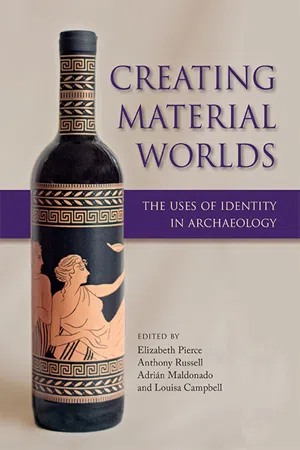
Creating Material Worlds
The Uses of Identity in Archaeology
- 192 pages
- English
- ePUB (mobile friendly)
- Available on iOS & Android
eBook - ePub
Creating Material Worlds
The Uses of Identity in Archaeology
About this book
Despite a growing literature on identity theory in the last two decades, much of its current use in archaeology is still driven toward locating and dating static categories such as 'Phoenician', 'Christian' or 'native'. Previous studies have highlighted the various problems and challenges presented by identity, with the overall effect of deconstructing it to insignificance. As the humanities and social sciences turn to material culture, archaeology provides a unique perspective on the interaction between people and things over the long term. This volume argues that identity is worth studying not despite its slippery nature, but because of it. Identity can be seen as an emergent property of living in a material world, an ongoing process of becoming which archaeologists are particularly well suited to study. The geographic and temporal scale of the papers included is purposefully broad to demonstrate the variety of ways in which archaeology is redefining identity. Research areas span from the Great Lakes to the Mediterranean, with case studies from the Mesolithic to the contemporary world by emerging voices in the field. The volume contains a critical review of theories of identity by the editors, as well as a response and afterword by A. Bernard Knapp.
Information
Subtopic
ArchaeologyIndex
Social SciencesChapter 1
Introduction: Creating Material Worlds
The debate over the relationship between archaeological finds and past identities is an enduring one in our discipline. It is also notoriously difficult terrain, but it has the benefit of lending significance to our endeavours beyond our corner of the social sciences. While creating typologies and refining chronologies are part of the stock-in-trade of archaeology – and important methodologies in their own right – the study of identity personalises the past, and makes it more accessible to those outside of the discipline. Indeed, it might be argued that for the all the variety of ways of being an archaeologist, the basic task uniting them all is the study of ways of being in the past. The assemblage of sites, finds and theories which make up our field constitute the search for processes of identification.
As archaeologists we recover the material remains of the past, but always interpret and re-interpret them in the present (Shanks and Tilley 1987). We identify these things first by what we think they are and how old they might be, and then we attempt a deeper analysis. Who made this? Who used it? How far has it travelled? What significance did it have culturally? Who influenced its form or function? What other things are associated with it? At every turn we encounter implications for past identities, and at nearly every turn such interpretations are difficult to prove. Yet still we try, and it is this continued push and pull between the impossibility of proof and the desire for interpretation that requires more study. This volume represents ten scholars’ meditations on identifying the mute stones, bones and sherds they encounter, but it should not be seen as a handbook to ‘finding identity’. Rather, it is a survey of ten different ways of grappling with theories of identification in the past.
This introductory essay serves two purposes. First, we will argue that the pervasive search for identity through material culture, going back to the origins of archaeological thought, speaks to a deep concern at the heart of the discipline. Although it has met much criticism and many dead-ends along the way, it continues to resurface, a phenomenon which needs to be problematised. Second, we will argue that while approaches to identity are as complex and multifarious as the term itself, it is the search that is important, and thinking about the ways in which it has been used tells us much about why we do archaeology in the first place.
Defining identity
But what is identity, and why do we need one?
Rowlands 1994, 131
We all seem to know what we are talking about when the term ‘identity’ is thrown about. Sometimes we add modifiers to specify one aspect of identity to make things easier: ethnic identity; gendered identity; political identity. In recent years, however, there has been a growing recognition that these categories cannot be so easily separated, and each is crucial for understanding the rest (Gilchrist 2007; Casella and Fowler 2005b). Despite the vast literature on the subject, much research relies upon simple pattern recognition, something which requires constant self-awareness on behalf of the researcher. Birdwatchers use the term GISS (general impression: size and shape) to describe in-the-field identification of species, when the observer intuitively ‘knows’ which bird they see without being able to say exactly how. The human brain’s pre-conscious propensity to find patterns is perhaps partly to blame for the general fuzziness of our definitions of identity: we ‘know’ what it means, but do not know how we know. This common-sense approach has led to trouble in the past, and it is why the need to deconstruct these categories grew to a fever pitch particularly within the post-processual critique (see below).
Nevertheless, it is perhaps worthwhile to attempt some sort of semantic parameters for the term. To bluntly summarise decades of theory, we accept the position that identity is not simply something we have, it is something we experience (Meskell and Preucel 2007, 24). Put another way, identity is not a thing in the world, but a perspective on the world (Brubaker and Cooper 2000, 122). As students of time depth and long term change, studying how certain discourses of identity become materialised should be one of the core aims of archaeology. It is not enough to merely say that identity is fluid, variable, multiple, or polysemic; we need to study why and how it is made to feel fixed and timeless in spite of this (Gardner 2011, 12–13). Yet even this does not go far enough, as we still need to question why we are concerned with finding identity in the past at all.
Archaeological thinking broadly follows the concerns of the times. Early antiquarians in the eighteenth century looked to ancient sites to shed light on scripture and refine Biblical chronologies (Morse 2005; Haycock 2002). The first ‘scientific’ archaeologists of the nineteenth century had race and nationality on their minds (Díaz-Andreu 2007), later twentieth-century theorists emphasised the power of the individual (Robb 2010) and, as more and more of our lives are expressed and stored virtually, it is no surprise that the last decade has seen renewed focus on the agency of things (e.g., Olsen et al. 2012). In an increasingly networked age, we are now becoming more attuned to the way in which people and things are interconnected and interwoven across both space and time, or as ‘assemblages’ rather than finished items (Harris, this volume). Yet no matter how much archaeological thought changes to suit the times, it seems that what we do is fundamentally concerned with identity. Whether the material being studied relates to settlement, economy, ritual, death or material culture itself, the perceived relevance of these studies is about what they tell us about life in the past and, often implicitly but increasingly outwardly, what this means to us in the present (Harrison 2011).
What has changed in recent times is a shift in focus from the search for sameness, so characteristic of cultural-historical approaches, to a greater focus on difference (Fowler 2010, 353; Insoll 2007b, 1–3; Meskell 2002, 280). It is again no surprise to find this shift correlates with a wider appreciation of the power of an individual to choose and act, echoing the vaunted (though not exclusive) western idealisation of the individual in society (Hall 1996, 4–5) to the point where, as Jenkins (2008b, 30) has put it, ‘[i]dentity, it seems, is the touchstone of the times’. However, it is also true that the categorization of others is not merely a communal act but inevitably part of self-construction (Barth 1969; Jenkins 2008a, 59–61). Since the practice of archaeology has long been about the ‘categorization of others’ – the denizens of the past – it follows that archaeology is a way of interrogating our own social structures in the present (cf. Jones 1997, 135–44). The realization that archaeological theory is as much about who we are now as how things were then revolutionized the field in the 1980s (see especially Shanks and Tilley 1987). Self-aware archaeologies of identity came into their own, exemplified by a string of publications which grappled with the concept explicitly, the legacy of which is reviewed below. These have recently been criticised for their emphasis on the western post-Enlightenment conception of self as an individual with an inherent capacity to act (Creese, this volume), but before we discard this debate as wholly misguided, we need to look at why it occurred in the first place. If the study of the past is only ever an index of the concerns of the present, then the long-lived and ongoing search for identity through archaeology reveals a fundamental insecurity at the heart of our discipline that requires explanation.
Archaeological theory and identity crisis
It is worth exploring what archaeologists do and their role within the humanities and social sciences. Archaeology has become a continuum of skills, encompassing fieldwork, specialist reports, theoretical debates and interpretation for the lay public. The public end of the spectrum has long focused on identity as a hook to interest non-specialists, whether it be local identities in the context of community engagement, or past identities such as ‘Aztec’ which can be used as a recognisable shorthand to draw attention and aid explanation. With the increasing amount of archaeology reporting in the mainstream media, there is increased pressure for scholars to positively identify sites, objects, and now with increasing use of DNA and stable isotope analysis, even named individuals like King Richard III (Buckley et al. 2013).
Yet on the academic side of the spectrum, there has been a recurring challenge to the hegemony of identity as a social construct too broad to be useful (Hall 1996; Brubaker and Cooper 2000; Olsen 2001; Joffe 2003; Pitts 2007; Fowler 2010). How do we square the perennial search for self, in ourselves as in the past, with the academic certainty that identity is an intangible notion that we can never really pin down? This depends on whether we see such uncertainty as a problem, or as an opportunity (Buchli 2010; Olsen 2001; González-Ruibal 2008; Wright, this volume).
Advocates of materiality, memory and personhood have shifted the focus toward the relationship between people and things, and more recently the post-human critique seeks to break down the barriers between people and things entirely. Such views tend to downplay identity as too human-focused at the expense of the materials and their interrelationships (Fowler 2010, 383–85; Webmoor and Witmore 2008). Rather than removing people from the frame, this perspective focuses on their lived experience and our own continuing engagement with a past that is all around us. In the context of this critique, the papers in this volume collectively suggest that there is a particularly archaeological approach to identity, one founded on the realisation that identity is an emergent property of living in a material world (cf. Fowler 2013). Getting to this point has not been a straightforward narrative of ‘progress’ from one paradigm to the next, nor do all the papers in this volume adhere to a single theoretical model (and indeed, many authors have opposed views). Rather, the papers approach identities and processes of identification in all their complexity, from tangible materials to the abstract concepts they embody. As such, the vision of identity offered is not meant to be definitive, but rather more like a set of Lego bricks – tools with which to create new worlds. This introductory...
Table of contents
- Cover
- Title Page
- Copyright
- Contents
- Preface
- Contributor Biographies
- Chapter 1: Introduction
- Chapter 2: Becoming Post-Human: Identity and the Ontological Turn
- Chapter 3: Materialising the Afterlife: The Long Cist in Early Medieval Scotland
- Chapter 4: Move Along: Migrant Identities in Scandinavian Scotland
- Chapter 5: Smoke and Mirrors: Conjuring the Transcendental Subject
- Chapter 6: Drinking Identities and Changing Ideologies in Iron Age Sardinia
- Chapter 7: Impressions at the Edge: Belonging and Otherness in the Post-Viking North Atlantic
- Chapter 8: We Are Not You: Being Different in Bronze Age Sicily
- Chapter 9: There Is No Identity: Discerning the Indiscernible
- Chapter 10: Food, Identity and Power Entanglements in South Iberia between the Ninth–Sixth Centuries BC
- Chapter 11: Proportionalising Practices in the Past: Roman Fragments Beyond the Frontier
- Chapter 12: Afterword: Identity … and Things
Trusted by 375,005 students
Access to over 1.5 million titles for a fair monthly price.
Study more efficiently using our study tools.
Frequently asked questions
Yes, you can cancel anytime from the Subscription tab in your account settings on the Perlego website. Your subscription will stay active until the end of your current billing period. Learn how to cancel your subscription
No, books cannot be downloaded as external files, such as PDFs, for use outside of Perlego. However, you can download books within the Perlego app for offline reading on mobile or tablet. Learn how to download books offline
We are an online textbook subscription service, where you can get access to an entire online library for less than the price of a single book per month. With over 1.5 million books across 990+ topics, we’ve got you covered! Learn about our mission
Look out for the read-aloud symbol on your next book to see if you can listen to it. The read-aloud tool reads text aloud for you, highlighting the text as it is being read. You can pause it, speed it up and slow it down. Learn more about Read Aloud
Yes! You can use the Perlego app on both iOS and Android devices to read anytime, anywhere — even offline. Perfect for commutes or when you’re on the go.
Please note we cannot support devices running on iOS 13 and Android 7 or earlier. Learn more about using the app
Please note we cannot support devices running on iOS 13 and Android 7 or earlier. Learn more about using the app
Yes, you can access Creating Material Worlds by Louisa Campbell, Adrian Maldonado, Elizabeth Pierce, Anthony Russell, Louisa Campbell,Adrian Maldonado,Elizabeth Pierce,Anthony Russell in PDF and/or ePUB format, as well as other popular books in Social Sciences & Archaeology. We have over 1.5 million books available in our catalogue for you to explore.