- 295 pages
- English
- PDF
- Available on iOS & Android
eBook - PDF
Dynamics of Production in the Ancient Near East
About this book
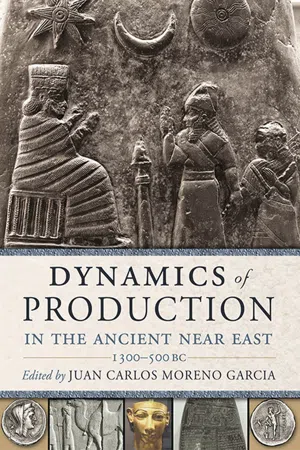
The transition between the 2nd and the 1st millennium BC was an era of deep economic changes in the ancient Near East. An increasing monetization of transactions, a broader use of silver, the management of the resources of temples through "entrepreneurs", the development of new trade circuits and an expanding private, small-scale economy, transformed the role previously played by institutions such as temples and royal palaces. The 17 essays collected here analyse the economic transformations which affected the old dominant powers of the Late Bronze Age, their adaptation to a new economic environment, the emergence of new economic actors and the impact of these changes on very different social sectors and geographic areas, from small communities in the oases of the Egyptian Western Desert to densely populated urban areas in Mesopotamia. Egypt was not an exception. Traditionally considered as a conservative and highly hierarchical and bureaucratic society, Egypt shared nevertheless many of these characteristics and tried to adapt its economic organization to the challenges of a new era. In the end, the emergence of imperial super-powers (Assyria, Babylonia, Persia and, to a lesser extent, Kushite and Saite Egypt) can be interpreted as the answer of former palatial organizations to the economic and geopolitical conditions of the early Iron Age. A new order where competition for the control of flows of wealth and of strategic trading areas appears crucial.
Information
Topic
GeschichteSubtopic
AltertumTable of contents
- Frontcover
- Title
- Copyright
- Contents
- List of contributors
- Introduction Juan Carlos Moreno García
- 1. Economies in transition: trade, “money”, labour and nomads at the turn of the 1st millennium BC Juan Carlos Moreno García
- 2. Oil and wine for silver? The economic agency of the Egyptian peasant communities in the Great Oasis during the Persian Period Damien Agut-Labordère
- 3. Urban craftsmen and other specialists, their land holdings, and the Neo-Assyrian state Heather D. Baker
- 4. Beyond capitalism – conceptualising ancient trade through friction, world historical context and bazaars Peter Fibiger Bang
- 5. Phoenician trade: the first 300 years Carol Bell
- 6. The contribution of pottery production in reconstructing aspects of local rural economy at the northern frontier of the Neo-Assyrian Empire Anacleto D’Agostino
- 7. Silver circulation and the development of the private economy in the Assyrian Empire (9th–7th centuries BCE): considerations on private investments, prices and prosperity levels of the imperial élite Salvatore Gaspa
- 8. Long-distance trade in Neo-Babylonian Mesopotamia: the effects of institutional changes Laetitia Graslin-Thomé
- 9. The empire of trade and the empires of force: Tyre in the Neo-Assyrian and Neo-Babylonian periods Caroline van der Brugge & Kristin Kleber
- 10. Temples and agricultural labour in Egypt, from the Late New Kingdom to the Saite Period Juan Carlos Moreno García
- 11. North-east Africa and trade at the crossroads of the Nile Valley, the Mediterranean and the Red Sea Robert G. Morkot
- 12. Temples, trade and money in Egypt in the 1st millennium BC Renate Müller-Wollermann
- 13. From “institutional” to “private”: traders, routes and commerce from the Late Bronze Age to the Iron Age Susan Sherratt
- 14. Intercultural contacts between Egypt and the Arabian Peninsula at the turn of the 2nd to the 1st millennium BCE Gunnar Sperveslage
- 15. Interactions between temple, king and local elites: the hanšû land schemes in Babylonia (8th–6th centuries BC) John P. Nielsen & Caroline Waerzeggers
- 16. Organisation and financing of trade and caravans in the Near East Jean-Baptiste Yon
- 17. Aegean economies from Bronze Age to Iron Age: some lines of development, 13th–7th centuries BC Julien Zurbach
Trusted by 375,005 students
Access to over 1.5 million titles for a fair monthly price.
Study more efficiently using our study tools.
Frequently asked questions
Yes, you can cancel anytime from the Subscription tab in your account settings on the Perlego website. Your subscription will stay active until the end of your current billing period. Learn how to cancel your subscription
No, books cannot be downloaded as external files, such as PDFs, for use outside of Perlego. However, you can download books within the Perlego app for offline reading on mobile or tablet. Learn how to download books offline
Perlego offers two plans: Essential and Complete
- Essential is ideal for learners and professionals who enjoy exploring a wide range of subjects. Access the Essential Library with 800,000+ trusted titles and best-sellers across business, personal growth, and the humanities. Includes unlimited reading time and Standard Read Aloud voice.
- Complete: Perfect for advanced learners and researchers needing full, unrestricted access. Unlock 1.5M+ books across hundreds of subjects, including academic and specialized titles. The Complete Plan also includes advanced features like Premium Read Aloud and Research Assistant.
We are an online textbook subscription service, where you can get access to an entire online library for less than the price of a single book per month. With over 1.5 million books across 990+ topics, we’ve got you covered! Learn about our mission
Look out for the read-aloud symbol on your next book to see if you can listen to it. The read-aloud tool reads text aloud for you, highlighting the text as it is being read. You can pause it, speed it up and slow it down. Learn more about Read Aloud
Yes! You can use the Perlego app on both iOS and Android devices to read anytime, anywhere — even offline. Perfect for commutes or when you’re on the go.
Please note we cannot support devices running on iOS 13 and Android 7 or earlier. Learn more about using the app
Please note we cannot support devices running on iOS 13 and Android 7 or earlier. Learn more about using the app
Yes, you can access Dynamics of Production in the Ancient Near East by Juan Carlos Moreno Garcia in PDF and/or ePUB format, as well as other popular books in Geschichte & Altertum. We have over 1.5 million books available in our catalogue for you to explore.