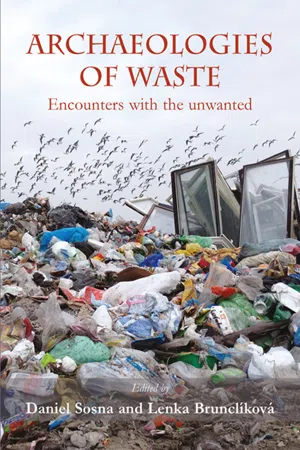
Waste represents a category of 'things', which is familiar and ubiquitous but rarely reflected in archaeological and cultural studies. Perception of waste changes over time and practices associated with waste vary. The ambiguity of waste challenges traditional archaeological approaches that take advantage of refuse to infer past behavior. Recent developments in research in the social sciences and humanities indicate that waste offers many more dimensions for exploration.This interdisciplinary book brings together scholars who demonstrate the potential of research into waste for understanding humans, non-humans and their interrelations. In 12 chapters the authors cover topics ranging from the relationship between waste and identity in early agricultural settlements to the perception of contemporary nuclear waste. Although archaeological approaches dominate the contributions, there are also chapters that represent the results of anthropological and historical research.The book is structured into three main sections that explore the relationship between waste and three domains of interest: value, social differentiation, and space. Archaeologies of Waste will interest archaeologists, anthropologists, historians and other readers intrigued by the potential of things, which were left behind, to shed light on social life.
- 182 pages
- English
- ePUB (mobile friendly)
- Available on iOS & Android
eBook - ePub
Archaeologies of waste
About this book
Trusted by 375,005 students
Access to over 1.5 million titles for a fair monthly price.
Study more efficiently using our study tools.
Information
Subtopic
ArchaeologyIndex
Social SciencesChapter 1
Introduction
The history of archaeology is closely associated with the study of things that were left behind and, therefore, could become a source of information about societies in the past. Straightforward understanding of the things that became unwanted and were refused – incorporated into the dominant concept of refuse – has led to the perception that this is an obvious and proven category of things established by decades of research. A closer look into the world of waste, however, indicates that it is too complex and unruly to be captured by a single perspective. Recent development of research in social geography, sociocultural anthropology, sociology, history and philosophy opened new dimensions of thinking about waste. What is waste really, and what are the most productive ways to approach it within and across the disciplines? Is it a social category constructed flexibly within various regimes of value or a specific physical entity? What is the potential of waste to inform us about the entanglements among humans, other beings, things and places? Similar questions open space for rethinking waste while taking seriously recent thoughts generated not only in archaeology but also in other disciplines.
This essay has three aims. The first is to provide the conceptual and historical background for thinking about waste in archaeology and juxtapose it with the approaches in other disciplines. Archaeological discourse is predominantly embedded in discussions about refuse discarded by humans, which reflects human society or culture. This logic of reasoning where waste materials are just mere epiphenomena of immaterial dimensions of reality can be extended to reasoning about all things in general (see Olsen 2010, 37). Although this ‘human > refuse > society’ model is legitimate, we argue that recent research and theorising not only in archaeology but also in other disciplines in the humanities and social sciences offers new directions for thinking about and with waste. As Shanks et al. (2004, 64) argued, it is critical to reflect on the ideas generated outside archaeology to fully understand the things that were thrown away. The second aim is to present the potential of archaeological approaches to waste to generate comparative data and engage in comparative projects across space and time. The third aim is to introduce three major themes of this edited volume – value, social practice, and space – to provide the reader with a map of the ‘bookscape’.
Situating waste
The paradox of the humanities and social sciences stems from the troubled relationship between omnipresence and clarity. The more obvious and frequently used the concept, the higher the degree of ambiguity and the more intensive the debates that attempt to define the main focus of scholarly interest. Culture, ritual or human are all examples of concepts that have attracted considerable attention whose careful review would go beyond the limits of this chapter. Waste falls into the same group of concepts. Waste is so ubiquitous, cognitively salient and intuitively obvious that its definition seems to be an easy task. The opposite is true, however. Let us explore this conceptual space.
Archaeology is a discipline with long-term experience with material remains that reflect disposal practices in past societies. Indeed, things found in disposal contexts probably dominate over those found in contexts of production or use (Shanks et al. 2004, 65; Trigger 1989, 360). This observation indicates that the things that were left behind provide the major source of information about past societies. The situation in the research of contemporary societies is quite opposite because it has been dominated by interest in earlier phases of the life of things such as their production, exchange or consumption, while disposal, decay or destruction remained largely overlooked (Gonzalez-Ruibal 2008, 248; Pétursdóttir and Olsen 2014, 3). Increasing interest in waste in sociocultural anthropology, sociology, social geography, history and philosophy is primarily a recent phenomenon (Alexander and Reno 2012; De León 2012; 2015; Dürr and Jaffe 2010; Gille 2007; Gregson et al. 2010; Henig 2012; Melosi 2005; Nagle 2013; Reno 2009; 2014; 2015; 2016; Scanlan 2005; Strasser 1999; Thompson 1979). This trend is interesting by itself. As Edensor (2011, 162) suggested for ruins – a material category closely related to waste – the turning to it may reflect discontent with the project of modernity and its implicit believe in progress and order. Waste falls into the same group of concepts that do not fit the narratives of advancement. Moreover, it is noticeable that recent approaches to waste and ruins emphasise ambiguity, absence, hybridity, mutability, transformation and similar concepts that reflect resistance to the images of the world organised into right angles that dwell in the black and white environment.
The early approaches to waste in archaeology were stimulated by the desire to understand large accumulations of animal remains and associated artefacts produced by ancient fishers and hunters. These kjøkkenmøddinger (kitchen middens) were approached as material remains of human practices in the past that provided evidence for the refutation of myths and enabled researchers to propose ‘scientific’ explanations of history and evolution (see Kristiansen 2002, 12). The central focus of research was analysis and interpretation of variability of material remains in the middens. Waste served as a vehicle for the creation of national chronologies and their mutual comparison to understand the differential development of nations and races (Worsaae and Thoms 1849, 1–3). The alternative approach envisioned waste as a vehicle for the understanding of the functioning of ancient human communities and their relationship to the environment (Steenstrup 1886). Despite the differences in interpretations of waste’s variability, waste itself was conceptualised as a result of the disposal of unwanted matter that had low value for the humans who disposed of it.
Most influential schools of thought in archaeology approached waste from the processual perspective. Leaving things behind is only a part in the sequence of processes that form and transform the archaeological record. The emphasis on the nature and sequence of processes responsible for the production of waste is shared by behavioural archaeologists (Reid et al. 1975; Schiffer 1972; 1996), the French school of technology studies (Boëda 1995; Bordes 1953; Inizan et al. 1995; Leroi-Gourhan 1964), the Taphonomic school (Lyman 1994; Sommer 1990), and archaeologists from other language communities (Kuna 2015; Wolfram 2003). This shared processual – sensu lato – perspective leads to the presentation of waste as a category of material things that emerges and disappears at specific points within the temporal sequence of human activities. For Schiffer (1996, 47), refuse1 forms when artefacts are discarded. The reasons for discard are functional. Artefacts are discarded because they cannot perform utilitarian or symbolic functions (Schiffer 1996, 47). The French technological tradition follows a similar logic but puts more emphasis on knowledge and intentions of humans (cf. Sellet 1993, 107). For example, during the production of chipped stone tools, there is a distinction between the final product, which was intended to be produced, and various leftovers, which represent just necessary accompanying phenomena of production. Therefore, the category of waste may include flakes and chips (éclats-déchets) produced by façonnage and retouche while exhausted cores represent waste produced by débitage (Inizan et al. 1995). Consequently, waste represents not only artefacts that ceased to fulfil their function but also material remains of human activities which originated during the production of something else.
Sommer’s (1990) taphonomic approach emphasises the transitions between different stages (coenoses) through which assemblages of things flow, especially the transition between thanatocoenosis and taphocoenosis. Again, the process is at the centre of interest but it is explicitly linked to space and emic classification of refuse based on its size, value, dirtiness and danger (Sommer 1990, 53). This perspective puts more emphasis on human capacity to categorise things based on their characteristics and act accordingly. Moreover, refuse is not just material, which would be perceived through the prism of its functionality, but it also participates in the process of semiosis when things become refuse via their symbolic relation to dirt or danger. It is not a coincidence that the workers responsible for clearing cesspits – described vividly by Oosten (Chapter 4) – are called nightmen because the world of light and sun wound not be the good fit for such activities. Sommer’s approach results in her interest in emic classification of things that corresponds to works of various scholars in other disciplines.
Several theoreticians derived their understanding of waste from an interest in classification (Moser 2002; Scanlan 2005; Strasser 1999; Thompson 1979). In this perspective waste is conceptualised as a specific category defined by relationships to other categories within a classification system. Douglas (2005) focused on the study of classification systems and uncovered that dirt, as a category, has an ambivalent nature. Dirt embodies all entities that potentially threaten order. Nonetheless, order itself is constituted by a limited set of relations. There is an unlimited unordered world lying beyond the limits of this ordered set of relations and it provides a substratum for the creation of order. Because of this potential, an unordered world symbolises danger (Douglas 2005, 117). Several authors follow the idea that waste is a strange liminal category. While Douglas derives liminality of waste from its association with dirt, Thompson (1979, 7–10) argues that waste (rubbish) is liminal because it provides space for the conversion between durable and transient objects. In addition to this, Gille (2007, 23) suggests that waste is liminal because it is associated with the guarding or the breaking of boundaries. Things lying on the outskirts of settlements, in middens or landfills have a potential that actors may recognise, engage with them and cross the boundaries between pure and impure, dangerous and safe, forgotten and salient while transforming their value. The perspectives that emphasise classification are powerful in elucidating the ways humans perceive the world through the prism of categories, but they are less efficient in capturing dynamics of social life. Materials and things flow through various contexts when actors interpret them differentially and their value may fluctuate. Such dynamics and agency are difficult to capture via totalising theories of shared general models of classification.
There is also a debate to what degree large accumulations of waste carry the potential to affect order. Douglas (2005, 197–198) argues that individual things within mass waste lose their identity and, therefore, also their symbolic potential. As Reno (2008, 6) demonstrated, even mass waste carries destructive potential that affects humans, animals and places that get in touch with this waste. Based on our experience with Central European landfills, this potential can be positive as well because mass waste can be transformed into energy, commodities and gifts. In other words, even disposal of mass waste in a special restricted place does not prevent this waste from participating in diverse social, economic, environmental and political relationships.
The indeterminacy of waste emerges when one moves beyond the functional paradigm where waste (or refuse) comes into being when artefacts are discarded because they cannot perform their functions. A recent study of shell mounds by Villagran (2014) demonstrates that these features cannot be understood as a mere result of the discard of food that was moved to a specific place of disposal as a secondary refuse. In contrast, she depicts a complex process including funerary practices, daily disposal of domestic refuse and relocation of middens which constitute materialised memory and connections with the past. In other words, waste is transformed from the unwanted result of domestic activities to a critical part of landscape that helps humans to understand who they are. Therefore, it would be too simple to envision waste as unwanted matter doomed to be forgotten. As Wolfram (Chapter 9) and Oosten (Chapter 4) argue, the value of waste is a matter of perspective. Waste is rather a dynamic category and being unwanted is only one dimension or phase during its ‘social life’. However, the state of being unwanted is a necessary prerequisite for the category of waste. At some point, zero or negative value has to be ascribed to it despite the fact that this perception may change later, during the phase that Reno (2015, 558) calls ‘productive afterlife of waste’.
One of the key questions concerning waste is its relationship to humans. Traditional processual, functionalist and symbolic perspectives begin with the implicit assumption that humans are the sole producers – both on the material and symbolic level – of waste. It is humans who discard non-functional artefacts and ascribe them into a special category within a classification system. But what happens when we take as a starting point for theorising waste all organisms, not only humans? Reno (2014) recently proposed a new theory of waste, which challenges the anthropocentric notion of waste and approaches it as a semi-biotic matter. This perspective draws on biosemiotics (see Favareau 2010; Hoffmeyer 2008) to show that waste is a ‘sign of life’ that expands beyond the world of humans. In Reno’s perspective, all animals have the capacity to recognise scat and give it meaning based on iconic or indexical logic of semiosis. In this sense, waste, as a semi-biotic entity can exist without socially contingent categorisation (Reno 2014, 5). Reno’s move takes humans from the pedestal of exceptionality and provides a theory that suppresses hierarchy between humans and non-humans. This theory, however, merges together the inevitable physiological process of excretion with human production ...
Table of contents
- Cover
- Title Page
- Copyright
- Contents
- List of Illustrations
- List of Tables
- List of Contributors
- Preface
- Chapter 1: Introduction
- Part 1 – Value of the Unwanted
- Part 2 – Social Practice: Consumption and Differentiation
- Part 3 – Positioning Waste: Spatial Nature of Waste
- Postscript
Frequently asked questions
Yes, you can cancel anytime from the Subscription tab in your account settings on the Perlego website. Your subscription will stay active until the end of your current billing period. Learn how to cancel your subscription
No, books cannot be downloaded as external files, such as PDFs, for use outside of Perlego. However, you can download books within the Perlego app for offline reading on mobile or tablet. Learn how to download books offline
Perlego offers two plans: Essential and Complete
- Essential is ideal for learners and professionals who enjoy exploring a wide range of subjects. Access the Essential Library with 800,000+ trusted titles and best-sellers across business, personal growth, and the humanities. Includes unlimited reading time and Standard Read Aloud voice.
- Complete: Perfect for advanced learners and researchers needing full, unrestricted access. Unlock 1.5M+ books across hundreds of subjects, including academic and specialized titles. The Complete Plan also includes advanced features like Premium Read Aloud and Research Assistant.
We are an online textbook subscription service, where you can get access to an entire online library for less than the price of a single book per month. With over 1.5 million books across 990+ topics, we’ve got you covered! Learn about our mission
Look out for the read-aloud symbol on your next book to see if you can listen to it. The read-aloud tool reads text aloud for you, highlighting the text as it is being read. You can pause it, speed it up and slow it down. Learn more about Read Aloud
Yes! You can use the Perlego app on both iOS and Android devices to read anytime, anywhere — even offline. Perfect for commutes or when you’re on the go.
Please note we cannot support devices running on iOS 13 and Android 7 or earlier. Learn more about using the app
Please note we cannot support devices running on iOS 13 and Android 7 or earlier. Learn more about using the app
Yes, you can access Archaeologies of waste by Daniel Sosna, Lenka Brunclíková in PDF and/or ePUB format, as well as other popular books in Social Sciences & Archaeology. We have over 1.5 million books available in our catalogue for you to explore.