The last several decades have seen a dramatic increase in interest in the Roman period on the island of Crete. Ongoing and some long-standing excavations and investigations of Roman sites and buildings, intensive archaeological survey of Roman areas, and intensive research on artefacts, history, and inscriptions of the island now provide abundant data for assessing Crete alongside other Roman provinces. New research has also meant a re-evaluation of old data in light of new discoveries, and the history and archaeology of Crete is now being rewritten.
The breadth of topics addressed by the papers in this volume is an indication of Crete’s vast archaeological potential for contributing to current academic issues such as Romanisation/acculturation, climate and landscape studies, regional production and distribution, iconographic trends, domestic housing, economy and trade, and the transition to the late-Antique era. These papers confirm Crete’s place as a fully realised participant in the Roman world over the course of many centuries but also position it as a newly discovered source of academic inquiry.
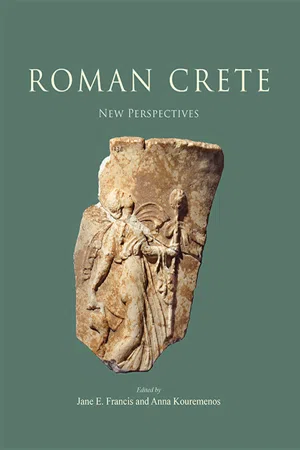
eBook - ePub
Roman Crete: New Perspectives
- 288 pages
- English
- ePUB (mobile friendly)
- Available on iOS & Android
eBook - ePub
Roman Crete: New Perspectives
About this book
Information
Subtopic
Roman Ancient HistoryIndex
History1
Foreword
A wide range of interests in Roman studies and an impressive variety of topics are brought together here for the first time in this remarkable collection of papers, all resulting from individual research in Crete and its international connections, or ‘networks’. This development, the gathering of different lines of independent research into various features of the island, is now presented as a unit and amounts to a general – and impressive – upgrading of the recorded history of Crete in the Roman period.
The contrast with the general situation which prevailed almost 50 years ago when I was asked to ‘clear the way’ for the subsequent full excavation of the prestigious Minoan ‘Unexplored Mansion’ could hardly be more striking. That fine building was built adjacent to the monumental ‘Little Palace’ and both were directly linked by the ‘Royal Road’ to the north side of the Palace of Minos. Sir Arthur Evans had peeked into and knew the extraordinary value of this site.
To put it positively, although I only had previous experience with Minoan and Classical ceramics (and stratigraphy), for this new project I was privileged to receive and enjoy the advice and assistance of the rare if not sole true Romanist available at that time – namely John Hayes. He was not only a rare expert in the field of Roman ceramics, but a generous and consistent visitor, excited by all the new finds as they came up: patient with a novice with no post-4th century BC expertise – e.g., in quickly separating out and distinguishing all those glossy ‘red sherds’ (Cypriot? Eastern Sigillata B? Çandarlı? North African? …) and as sure in producing a date as if they belonged to a Caesar! For a wider spread of parallels, I was also able to consult J. A. Riley and his colleagues (of Berenice).
While this was a full, rich, continuous and privileged sequence, now local enthusiasm is branching out so much more widely all over Crete and finding direct connections with other impressive centres of Roman culture and tracing their interconnections, which even ‘outstrip’ those of Knossos.
All the more exciting to be able to share here in these new, wider discoveries, and in the publication of a broad range of comparable sequences throughout the Megalonisi which is Crete.
2
Introduction
This volume has its origins in the increased research and publication of the history and material culture of the island of Crete in the Roman period. During the last three decades, intensive excavations at sites with substantial Roman phases are providing new data about Crete’s urban landscape, while survey projects across the island offer new understandings of rural contexts. Research focused on particular artefact classes, especially ceramics, but also domestic and civic architecture, water systems, and agricultural production, offers a comparative basis for assessing Cretan evidence against that from other parts of the Roman world. This activity, in turn, now allows scholars working on Crete to become more involved in wider issues of interpreting the Roman world and for those outside the island to use its data in their own assessments of the Roman provinces.
The collection of articles in this volume was instigated by a panel on Roman Crete presented at the Roman Archaeology Conference in Frankfurt, Germany in March 2012. This panel, comprising six papers, had several aims, the first of which was to bring greater attention to the Roman period on Crete, which has long been overshadowed by the island’s Minoan past. The Roman period, by contrast, has not received significant attention and is little known, even to scholars of the eastern Roman provinces. Despite this, the arrival of the Romans to Crete and the incorporation of the island into the double province of Creta et Cyrene remains an important event, one that is not overstated by Chaniotis’ statement, cited by Kouremenos in the RAC Roman Crete panel abstract, that the incorporation of the island into the Roman Empire was ‘the most significant turning point in the history of Crete since the destruction of the Minoan palaces.’ (Chaniotis 2008, 83; Kouremenos 2012). A second goal was to identify how the data from Crete could contribute to the current debates about the Roman world, especially in scholarship on the provinces and their relationships with Rome (e.g., Forsén and Salmeri 2008; Sweetman 2011a). A further aim was to bring together scholars working on disparate material and in different parts of Crete not only to disseminate results but also to discuss strategies for future research.
The current volume comprises a selected number of papers from the RAC panel, to which are added seven other articles. This total represents a cross-section of the variety of Cretan material evidence, history, and interpretations available to date, although the subject is undeniably larger than can be contained in a single collection.
The historiography of Roman Crete
Ancient texts confirm that the island of Crete was ever vibrant in the minds of the Romans. It was the source of agricultural abundance like passum wine and medicinal herbs, and accounts of pirates whose existence provided the pretext for the Roman invasion in the 1st century BC. Its Minoan past, awash in tales of the Minotaur, Knossos, and heroic actions, continued to resonate well into late antiquity. The story of the Roman invasions and battle for the island in the 1st century BC between Pompey and Metellus, later named Creticus, are detailed in the accounts of authors like Livy and Plutarch, even if the precise dates for the creation of the administrative province of Creta et Cyrene remain uncertain. The island’s location part way between North Africa and Greece and part way along the trade routes from the eastern Mediterranean to the west ensured its ongoing prominence in travel and maritime trade. In later periods, the standing remains of the island were of some interest to scholars and travellers: Onorio Belli, in the 16th century, investigated the theatres of Roman Crete, while in the Venetian period accounts of Captain Spratt and Buondelmonte described landscapes and monuments. To scholars of the 20th century, however, Crete meant the Minoans, especially after Evans’ discovery in 1900 of the Palace at Knossos and subsequent intensive excavation and study of Minoan remains by scholars like Bosanquet, Seager, Hall, Halbherr, and Hawes. The lack of interest in the later periods is emphasized by Evans’ destruction of the Roman levels at the Unexplored Mansion and the so-called Villa Dionysos in order to reach the Minoan remains below (Sackett 1992; Kouremenos, forthcoming). This concentration on the Minoan Bronze Age marginalized the later periods to a certain extent, although Roman studies have been more fortunate that others; for instance, data has only recently been accumulating for the Classical period on Crete at sites like Eleutherna (Stampolidis 2004; Themelis 2009), Kato Syme, Afrati (Erickson 2002), and Priniatikos Pyrgos (Erickson 2010). An exception has been the excavations at Gortyn, which began in 1884 and still continue today, under the auspices of the Scuola Archeologica Italiana di Atene and now with the participation of teams from multiple Italian universities. Sporadic research occurred at other sites as well, but results were not conducive to a broader understanding of Roman Crete. Research at Knossos, mostly rescue excavations around the Minoan palace by the British School at Athens, revealed fragments of the Roman colony, including the so-called Villa Dionysos, excavated in 1935, Roman tombs, and a Byzantine basilica. Parts of Aptera and the Sanctuary of Diktynna in west Crete were investigated by German scholars during the occupation of the island in World War II (Matz 1951), while brief excavations were undertaken by an American team at Tarrha in 1959 (Weinberg 1960). The ongoing excavations at Eleutherna by the University of Crete have, since 1985, revealed parts of a basilica, two Roman houses, and more (Themelis 2000; Stampolidis 2004; Themelis 2009). Other Roman sites were also subject to brief excavations and yielded disparate, unconnected scraps of archaeological information, including, for example, Lissos (Niniou-Kindeli 1990), Tsoutsouras (Marinatos 1934–1935), Tholos (Haggis 1996), Makrygialos (Papadakis 1986), and Kouphonisi/Leuke (Papadakis 1983).
Individual artefact classes also began to be studied, based on available evidence. The late 19th century saw Svoronos’ publication of the island’s numismatic evidence and history (1890), while the inscriptions of Crete followed in the early 20th century with the efforts of Margherita Guarducci and Federico Halbherr producing the monumental four volumes of the Inscriptiones Creticae. The study of Roman Crete has indirectly benefitted from generations of intrepid archaeologists whose focus was primarily the Minoan period. Scholars like Richard Seager, John Pendlebury, Gerald Cadogan, Peter Warren, and Sinclair Hood were looking for Minoan remains, but often found and recorded Roman sites and artefacts. One can, for instance, find Roman entries in Pendlebury’s The Archaeology of Crete: An Introduction (1939) and Costas Davaras’ Guide to Cretan Antiquities (1976). Yet this data was not systematically collected or analyzed, and knowledge about the history and archaeological record of Roman Crete remained disparate, with the period seemingly destined to remain the poor cousin of the island’s more ‘exotic’ Minoan past.
This situation changed in the 1970s when a young scholar named Ian Sanders undertook an island-wide, methodical survey of Roman Crete, with a focus on its sites and visible remains. This research, which was completed shortly before Sanders’ premature illness and death, was submitted posthumously to the University of Oxford for his D.Phil. Published in 1982 as Roman Crete: An Archaeological Survey and Gazetteer of late Hellenistic, Roman, and early Byzantine Crete, the importance of this research remains considerable, even more than three decades later, and it has become the point of departure for everyone working in this field. Sanders built upon the available published data for Roman Crete, but augmented it considerably through his fieldwork, which ultimately identified 429 sites. He also included observations about artefacts on the ground and those available in local museums. This was the first time that Roman evidence was brought together with the goal of providing a comprehensive interpretation of Roman Crete.
Sanders organized this research into eight chapters, beginning with the historical background for the Roman conquest of the island. The second chapter examines and analyzes settlement patterns, with the island divided into eight geographical sectors from east to west. The sites under discussion are matched with their ancient names, where possible, and changes between coastal and inland, lowland and upland sites were correlated to historical events specific to their regions. Sanders also tried to understand the natural advantages of these areas and how one site might relate to its neighbour. The third chapter, on the economy of Roman Crete, explores evidence for the agricultural produce and other commodities available on Crete and how they were exploited both on and off the island. Sanders then delved into religion in Roman Crete, starting with a section on pagan worship in which he discussed local Cretan deities, like Zeus Cretagenes and Diktynna, ritual inscriptions, and the remains of sanctuaries and small shrines. He then turned to burial customs and outlined the types of tombs identified on Crete. The final section in this chapter investigates evidence for Judaism and Christianity on the island. Chapter five examines the art produced in Roman Crete and includes artefact types like carved sarcophagi, statues of both historical and mythological figures, and the large corpus of mosaics, discussed with reference to their findspots. The next chapter presents the architecture of the island, by type and then by site. This is a particularly disparate group of structures and represents well the vagaries of ancient preservation and modern investigations: theatres and amphitheatres, public buildings, temples and sanctuaries, nymphaea, cisterns, and the few private villas known at the time. Christian basilicas on Crete are addressed in chapter seven, a subject that provides a considerable body of evidence. The last chapter contains Sanders’ conclusion...
Table of contents
- Cover
- Title Page
- Copyright
- Contents
- Acknowledgements
- Abbreviations
- Chapter 1: Foreword
- Chapter 2: Introduction
- Chapter 3: From Cyrene to Gortyn. Notes on the relationship between Crete and Cyrenaica under Roman domination (1st century BC–4th century AD)
- Chapter 4: A context for Knossos: Italian Sigillata stamps and cultural identity across Crete
- Chapter 5: The double-axe (λάβρυς) in Roman Crete and beyond: the iconography of a multi-faceted symbol
- Chapter 6: The Roman climate in the southwest Aegean: was it really different?
- Chapter 7: Apiculture in Roman Crete
- Chapter 8: Roman imperial sculpture from Crete: a re-appraisal
- Chapter 9: An Attic marble table support (τραπεζοφόρον) in relief from Roman Kissamos: preliminary remarks
- Chapter 10: The Roman theatre at Aptera: a preliminary report
- Chapter 11: Roman Gortyn: from Greek polis to provincial capital
- Chapter 12: Crete’s economic transformation in the late Roman Empire
- Chapter 13: Theatres, plays, and the ‘3rd century crisis’
- Chapter 14: Pottery of the 4th–early 9th centuries AD on Crete: the current state of research and new directions
- Chapter 15: Afterword: putting Crete on the Roman map
- Plates
Trusted by 375,005 students
Access to over 1.5 million titles for a fair monthly price.
Study more efficiently using our study tools.
Frequently asked questions
Yes, you can cancel anytime from the Subscription tab in your account settings on the Perlego website. Your subscription will stay active until the end of your current billing period. Learn how to cancel your subscription
No, books cannot be downloaded as external files, such as PDFs, for use outside of Perlego. However, you can download books within the Perlego app for offline reading on mobile or tablet. Learn how to download books offline
Perlego offers two plans: Essential and Complete
- Essential is ideal for learners and professionals who enjoy exploring a wide range of subjects. Access the Essential Library with 800,000+ trusted titles and best-sellers across business, personal growth, and the humanities. Includes unlimited reading time and Standard Read Aloud voice.
- Complete: Perfect for advanced learners and researchers needing full, unrestricted access. Unlock 1.5M+ books across hundreds of subjects, including academic and specialized titles. The Complete Plan also includes advanced features like Premium Read Aloud and Research Assistant.
We are an online textbook subscription service, where you can get access to an entire online library for less than the price of a single book per month. With over 1.5 million books across 990+ topics, we’ve got you covered! Learn about our mission
Look out for the read-aloud symbol on your next book to see if you can listen to it. The read-aloud tool reads text aloud for you, highlighting the text as it is being read. You can pause it, speed it up and slow it down. Learn more about Read Aloud
Yes! You can use the Perlego app on both iOS and Android devices to read anytime, anywhere — even offline. Perfect for commutes or when you’re on the go.
Please note we cannot support devices running on iOS 13 and Android 7 or earlier. Learn more about using the app
Please note we cannot support devices running on iOS 13 and Android 7 or earlier. Learn more about using the app
Yes, you can access Roman Crete: New Perspectives by Jane E. Francis, Anna Kouremenos, Jane E. Francis,Anna Kouremenos in PDF and/or ePUB format, as well as other popular books in History & Roman Ancient History. We have over 1.5 million books available in our catalogue for you to explore.