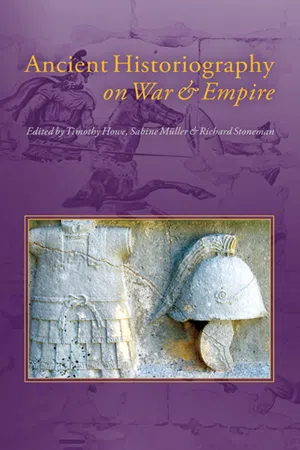
eBook - PDF
Ancient Historiography on War and Empire
- 297 pages
- English
- PDF
- Available on iOS & Android
eBook - PDF
Ancient Historiography on War and Empire
About this book
In the ancient Greek-speaking world, writing about the past meant balancing the reporting of facts with shaping and guiding the political interests and behaviours of the present. Ancient Historiography on War and Empire shows the ways in which the literary genre of writing history developed to guide empires through their wars. Taking key events from the Achaemenid Persian, Athenian, Macedonian and Roman 'empires', the 17 essays collected here analyse the way events and the accounts of those events interact. Subjects include: how Greek historians assign nearly divine honours to the Persian King; the role of the tomb cult of Cyrus the Founder in historical narratives of conquest and empire from Herodotus to the Alexander historians; warfare and financial innovation in the age of Philip II and his son, Alexander the Great; the murders of Philip II, his last and seventh wife Kleopatra, and her guardian, Attalos; Alexander the Great's combat use of eagle symbolism and divination; Plutarch's juxtaposition of character in the Alexander-Caesar pairing as a commentary on political legitimacy and military prowess, and Roman Imperial historians using historical examples of good and bad rule to make meaningful challenges to current Roman authority. In some cases, the balance shifts more towards the 'literary' and in others more towards the 'historical', but what all of the essays have in common is both a critical attention to the genre and context of history-writing in the ancient world and its focus on war and empire.
Information
Topic
HistoriaSubtopic
Historia antiguaTable of contents
- List of contributors
- Abbreviations
- Foreword: Ancient historiography and ancient history
- Part I: Introduction
- 1. Why history? On the emergence of historical writing
- Part II: Persia and Greece
- 2. The political and the divine in Achaemenid royal inscriptions
- 3. Cyrus the Great and the sacrifices for a dead king
- 4. The horse and the stag: Philistus’ view of tyrants
- Part III: Macedon
- 5. Alexander II of Macedon
- 6. ‘The giver of the bride, the bridegroom, and the bride’: a study of the murder of Philip II and its aftermath
- 7. Royal tombs and cult of the dead kings in Early Hellenistic Macedonia
- Part IV: The Empires of Alexander the Great and the Diadochoi
- 8. The financial administration of Asia Minor under Alexander the Great: an interpretation of two passages from Arrian’s Anabasis
- 9. The Eagle has landed: divination in the Alexander historians
- 10. The casualty figures of Alexander’s army
- 11. Alexander’s battles against Persians in the art of the Successors
- 12. How the hoopoe got his crest: reflections on Megasthenes’ stories of India
- 13. Creating the king: the image of Alexander the Great in 1 Maccabees, 1–10
- Part V: Second Sophistic Rome
- 14. The hero vs. the tyrant: legitimate and illegitimate rule in the Alexander-Caesar pairing
- 15. Plutarch’s Alexander, Dionysos and the metaphysics of power
- 16. The artistic king: reflections on a Topos in Second Sophistic Historiography
- 17. Flattery, history, and the Πεπαιδευμένος
- Index
Trusted by 375,005 students
Access to over 1.5 million titles for a fair monthly price.
Study more efficiently using our study tools.
Frequently asked questions
Yes, you can cancel anytime from the Subscription tab in your account settings on the Perlego website. Your subscription will stay active until the end of your current billing period. Learn how to cancel your subscription
No, books cannot be downloaded as external files, such as PDFs, for use outside of Perlego. However, you can download books within the Perlego app for offline reading on mobile or tablet. Learn how to download books offline
Perlego offers two plans: Essential and Complete
- Essential is ideal for learners and professionals who enjoy exploring a wide range of subjects. Access the Essential Library with 800,000+ trusted titles and best-sellers across business, personal growth, and the humanities. Includes unlimited reading time and Standard Read Aloud voice.
- Complete: Perfect for advanced learners and researchers needing full, unrestricted access. Unlock 1.5M+ books across hundreds of subjects, including academic and specialized titles. The Complete Plan also includes advanced features like Premium Read Aloud and Research Assistant.
We are an online textbook subscription service, where you can get access to an entire online library for less than the price of a single book per month. With over 1.5 million books across 990+ topics, we’ve got you covered! Learn about our mission
Look out for the read-aloud symbol on your next book to see if you can listen to it. The read-aloud tool reads text aloud for you, highlighting the text as it is being read. You can pause it, speed it up and slow it down. Learn more about Read Aloud
Yes! You can use the Perlego app on both iOS and Android devices to read anytime, anywhere — even offline. Perfect for commutes or when you’re on the go.
Please note we cannot support devices running on iOS 13 and Android 7 or earlier. Learn more about using the app
Please note we cannot support devices running on iOS 13 and Android 7 or earlier. Learn more about using the app
Yes, you can access Ancient Historiography on War and Empire by Timothy Howe, Sabine Müller, Richard Stoneman, Timothy Howe,Sabine Müller,Richard Stoneman in PDF and/or ePUB format, as well as other popular books in Historia & Historia antigua. We have over 1.5 million books available in our catalogue for you to explore.