How the euro survived a series of crises, and how to make it more resilient
The euro has survived crises unimagined at its founding: the financial meltdown of 2007–2009, the sovereign debt crisis of 2010–2012, the pandemic, and the Russian invasion of Ukraine. The European Central Bank fought these crises with dramatic policy innovations, buying up vast amounts of debt and providing large loans to banks. But now everyone expects the ECB to intervene routinely, and the euro is more fragile as a result. Crisis Cycle recounts this history and offers recommendations for restoring a durable monetary union.
Monetary and fiscal policy are intertwined, especially in a currency union like the eurozone. Member states can be tempted to borrow and spend too much, and then count on the ECB to rescue them by printing money to buy their bonds. To avoid these disincentives, the ECB was founded with a narrow mandate: use interest rates to pursue price stability, and don’t buy sovereign debt. Debt and deficit rules would keep countries from getting into trouble.
The ECB’s emergency innovations brought back these disincentives. How can the EU avoid larger and larger bailouts? The authors argue that Europe needs a joint fiscal institution that can provide temporary help to sovereigns, a resolution mechanism so sovereign default is a motivating possibility, and bank reform that ensures sovereign default will not bring down the financial system. This timely book shows how to restore the euro’s ambitious and effective founding framework. The unique group of authors combine extensive policy experience and authoritative academic credentials.
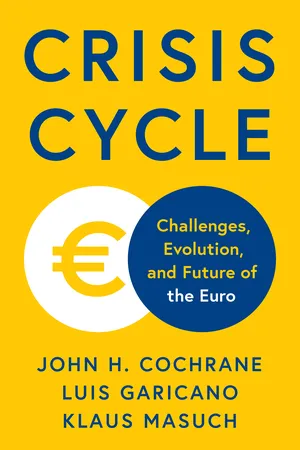
eBook - ePub
Crisis Cycle
Challenges, Evolution, and Future of the Euro
- English
- ePUB (mobile friendly)
- Available on iOS & Android
eBook - ePub
Crisis Cycle
Challenges, Evolution, and Future of the Euro
About this book
Information
Publisher
Princeton University PressYear
2025Print ISBN
9780691271620
9780691271606
eBook ISBN
9780691271613
Table of contents
- Cover Page
- Title Page
- Copyright Page
- Epigraphs
- Contents
- Preface
- 1. Introduction and Overview
- 2. Key Economic Ideas
- 3. The Design of the Economic and Monetary Union
- 4. Prelude to Financial Crisis
- 5. The Sovereign Debt Crisis
- 6. Institutional Reforms
- 7. The Zero Bound
- 8. The Pandemic
- 9. Inflation, War, and Tightening
- 10. The Unsustainable Present
- 11. Reform Proposals
- Notes
- Bibliography
- Index
Trusted by 375,005 students
Access to over 1.5 million titles for a fair monthly price.
Study more efficiently using our study tools.
Frequently asked questions
Yes, you can cancel anytime from the Subscription tab in your account settings on the Perlego website. Your subscription will stay active until the end of your current billing period. Learn how to cancel your subscription
No, books cannot be downloaded as external files, such as PDFs, for use outside of Perlego. However, you can download books within the Perlego app for offline reading on mobile or tablet. Learn how to download books offline
Perlego offers two plans: Essential and Complete
- Essential is ideal for learners and professionals who enjoy exploring a wide range of subjects. Access the Essential Library with 800,000+ trusted titles and best-sellers across business, personal growth, and the humanities. Includes unlimited reading time and Standard Read Aloud voice.
- Complete: Perfect for advanced learners and researchers needing full, unrestricted access. Unlock 1.5M+ books across hundreds of subjects, including academic and specialized titles. The Complete Plan also includes advanced features like Premium Read Aloud and Research Assistant.
We are an online textbook subscription service, where you can get access to an entire online library for less than the price of a single book per month. With over 1.5 million books across 990+ topics, we’ve got you covered! Learn about our mission
Look out for the read-aloud symbol on your next book to see if you can listen to it. The read-aloud tool reads text aloud for you, highlighting the text as it is being read. You can pause it, speed it up and slow it down. Learn more about Read Aloud
Yes! You can use the Perlego app on both iOS and Android devices to read anytime, anywhere — even offline. Perfect for commutes or when you’re on the go.
Please note we cannot support devices running on iOS 13 and Android 7 or earlier. Learn more about using the app
Please note we cannot support devices running on iOS 13 and Android 7 or earlier. Learn more about using the app
Yes, you can access Crisis Cycle by John H. Cochrane,Luis Garicano,Klaus Masuch in PDF and/or ePUB format, as well as other popular books in Economics & Government & Business. We have over 1.5 million books available in our catalogue for you to explore.