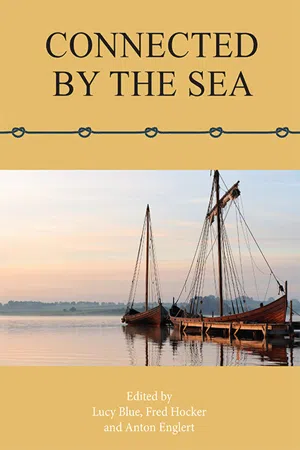
The 10th International Symposium on Boat and Ship Archaeology was held in Roskilde, Denmark in 2003. The theme of the meeting was "Connected by the Sea", and was designed to emphasize the role of the sea, seafaring and watercraft as bridges rather than barriers. Maritime archaeology tends to take place within national borders, with a national focus, yet the very premise of seafaring is the desire to travel beyond the horizon to establish contact with other places and cultures. The conference theme was chosen to encourage the maritime archaeological community to think in international terms.
- 337 pages
- English
- PDF
- Available on iOS & Android
eBook - PDF
Connected by the Sea
About this book
Trusted by 375,005 students
Access to over 1.5 million titles for a fair monthly price.
Study more efficiently using our study tools.
Information
Subtopic
ArchaeologyIndex
Social SciencesTable of contents
- List of Contributors
- Preface
- Keynote address: An international forum for nautical research 1976–2003
- Seán McGrail: Walking on water: Maritime archaeology by air, land and sea
- A. Experimental Archaeology
- Chapter 1: Experimental archaeology and ships – principles, problems and examples
- Chapter 2: Experimental boat archaeology: Has it a future?
- Chapter 3: Experimental archaeology at the Viking Ship Museum in Roskilde
- Chapter 4: History written in tool marks
- Chapter 5: Reconstruction of rope for the copy of Skuldelev 2: Rope in the Viking Period
- Chapter 6: Trial voyages as a method of experimental archaeology: The aspect of speed
- Chapter 7: An example of experimental archaeology and the construction of a full-scale research model of the Cavalière ship’s hull
- Chapter 8: Reconstruction of the large Borobudur outrigger sailing craft
- Chapter 9: The construction and trials of a half-scale model of the Early Bronze Age ship, Ferriby 1, to assess the capability of the full-size ship
- Chapter 10: The value of experimental archaeology for reconstructing ancient seafaring
- Chapter 11: The Pacific migrations by canoe-form craft
- B. Theoretical issues in the construction of ships
- Chapter 12: New light on the false clinkers in ancient Mediterranean shipbuilding
- Chapter 13: A preliminary report on the hull characteristics of the Gallo-Roman EP1-Taillebourg wreck (Charente-Maritime, France): archaeological evidence of regional practices of ancient flat-bottomed construction?
- Chapter 14: The Dor 2001/1 wreck, Dor/Tantura Lagoon, Israel: Preliminary Report
- Chapter 15: A hypothesis on the development of Mediterranean ship construction from Antiquity to the Late Midde Ages
- Chapter 16: Geometric rules in early medieval ships: Evidence from the Bozburun and Serçe Limani vessels
- Chapter 17: Oak growing, hull design and framing style. The Cavalaire-sur-Mer wreck, c. 1479
- Chapter 18: Ship design in Holland in the eighteenth century
- Chapter 19: Archaeobotanical characterisation of three ancient, sewn, Mediterranean shipwrecks
- Chapter 20: Coating, sheathing, caulking and luting in ancient shipbuilding
- C. Between land and sea
- Chapter 21: Roman techniques for the transport and conservation of fish: the case of the Fiumicino 5 wreck
- Chapter 22: Land and sea connections: the Kastro rock-cut site (Lemnos Island, Aegean Sea, Greece)
- Chapter 23: Local boat-building traditions in the Bristol region
- Chapter 24: The harbour of Haiðaby
- Chapter 25: Money, port and ships from a Schleswig point of view
- Chapter 26: Inland water transport in the Pre-Roman and Roman Iron Age in Northern Germany and its role in intra- and intercultural communication
- Chapter 27: Staraya Ladoga: a seaport in medieval Russia
- Chapter 28: The APES Archaeological Study: The North Carolina Sounds, an interface between land and sea
- D. Long distance seafaring and the connections between cultures
- Chapter 29: The ends of the earth: maritime technology transfer in remote maritime communities
- Chapter 30: The ships that connected people and the people that commuted by ships: The western Baltic case-study
- Chapter 31: Early cogs, Jutland boatbuilders, and the connection between East and West before AD 1250.
- Chapter 32: Couronian ship building, navigation and contacts with Scandinavia
- E. Historical, Iconographic and Ethnographic sources and approaches
- Chapter 33: From Carl Reinhold Berch to Nils Månsson Mandelgren: On the concept of maritime history, (Sw. sjöhistoria), and its meanings in Sweden since the latter 18th century
- Chapter 34: Ships and subsidies
- Chapter 35: Sea-lanes of communication: Language as a tool for nautical archaeology
- Chapter 36: Medieval shipping in the estuary of the Vistula River. Written sources in the interpretation of archaeological finds
- Chapter 37: Linking boats and rock carvings – Hjortspring and the North
- Chapter 38: Aeneas’ Sail: the iconography of seafaring in the central Mediterranean region during the Italian Final Bronze Age
- Chapter 39: Western European design boat building in Buton (Sulawesi, Indonesia): a “sequence of operations” approach (SOA)
- Chapter 40: Balagarhi Dingi: An anthropological approach to traditional technology
- F. News from the Baltic
- Chapter 41: The Roskilde ships
- Chapter 42: Two double-planked wrecks from Poland
- Chapter 43: Mynden. A small Danish frigate of the 18th century
- Chapter 44: The wreck of a 16th/17th-century sailing ship near the Hel Peninsula, Poland
- G. News from around the world
- Chapter 45: Sewn boat timbers from the medieval Islamic port of Quseir al-Qadim on the Red Sea coast of Egypt
- Chapter 46: A Roman river barge from Sisak (Siscia), Croatia
- Chapter 47: Contributions of maritime archaeology to the study of an Atlantic port: Bordeaux and its reused boat timbers
- Chapter 48: A Roman barge with an artefactual inventory from De Meern (the Netherlands)
- Chapter 49: The Arade 1 shipwreck. A small ship at the mouth of the Arade River, Portugal
- Chapter 50: A Black Sea merchantman
- Chapter 51: Medieval boats from the port of Olbia, Sardinia, Italy
Frequently asked questions
Yes, you can cancel anytime from the Subscription tab in your account settings on the Perlego website. Your subscription will stay active until the end of your current billing period. Learn how to cancel your subscription
No, books cannot be downloaded as external files, such as PDFs, for use outside of Perlego. However, you can download books within the Perlego app for offline reading on mobile or tablet. Learn how to download books offline
Perlego offers two plans: Essential and Complete
- Essential is ideal for learners and professionals who enjoy exploring a wide range of subjects. Access the Essential Library with 800,000+ trusted titles and best-sellers across business, personal growth, and the humanities. Includes unlimited reading time and Standard Read Aloud voice.
- Complete: Perfect for advanced learners and researchers needing full, unrestricted access. Unlock 1.5M+ books across hundreds of subjects, including academic and specialized titles. The Complete Plan also includes advanced features like Premium Read Aloud and Research Assistant.
We are an online textbook subscription service, where you can get access to an entire online library for less than the price of a single book per month. With over 1.5 million books across 990+ topics, we’ve got you covered! Learn about our mission
Look out for the read-aloud symbol on your next book to see if you can listen to it. The read-aloud tool reads text aloud for you, highlighting the text as it is being read. You can pause it, speed it up and slow it down. Learn more about Read Aloud
Yes! You can use the Perlego app on both iOS and Android devices to read anytime, anywhere — even offline. Perfect for commutes or when you’re on the go.
Please note we cannot support devices running on iOS 13 and Android 7 or earlier. Learn more about using the app
Please note we cannot support devices running on iOS 13 and Android 7 or earlier. Learn more about using the app
Yes, you can access Connected by the Sea by Lucy Blue, Frederick M. Hocker, Anton Englert in PDF and/or ePUB format, as well as other popular books in Social Sciences & Archaeology. We have over 1.5 million books available in our catalogue for you to explore.