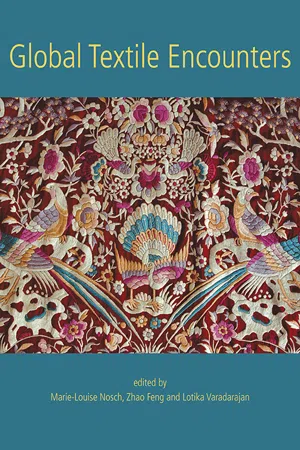
Global Textile Encounters is a fascinating journey into three significant textiles and clothing cultures: China, India and Europe. The common thread is how fashions and traditions have travelled through space and time. In this richly illustrated anthology, with its 242 images, written both by textile researchers and practitioners as well as scholars from other fields across the globe, we hear of various types of encounters that bring to life a world of interactions and consequences as colourful as the textiles themselves. Among the 33 contributions we learn of an historian of ancient Roman textiles who has an intellectual epiphany in the streets of modern Iran; of 17th-century European Jesuits spreading the Gospel in Asia who attire themselves in the clothing suitable to their host countries; a visiting Siamese delegation that unwittingly creates fashion in 18th-century France;; how Chinese textile technology changed as a result of encountering textile patterns along the silk road; how political messages are conveyed in the sari; how Maharajahs inspired global pop culture; and the value we ascribe to old clothing. Recurrent themes include how religious praxis is informed by textile encounters; how travelling textiles enable patterns and symbols to be copied onto stone and metals; and textile motifs that acquire other symbolic meanings in their travels and encounters with different societies.
This sensibly priced, highly readable paperback, edited by three eminent textile scholars from Europe, China and India, is aimed at the interested general public and students. A Chinese version will be published by Donghua University Press in China.
eBook - PDF
Global Textile Encounters
- 321 pages
- English
- PDF
- Available on iOS & Android
eBook - PDF
Global Textile Encounters
About this book
Information
Subtopic
Materials ScienceIndex
Social SciencesTable of contents
- Cover
- Title Page
- Copyright Page
- Contents
- Chapter 1: Textiles and Elite Tastes between the Mediterranean, Iran and Asia at the End of Antiquity Matthew P. Canepa
- Chapter 2: Palla, Pallu, Chador: Draped clothing in ancient and modern cultures Mary Harlow
- Chapter 3: From Draupadi to Dido: The duties of dress in paintings inspired by the Mahābhārata and the Aeneid Linda Matheson
- Chapter 4: The Kaftan: An unusual textile encounter in the Scandinavian Late Iron Age Ulla Mannering
- Chapter 5: Ancient Running Animals: Tablet-woven borders from China and Norway Lise Ræder Knudsen
- Chapter 6: The Development of Pattern Weaving Technology through Textile Exchange along the Silk Road Zhao Feng
- Chapter 7: The Earliest Cotton Ikat Textiles from Nahal ´Omer Israel 650–810 CE Orit Shamir and Alisa Baginski
- Chapter 8: Northerners: Global travellers in the Viking Age Eva Andersson Strand
- Chapter 9: Unravelling Textile Mysteries with DNA Analysis Luise Ørsted Brandt
- Chapter 10: The Traceable Origin of Textiles Karin Margarita Frei
- Chapter 11: The World of Textiles in Three Spheres: European woollens, Indian cottons and Chinese silks, 1300–1700 Giorgio Riello
- Chapter 12: Chinese Silks in Mamluk Egypt Helen Persson
- Chapter 13: Woven Mythology: The textile encounter of makara, senmurw and phoenix Mariachiara Gasparini
- Chapter 14: Textile in Art: The influence of textile patterns on ornaments in the architecture of medieval Zirikhgeran Zvezdana Dode
- Chapter 15: Coromandel Textiles: The changing face of consumer demand and weavers’ responses 16th to 18th century CE Vijaya Ramaswamy
- Chapter 16: The Jesuit Dilemma in Asia: Being a naked ascetic or a court literate? Selusi Ambrogio
- Chapter 17: The Colourful Qualities of Desire: Fashion, colours and industrial espionage Vibe Maria Martens
- Chapter 18: Fashion Encounters: The “Siamoise”, or the impact of the Great Embassy on textile design in Paris in 1687 Corinne Thépaut-Cabasset
- Chapter 19: The Chinoiserie of the 17th to 18th-century Soho Tapestry Makers Mette Bruun
- Chapter 20: Exoticism in Fashion: From British North America to the United States Madelyn Shaw
- Chapter 21: Textile Symbolism and Social Mobility during the Colonial Period in Sydney Cove Judith Cameron
- Chapter 22: The Impact of British Rule on the Dressing Sensibilities of Indian Aristocrats: A case study of the Maharaja of Baroda’s dress Toolika Gupta
- Chapter 23: Re-imagining the Dragon Robe: China chic in early twentieth-century European fashion Sarah Cheang
- Chapter 24: Sari and the Narrative of Nation in 20th-Century India Aarti Kawlra
- Chapter 25: From Cool to Un-cool to Re-cool: Nehru and Mao tunics in the sixties and post-sixties West Michael A. Langkjær
- Chapter 26: Too Old: Clothes and value in Norwegian and Indian wardrobes Ingun Grimstad Klepp, Lill Vramo and Kirsi Laitala
- Chapter 27: A ‘Stinging’ Textile: Cultivation of nettle fibre in Denmark and Asia Ellen Bangsbo
- Chapter 28: Fist-braided Slings from Peru and Tibet Lena Bjerregaard
- Chapter 29: Parsi Embroidery: An intercultural amalgam Shernaz Cama
- Chapter 30: The Navjote Ceremony and the Sudreh Kushti Lotika Varadarajan
- Chapter 31: Globalization, Identity and T-shirt Communication Karl-Heinz Pogner
- Chapter 32: India to Africa: Indian Madras and Kalabari creativity Joanne B. Eicher
- Chapter 33: Textile: The non-verbal language Jasleen Dhamija
- Dedication
- Acknowledgements
Trusted by 375,005 students
Access to over 1.5 million titles for a fair monthly price.
Study more efficiently using our study tools.
Frequently asked questions
Yes, you can cancel anytime from the Subscription tab in your account settings on the Perlego website. Your subscription will stay active until the end of your current billing period. Learn how to cancel your subscription
No, books cannot be downloaded as external files, such as PDFs, for use outside of Perlego. However, you can download books within the Perlego app for offline reading on mobile or tablet. Learn how to download books offline
Perlego offers two plans: Essential and Complete
- Essential is ideal for learners and professionals who enjoy exploring a wide range of subjects. Access the Essential Library with 800,000+ trusted titles and best-sellers across business, personal growth, and the humanities. Includes unlimited reading time and Standard Read Aloud voice.
- Complete: Perfect for advanced learners and researchers needing full, unrestricted access. Unlock 1.5M+ books across hundreds of subjects, including academic and specialized titles. The Complete Plan also includes advanced features like Premium Read Aloud and Research Assistant.
We are an online textbook subscription service, where you can get access to an entire online library for less than the price of a single book per month. With over 1.5 million books across 990+ topics, we’ve got you covered! Learn about our mission
Look out for the read-aloud symbol on your next book to see if you can listen to it. The read-aloud tool reads text aloud for you, highlighting the text as it is being read. You can pause it, speed it up and slow it down. Learn more about Read Aloud
Yes! You can use the Perlego app on both iOS and Android devices to read anytime, anywhere — even offline. Perfect for commutes or when you’re on the go.
Please note we cannot support devices running on iOS 13 and Android 7 or earlier. Learn more about using the app
Please note we cannot support devices running on iOS 13 and Android 7 or earlier. Learn more about using the app
Yes, you can access Global Textile Encounters by Marie-Louise Nosch, Zhao Feng, Lotika Varadarajan, Marie-Louise Nosch,Zhao Feng,Lotika Varadarajan in PDF and/or ePUB format, as well as other popular books in Social Sciences & Materials Science. We have over 1.5 million books available in our catalogue for you to explore.