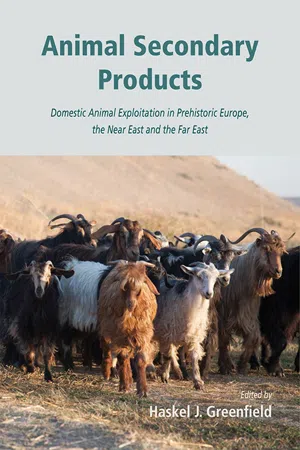
Animal Secondary Products investigates domestic animal exploitation and the animal economy from the Palaeolithic to the Bronze and Iron Ages across Eurasia (Europe, Near East, Siberia and China). Incorporating current zooarchaeological theory and cutting-edge methodological developments, it critically assesses Andrew Sherratt’s concept of a Secondary Products Revolution that proposed that a package of new subsistence practices and technologies swept across much of Eurasia at the end of the Neolithic, which triggered large-scale changes in economies and settlement across the landscape.
This model argues that these changes were associated with a genuine shift from an emphasis upon domestic animals for their primary (meat hide, bone) products to a more diversified exploitation pattern which included their secondary (milk, wool, traction) products. Sherratt’s model attempted to conceptualise the changes between the Neolithic and Bronze Age that dramatically transformed the nature of animal exploitation strategies, cultivation practices, land management strategies, nature of settlement, and political and economic organization in Europe and the Near East that set the stage for the evolution of historic land use and animal exploitation patterns. Though setting the parameters for debate within the discipline for over 30 years, science has moved on and many kinds of new data, methods and techniques have been proposed since then that allow greater insights into these issues.
In this volume, thirteen papers present a holistic discussion of Sherratt’s concept and investigate the theoretical development in our understanding of the origins of milking, wool production, transhumance, as well as examining the need for a contextualised zooarchaeological analysis and harvest profiles from various international sites in order to reconstruct the nature of Secondary Products exploitation. It also extends the secondary products concept across the Old World into Siberia and China and back in time to the Palaeolithic with the domestication of dogs. Through reviewing artefacts and textual evidence, the book bridges an important divide by cross-referencing statistical and scientific data with more traditional archaeological techniques and demonstrates the necessity of using many techniques to analyse data before interpreting patterns as exploitation practices. Offering fresh insight into the development of civilisation from the Neolithic and Bronze and Iron Ages in the Near East, Europe, and China, this book will be important for archaeozoologists and prehistorians.
eBook - PDF
Animal Secondary Products
Domestic Animal Exploitation in Prehistoric Europe, the Near East and the Far East
- 361 pages
- English
- PDF
- Available on iOS & Android
eBook - PDF
Animal Secondary Products
Domestic Animal Exploitation in Prehistoric Europe, the Near East and the Far East
About this book
Information
Subtopic
European HistoryIndex
Social SciencesTable of contents
- Cover
- Title Page
- Copyright Page
- Contents
- Contributors
- Preface
- 1: Introduction
- Part I: Other ways of thinking about secondary products
- Part II: Zooarchaeology, artefacts, and secondary products
- Part III: Methodological issues in the application of zooarchaeological harvest profiles and other methods to the study of secondary products
- Part IV: Other indicators of secondary products exploitation
- Part V: Zooarchaeological analysis of remains from Vinča-Belo Brdo
Trusted by 375,005 students
Access to over 1.5 million titles for a fair monthly price.
Study more efficiently using our study tools.
Frequently asked questions
Yes, you can cancel anytime from the Subscription tab in your account settings on the Perlego website. Your subscription will stay active until the end of your current billing period. Learn how to cancel your subscription
No, books cannot be downloaded as external files, such as PDFs, for use outside of Perlego. However, you can download books within the Perlego app for offline reading on mobile or tablet. Learn how to download books offline
We are an online textbook subscription service, where you can get access to an entire online library for less than the price of a single book per month. With over 1.5 million books across 990+ topics, we’ve got you covered! Learn about our mission
Look out for the read-aloud symbol on your next book to see if you can listen to it. The read-aloud tool reads text aloud for you, highlighting the text as it is being read. You can pause it, speed it up and slow it down. Learn more about Read Aloud
Yes! You can use the Perlego app on both iOS and Android devices to read anytime, anywhere — even offline. Perfect for commutes or when you’re on the go.
Please note we cannot support devices running on iOS 13 and Android 7 or earlier. Learn more about using the app
Please note we cannot support devices running on iOS 13 and Android 7 or earlier. Learn more about using the app
Yes, you can access Animal Secondary Products by Haskel J. Greenfield in PDF and/or ePUB format, as well as other popular books in Social Sciences & European History. We have over 1.5 million books available in our catalogue for you to explore.