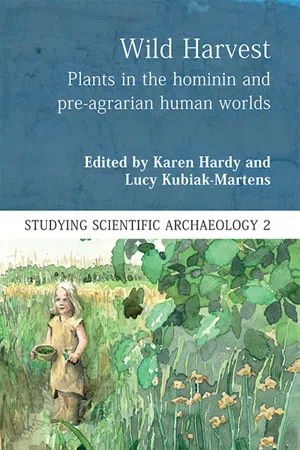
Plants are fundamental to life; they are used by all human groups and most animals. They provide raw materials, vitamins and essential nutrients and we could not survive without them. Yet access to plant use before the Neolithic can be challenging. In some places, plant remains rarely survive and reconstructing plant use in pre-agrarian contexts needs to be conducted using a range of different techniques. This lack of visible evidence has led to plants being undervalued, both in terms of their contribution to diet and as raw materials. This book outlines why the role of plants is required for a better understanding of hominin and pre-agrarian human life, and it offers a variety of ways in which this can be achieved.Wild Harvest is divided into three sections. In section 1 each chapter focuses on a specific feature of plant use by humans; this covers the role of carbohydrates, the need for and effects of processing methods, the role of plants in self-medication among apes, plants as raw materials, and the extent of evidence for plant use prior to the development of agriculture in the Near East. Section 2 comprises seven chapters which cover different methods available to obtain information on plants, and the third section has five chapters, each covering a topic related to ethnography, ethnohistory, or ethnoarchaeology, and how these can be used to improve our understanding of the role of plants in the pre-agrarian past.
- 368 pages
- English
- ePUB (mobile friendly)
- Available on iOS & Android
eBook - ePub
Wild Harvest
About this book
Trusted by 375,005 students
Access to over 1.5 million titles for a fair monthly price.
Study more efficiently using our study tools.
Information
Subtopic
EcologyIndex
Social SciencesPART 1
SETTING THE SCENE
In this volume, we start with two chapters which set out the nutritional context for why humans need plants. Plant foods provide carbohydrates, proteins, oils, minerals, vitamins, and dietary fibre. As highlighted in Chapters 1 and 2, all these plant nutrients are important components of the human diet. The need to balance consumption of meat with plants is emphasised. Carbohydrates, which are essential for human nutrition, may have been eaten raw, but in order to turn many starchy food items, such as roots and tubers and grains of wild grasses, into readily digestible forms, they need to be processed. This raises interesting questions in particular for how early hominins obtained their dietary energy from starch-rich plants, which is discussed in Chapter 2. In this respect, the concept of ‘timely dextrous unpacking’ which refers to the ways that food sources can be extracted from either soil or their protective plant coverings (for example shells) as well as the ecological knowledge to know when to collect specific items, have been outlined by Jones (2009: 173).
This is followed with a chapter on the extent of applied knowledge of medicinal plants by apes (Chapter 3). This offers a new contextual horizon for understanding the use of some plants by hominins and early human populations. There is an extensive overlap in the use of certain plants for medicinal purposes by some apes and some contemporary human populations. One of the most fascinating aspects of this chapter is the description of self-medication by chimpanzees and the potential implication of this in terms of plant-based self-medication by hominins and early human populations. Chapter 4 outlines some of the pre-agrarian evidence for plant raw materials in early prehistory, and places into context some of the plant-based technological achievements, many of which form the basis for the human world in its broadest sense. The developments of twisting fibre, the art of pitch and bitumen preparation, and the resulting development of composite technology should be considered as major human technological achievements. The final chapter in this part (Chapter 5) lays out the extent of wild plant use from the Epipaleolithic to the Early Neolithic in the Levant and suggests how the use of this broad range of plants eventually led to the development of agriculture here. Among others, two of the best known Epipaleolithic sites of Ohalo II and Abu Hureyra I are discussed. Both sites revealed exceptionally rich assemblages of small-grained grasses and wild cereals and other plant-foods, including possible staples. This chapter provides a contextual background to the early development of agriculture.
1. Food carbohydrates from plants
This chapter gives an overview of the significance and properties of dietary carbohydrates from plant sources. Carbohydrates are macro-constituents of many foods and essential in the human diet, providing a source of readily metabolisable energy, and dietary fibre and prebiotics necessary for gut microflora and gut health. Carbohydrates occur in diverse forms, which include monosaccharides (simple sugars), oligosaccharides (containing 2–10 monosaccharides), and polysaccharides (complex biopolymers that contain many monosaccharide units). Monosaccharides are chemically highly reactive molecules and hence have a low natural abundance in the free state. They occur mostly as the building blocks of oligo- and polysaccharides and other biological molecules. Sucrose is the most abundant disaccharide in plants, with trehalose, maltose, cellobiose and lactose also naturally occurring disaccharides. Fructo-oligosaccharides and related polymeric fructans, such as inulins and levans, are water-soluble carbohydrates that are abundant in some food plants, although their botanical distribution is limited. Starch is the main reserve polysaccharide in plants, which contributes 35–70% of the energy intake in the modern human diet, as well as being an important source of pre-formed glucose for brain, red blood cells, and reproductive tissues. Non-starch polysaccharides are a diverse group of carbohydrates that are abundant in many plant foods. They occur mostly in plant cell walls, where they have important structural functions. Non-starch polysaccharides, like fructo-oligosaccharides and fructans, are not digested in the upper gut and pass largely undigested into the large intestine as a component of dietary fibre and fermentable substrates for gut microbiota. The amounts and forms of starch and non-starch polysaccharides in modern food plants are likely to differ considerably from their respective ancestral forms.
Today, much of the human diet comes from plant foods in the form of seeds, tubers, roots, fruits, nuts, and leafy vegetation. Plant storage tissues, in particular, contain reserves of carbohydrates, proteins, lipids (oils), minerals and vitamins to support new growth at different stages of plant development, and hence are potentially a good source of nutrition for humans. Many plants also contain biologically active phytochemicals, some of which contribute aroma and taste, and others that are anti-nutritional or hazardous due to their toxicity. Survival skills of pre-agricultural humans would need to have been based on a good understanding of plants in their environment and an ability to select and adapt species for use as foods or medicines. Plant foods are the source of diverse types of carbohydrates, which are essential for human nutrition. Carbohydrates provide the majority of the energy in the human diet and are the main fermentable substrates that nourish the gut microflora.
The aim of this chapter is to provide a concise overview of the significance and properties of dietary carbohydrates from plant sources. The material is presented in the style of an introductory chapter rather than as a fully referenced review article. Suggestions for further reading are included at the end of the chapter.
What are carbohydrates?
Carbohydrates make up about 90% of the dry matter of plants and are the most abundant carbon compounds in Nature. They serve as stores of energy and in structural roles, forming the framework of plant cell walls and external structures. Carbohydrates are macro-constituents of many foods and essential in the human diet, providing a source of readily metabolisable energy, pre-formed glucose for brain, red blood cells, and reproductive tissues, and dietary fibre and prebiotics necessary for gut microflora and gut health.
Carbohydrates are polyhydroxy aldehydes or ketones that have the general formula C(H2O)n, as the name hydrates of carbon implies. Most carbohydrates are made up of only carbon, hydrogen and oxygen, although some may also contain nitrogen, phosphorus and sulphur atoms. They occur in diverse forms, which include monosaccharides (simple sugars), oligosaccharides (oligomers containing 2–10 monosaccharides), and polysaccharides (complex biopolymers that contain many monosaccharide units).
Sources of dietary carbohydrates
Most plant cells contain small amounts of carbohydrate energy reserves, but some tissues, notably underground storage organs (USOs) and seeds, accumulate large amounts of carbohydrates to support growth and development at certain stages during the life cycle of the plant.
Underground storage organs
USOs may be derived from tap-root tissue (e.g., carrot, turnip), tuberous roots (e.g., potato, cassava), stem tissue (e.g., sweet potato, yams), corms (e.g., taro), or rhizomes (e.g., ginger). The dry matter (DM) content of USOs is usually 15–35% of their mass, of which carbohydrate (mostly as starch) is the major constituent (70–85% of DM). Their bulk and relatively high moisture content mean that USOs have limited portability and storability and are susceptible to spoilage once harvested. However, if left undisturbed in the ground they remain stable until seasonal changes induce mobilisation of stored reserves for new plant growth. As a food source, USOs can be harvested as needed over a period of months, or they can also be dried to increase durability and portability.
Grains and seeds
Grains (seeds) are the foundation of the modern human diet. Statistical data published by bodies such as the Food and Agriculture Organisation (FAO) indicate that total global grain production is about 2.5 billion tonnes/year, of which 40% is used for livestock feeding. The low moisture content of grains and their hard seed coat, which may contain toxic or anti-nutritional constituents, provide protection against the environment and against microbial and insect attack and herbivory. The ability to harvest seeds from plants with a non-shattering rachis, and the storability and transportability of grains, are considered to have been important in the transformation of humans from hunter-gatherers to agriculturalists. The largest source of food grains is cereals (wheat, rice, corn, barley, oats, millets), with the average annual human consumption of cereal grains being about 150 kg per capita (www.fao.org). In addition to cereals, other important modern food grains are pulses (peas, beans, chickpeas, lentils), oilseeds (canola, sunflower, soybean, peanut) and niche grains such as quinoa, buckwheat, and amaranth (sometimes referred to as pseudo cereals). Raw grains are unpalatable and indigestible and need to be processed to increase the bioavailability of nutrients for foods and feed. Grains are also an important source of raw materials for industry. The relative amounts of carbohydrate, protein and lipid in grains differ between and within plant species (Table 1.1), and are influenced by the plant genotype and environmental influences during plant growth and post-harvest processing.
Table 1.1. Approximate carbohydrate, protein and oil composition of food grains (as % of dry matter)

Other sources of carbohydrates
Depending on climate and season, some fruits and nuts may provide a good source of dietary carbohydrates (Tiwari et al. 2013). For example, chestnuts and acorns contain over 60% of their DM as carbohydrates (mostly as starch), and cashew nuts may contain 25% of DM as starch. Many other nut species used as foods (e.g., almonds, hazelnuts, pine nuts, pistachios) contain large amounts of lipids (45–50% DM), 15–20% protein and 25–30% carbohydrate, of which only a small amount is starch (USDA National Nutrient Database for Standard Reference 2014). Starch is also stored in significant amounts in the bark and xylem tissues of stems and branches of many tree species, although this varies seasonally and with the age of the tree (Pallardy 2008). The pith of some palms (for example, the sago palm) is a rich source of starch, which is extracted commercially.
Monosaccharides
Monosaccharides with 3, 4, 5, 6, or 7 carbons occur naturally and are referred to as trioses, tetraoses, pentoses, hexoses, and heptaoses, respectively. Monosaccharides are chemically highly reactive molecules and hence have a low natural abundance in the free state. They occur mostly as the building blocks of oligo- and polysaccharides and other biological molecules. One of the carbons in the monosaccharide molecule (referred to as the anomeric carbon) can act as a reducing agent in chemical reactions and hence these compounds are referred to as reducing sugars. The anomeric carbon can also form links to other reactive chemical groups. Glucose (commonly abbreviated as Glc), fructose (Fru), galactose (Gal), and mannose (Man) are examples of hexoses that are commonly combined into more complex molecules, whereas the pentoses deoxyribose and ribose are part of the structural backbone of the nucleic acids DNA and RNA, respectively.
An exception to the low natural abundance of free monoscacharides is glucose, which occurs in appreciable amounts in the free form in animals. Humans need to maintain a steady level of glucose in the blood stream as the essential source of biochemical energy to support the normal functioning of a large brain, which alone accounts for 20–25% of basal expenditure of metabolic energy (Fonseca-Azevedo and Herculano-Houzel 2012). Red blood cells have a requirement for glucose, which is also essential for reproductive fitness during pregnancy and lactation. This requirement for glucose is met from a combination of dietary carbohydrate, mobilisation of transient stores of glycogen in the liver, and glucose synthesis in vivo from non-carbohydrates in a biochemical process known as gluconeogenesis. At least some of the glucose must be obtained from the diet, as under normal physiological conditions liver glycogen reserves and gluconeogenesis can meet only part of the daily requirement. Dietary glucose is obtained from the digestion of glycemic carbohydrates (also referred to as available carbohydrates) and subsequent absorption from the small intestine into the bloodstream. Because of its chemical reactivity, the concentration of glucose in the bloodstream in healthy individuals is normally maintained within narrow limits by complex physiological mechanisms that balance the need for continual availability of this essential metabolic substrate, with ensuring that its concentration does not exceed a level that can cause harmful effects due its chemical reactivity. Chronic over-loading of glucose into the bloodstream tri...
Table of contents
- Cover
- Title Page
- Copyright
- Contents
- List of contributors
- Dedication
- Introduction
- Part 1: Setting the scene
- Part 2: Plant foods, tools and people
- Part 3: Providing a context: ethnography, ethnobotany, ethnohistory, ethnoarchaeology
Frequently asked questions
Yes, you can cancel anytime from the Subscription tab in your account settings on the Perlego website. Your subscription will stay active until the end of your current billing period. Learn how to cancel your subscription
No, books cannot be downloaded as external files, such as PDFs, for use outside of Perlego. However, you can download books within the Perlego app for offline reading on mobile or tablet. Learn how to download books offline
We are an online textbook subscription service, where you can get access to an entire online library for less than the price of a single book per month. With over 1.5 million books across 990+ topics, we’ve got you covered! Learn about our mission
Look out for the read-aloud symbol on your next book to see if you can listen to it. The read-aloud tool reads text aloud for you, highlighting the text as it is being read. You can pause it, speed it up and slow it down. Learn more about Read Aloud
Yes! You can use the Perlego app on both iOS and Android devices to read anytime, anywhere — even offline. Perfect for commutes or when you’re on the go.
Please note we cannot support devices running on iOS 13 and Android 7 or earlier. Learn more about using the app
Please note we cannot support devices running on iOS 13 and Android 7 or earlier. Learn more about using the app
Yes, you can access Wild Harvest by Karen Hardy, Lucy Kubiak Martens in PDF and/or ePUB format, as well as other popular books in Social Sciences & Ecology. We have over 1.5 million books available in our catalogue for you to explore.