Filling an important gap in design history, Another Modernism examines how domestic space was conceived by the US home economics movement in the first half of the 20th century.
In doing so, it tells the story of how home economists-mainly women-developed design that challenged the traditional architecture of American farm communities and countered the approach of modernist architects. Uncovering unacknowledged contributions of women to domestic architecture and design history, it reveals early instances of participation, sustainability, and accommodating the disabled body in domestic design.
In contrast to the canonical modernist model of space, which is primarily visual, home economists centered on a user who interacts with the interior in a tactile, bodily way. Although both strove for efficiency, they understood it differently: whereas for many of the mainstream modernists the term 'efficiency' meant functionalist aesthetics, for home economists it signified design solutions intended to ease the labor of an average American homemaker. The book argues that the home economists' focus on tactility, the user's corporeality, movement, access, preferences, and her engagement in the design process, constituted an alternative model of modern architecture – a popular and largely rural modernism centered on the specificity of the female user and her personal experience of the domestic interior.
Based on little-known archival material, and with an emphasis on mostly female researchers, designers, and users/occupants, Another Modernism will appeal to architects, design historians, and anyone interested in gender, women's and disability studies, as well as non-visual approaches to design.
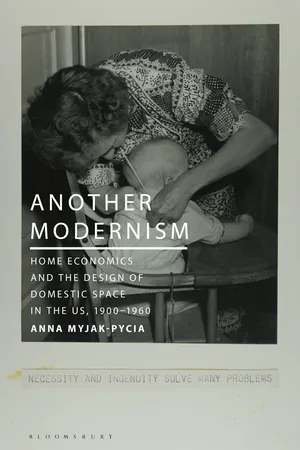
eBook - ePub
Another Modernism
Home Economics and the Design of Domestic Space in the US, 1900-1960
- English
- ePUB (mobile friendly)
- Available on iOS & Android
eBook - ePub
Another Modernism
Home Economics and the Design of Domestic Space in the US, 1900-1960
About this book
Information
Topic
ArchitectureSubtopic
History of ArchitectureTable of contents
- Cover
- Half-Title Page
- Dedication
- Title Page
- Contents
- List of Illustrations
- Acknowledgments
- Introduction
- 1 Institutions
- 2 Theory of Domestic Space
- 3 Design Practice
- 4 Disabled Homemaker
- 5 Visual Idiom
- Conclusion
- Notes
- Index
- Copyright
Trusted by 375,005 students
Access to over 1.5 million titles for a fair monthly price.
Study more efficiently using our study tools.
Frequently asked questions
Yes, you can cancel anytime from the Subscription tab in your account settings on the Perlego website. Your subscription will stay active until the end of your current billing period. Learn how to cancel your subscription
No, books cannot be downloaded as external files, such as PDFs, for use outside of Perlego. However, you can download books within the Perlego app for offline reading on mobile or tablet. Learn how to download books offline
Perlego offers two plans: Essential and Complete
- Essential is ideal for learners and professionals who enjoy exploring a wide range of subjects. Access the Essential Library with 800,000+ trusted titles and best-sellers across business, personal growth, and the humanities. Includes unlimited reading time and Standard Read Aloud voice.
- Complete: Perfect for advanced learners and researchers needing full, unrestricted access. Unlock 1.5M+ books across hundreds of subjects, including academic and specialized titles. The Complete Plan also includes advanced features like Premium Read Aloud and Research Assistant.
We are an online textbook subscription service, where you can get access to an entire online library for less than the price of a single book per month. With over 1.5 million books across 990+ topics, we’ve got you covered! Learn about our mission
Look out for the read-aloud symbol on your next book to see if you can listen to it. The read-aloud tool reads text aloud for you, highlighting the text as it is being read. You can pause it, speed it up and slow it down. Learn more about Read Aloud
Yes! You can use the Perlego app on both iOS and Android devices to read anytime, anywhere — even offline. Perfect for commutes or when you’re on the go.
Please note we cannot support devices running on iOS 13 and Android 7 or earlier. Learn more about using the app
Please note we cannot support devices running on iOS 13 and Android 7 or earlier. Learn more about using the app
Yes, you can access Another Modernism by Anna Myjak-Pycia in PDF and/or ePUB format, as well as other popular books in Architecture & History of Architecture. We have over 1.5 million books available in our catalogue for you to explore.