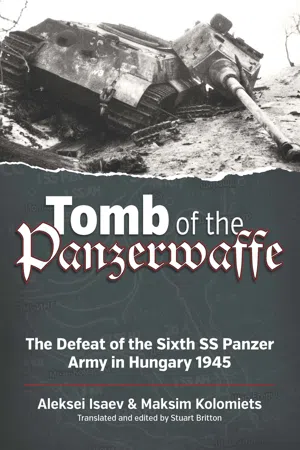
In March 1945 the German Wehrmacht undertook its final attempt to change the course of the war by launching a counteroffensive in the area of Lake Balaton, Hungary. Here, the best panzer forces of the Third Reich and the elite of the Panzerwaffe were assembled - the panzer divisions SS Leibstandarte Adolf Hitler, Das Reich, Totenkopf, Wiking and others, staffed by ardent believers in Nazism and armed with the most up-to-date combat equipment, including up to 900 tanks and self-propelled guns. At the time, this was considered a secondary axis for the Red Army, and thus the troops of the 3rd Ukrainian Front had to stop the German counteroffensive with their own forces and could not count upon reinforcements from the Stavka Reserve, which were needed for the decisive storming of Berlin. Relying upon their combat skill and rich combat experience, the Soviet troops carried out this task with honor, stopping the tidal wave of German armor and inflicting a decisive defeat and enormous, irreplaceable losses upon the enemy. The defeat of the Sixth SS Panzer Army became a genuine catastrophe for Germany, and Balaton became the tomb of the Panzerwaffe. In this book, penned by two leading Russian military historians, this major defeat suffered by the Wehrmacht has been described and analyzed for the first time using data from both Soviet and German archives. It focuses not only on Operation Spring Awakening, but also describes the preceding Konrad offensives conducted by the Germans in the effort to come to the aid of the encircled and desperate German and fascist Hungarian defenders of Budapest. This edition is lavishly illustrated with over a hundred rare photographs of destroyed or disabled German armor taken shortly after the battle by a Soviet inspection team, besides other photographs and specially commissioned color maps.
- 200 pages
- English
- ePUB (mobile friendly)
- Available on iOS & Android
eBook - ePub
Tomb of the Panzerwaffe
About this book
Information
Subtopic
Military & Maritime HistoryIndex
HistoryPart I
Gille and Balck Hurry to the Relief of the Budapest Garrison
1
Introduction
“Whoever has visited Lake Balaton will never forget it even once. Like an enormous pallet, it has been splashed with all the colors of the rainbow. The blue mirror of the water strikingly reflects the emerald green of the banks and the ornate buildings beneath orange tile roofs. It is no coincidence that songs are sung and legends written about Balaton.”1
With this poetic introduction, one of the combat veterans of the fighting in Hungary begins his tale. Soviet soldiers and officers fought in Hungary at a time most unsuitable for admiring the local scenery: January – March 1945. However, they were looking at the Hungarian landscape with different eyes, the eyes of conquerors. They were slogging through mud on the outskirts of the capitals of hostile countries, and the end of the war was now close. Thus the vineyards and forests covered with dirty gray snow and the buildings with their empty window frames appeared completely differently to the fighters of the Red Army than they would have to a side observer. However, one could not say that the quiet landscape back then was safe even behind the front lines. The situation in Hungary was rather hostile, and flowers weren’t being tossed onto the passing vehicles of the Red Army’s advancing armor columns. Hungary was an ally of Nazi Germany. When the fortunes of war turned against the Red Army for a spell, the Hungarians who had been sourly smiling at the Soviet soldiers and officers just the day before were now firing at them from the attics of the “buildings beneath orange tile roofs.”
On the whole, the fighting at Lake Balaton is not a “forgotten battle”. The last major offensive of the German Army in the Second World War was a widely known event. Even people who were only quite superficially interested in military history knew of the existence of Lake Balaton and the Hungarian town with the elaborate name of Székesfehérvár.
To a certain extent, Hungary’s notable role in the events of the final months of the war was the result of a combination of circumstances. At a time when a calm before the storm was prevailing in the autumn of 1944 on other battlefronts stretching from the Baltic to Silesia, the Soviet offensives that had been launched on the southern flank of the Soviet-German front back in the summer were still in motion. By the end of 1944, the Soviet 2nd and 3rd Ukrainian Fronts had entered the territory of Hungary, reached the approaches to Budapest from the east, and had also forced a crossing of the Danube River to the south of the capital. The next phase of the Soviet offensive out of the bridgehead on the western bank of the Danube resulted in a breakthrough of the so-called Margarethe Line and to the encirclement of Budapest together with its German and Hungarian garrison.
Hitler’s impulsive decision to launch a relief attack followed on 24 December 1944, a day before the ring closed around Budapest. It is impossible to say that this was a simple whim. From a political point of view, Hungary remained the final ally of the Third Reich in its agonies. From an economic standpoint, almost the final sources of oil that remained under Germany’s control were in Hungary. The country also lay on the path to Austria, where significant productive capacities of the German military industry were concentrated. From the military point of view, the loss of such an important defensive line as the Danube River, as well as the threat of losing the communications hub of Budapest, meant a loss of resilience on the southern wing of the Eastern Front. It would be possible to hold Budapest only for a very limited amount of time via the Germans’ typical scenario of supplying the fortress by air. After this, the road hub would pass to the complete control of the Soviet forces. Given that the fronts in Poland, East Prussia and Kurland (Courland) were relatively quiet, Hitler’s temptation to throw reserves into the fighting in Hungary and to reverse the events at Budapest in Germany’s favor was at least explicable.
Several days later, the wheels of the German war machine began to turn, and tens of thousands of German troops were put into motion. The German armies standing on the Vistula River received a terrible blow from their own high command – the IV SS Panzer Corps was withdrawn from their ranks and sent to Hungary. In December 1944, it had been positioned north of Warsaw, ready to repel the next attempt by the Red Army to storm the Polish capital.
The reputation of the commander of the IV SS Panzer Corps, Obergruppenführer and General of SS Troops Herbert Gille, was far from an insignificant factor in the Führer’s choice. It was he who had broken through to the German units encircled in the Korsun-Shevchenkovsky pocket and had held open the escape route for them. At the time, he had been commanding the 5th SS Panzer Division Wiking. Just the radio message alone that Gille was coming to their relief raised the morale of the German units encircled in Budapest, and gave them hope of rescue.
Naturally, certain objective factors also played a role in Hitler’s decision. The divisions of Gille’s panzer corps had much more personnel than the divisions of General Walther Nehring’s XXIV Panzer Corps. The SS Wiking Panzer Division had two extra battalions – I Battalion of both the Norge and Danmark Panzer Grenadier Regiments, which had been destroyed in the Baltics. These two battalions had been reconstituted, but it was thought to be senseless to return them to isolated Kurland. Thus they were attached to the SS 5th Panzer Division Wiking’s roster, and continued to fight as part of it until May 1945.
If there was also the factor of the Führer’s great trust in Himmler’s organization, it didn’t outweigh arguments of reason. The German 96th and 711th Infantry Divisions were also sent to the Budapest axis to reinforce the infantry component of Gille’s IV SS Panzer Corps.
Back in August 1944, the arrival of the two SS panzer divisions in Poland had sealed the fate of the Warsaw Uprising and had stopped the seemingly irresistible Soviet advance toward the Polish capital. In the event of the start of a new Soviet offensive near Warsaw, the IV SS Panzer Corps doubtlessly would have had a real influence on the course of events. However, this powerful and dangerous panzer formation was sent to Hungary literally just two weeks before the launching of the Soviet Vistula-Oder operation. This decision to a great degree determined Germany’s strategy in the 1945 campaign. In February 1945, almost half of the German panzer divisions on the Eastern Front were operating in Hungary.
However, unlike the many other German relief attempts, the intention of which had been to evacuate the encircled groupings, IV SS Panzer Corps was to fight its way into Budapest in order to strengthen the defense of the Hungarian capital and to re-establish the front along the Margarethe Line. In a word, Gille’s IV SS Panzer Corps was supposed to restore the situation to the point where it had existed prior to the launching of the Soviet offensive, which had led to Budapest’s encirclement. Having accomplished this, the SS divisions might return again to Poland.
After the Führer had earmarked the use of the IV SS Panzer Corps for use at Budapest, it was necessary to select the axis of the attack. An attack out of the area of Székesfehérvár, bypassing Lake Velence from the south (the so-called Operation Paula) promised success in view of the terrain, which was suitable for panzer operations. However, in this case, an additional 900 cubic meters of fuel would be required, as well as five additional days to assemble the forces. The second option was an offensive across the shortest distance to Budapest, practically parallel to the course of the Danube north of Lake Velence. This option received the code name “Konrad”. Its main shortcoming was the need to attack across hilly, wooded terrain, but its main advantage was the element of surprise. Each day and hour of delay was working to the benefit of the Soviet troops, who were busily strengthening the defenses of the outer ring of Budapest’s encirclement. The more quickly the attack was launched, the greater the prospects for crushing a still not fully prepared defense. Guderian himself was an advocate of Operation Paula, but his protégé General Walther Wenck and the command of Army Group South supported Operation Konrad.
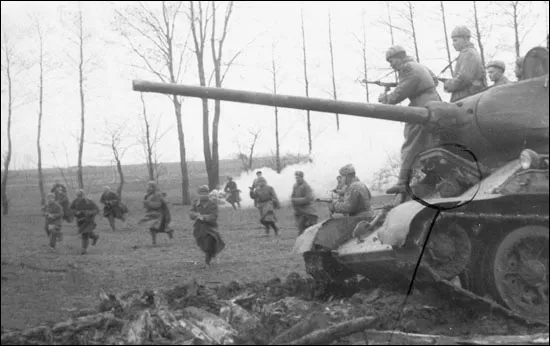
A Soviet T-34/85 tank with tank riders aboard it, preparing for an attack. Hungary, end of 1944.
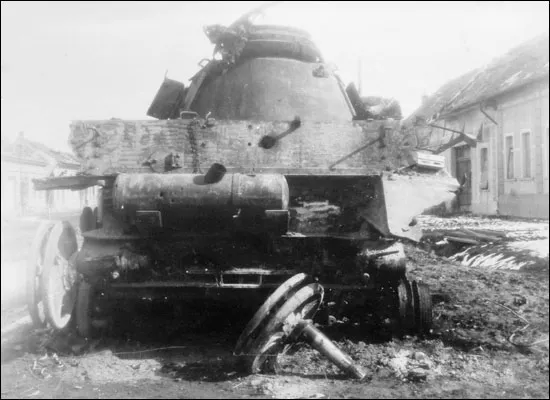
A Pz.Kpfw.IV tank knocked out by a shell hit in the rear of the hull. (TsAMO)
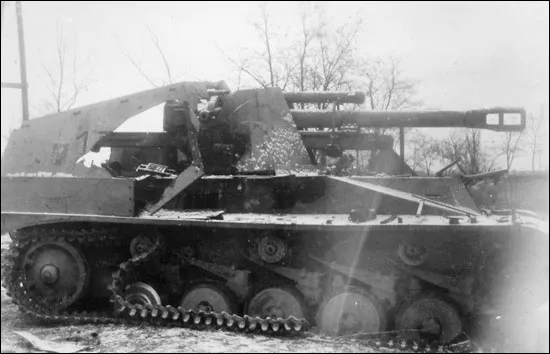
A destroyed Wespe self-propelled artillery vehicle. The fractures in the sides of the armored fighting compartment were most likely caused by penetrations from large-caliber artillery shells.
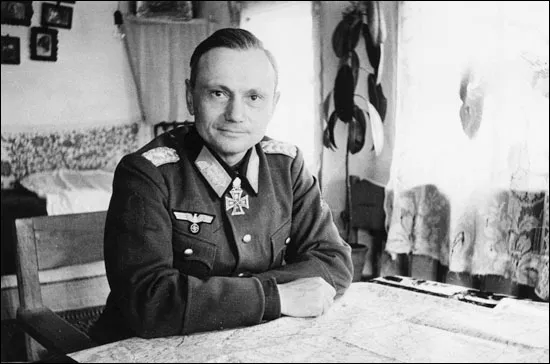
Commander of Armeegruppe Balck, General der Panzertruppen Hermann Balck. (Bundesarchiv, Bild 101I-732-0118-03, photo: Bauer)
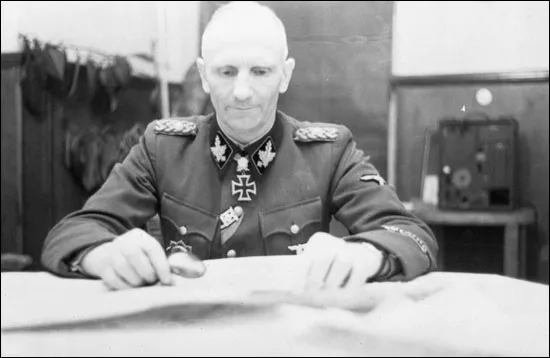
Obergruppenführer und General der Waffen-SS Herbert Gille, commander of IV SS Panzer Corps. (Bundesarchiv, Bild 101I-090-3916-14, photo: Etzhold)
In the end, the German High Command opted for Konrad. The then chief of staff of the IV SS Panzer Corps Obersturmbannführer Schönfelder later talked about this choice:
1. Time played a major role;
2. The strength of the defending troops in Budapest was almost exhausted and unable to resist;
3. The shortest distance to the operation’s objective was the determining factor.
The season of the year and the terrain made the attack of panzers more difficult, but this was accepted as part of the bargain.1
Gille, his headquarters and his men were effectively temporary guests in Hungary. They wanted to finish the job quickly and return to Warsaw.
The operation’s top leaders were new in their posts, as well as in the given theater of combat operations. This includes Gille, who had just arrived from Poland – he was going to have to go into battle straight from the trains. However, the situation was only a little better with those above him in rank and post. Only General of Infantry Otto Wöhler, the commander of Army Group Center, was to some extent familiar with the theater of combat operations – he had previously commanded the Eighth Army in Hungary. However, he was new to his role as commander of an army group. At the onset of the operation to break the Soviet ring around Budapest, he had been in his new post for just eight days. General of Panzer Forces Balck was commanding forces in Hungary for the first time, and only recently had accepted command of the Sixth Army. He was one of the most decorated and well-known German panzer commanders of the Second World War. By January 1945, he held the Knight’s Cross with Swords, Oak Leaves and Diamonds, whereas his superior Wöhler had only the Knight’s Cross with Oak Leaves. But if for Gille the assignment to break through to Budapest was a nod to his past services, for Balck the new assignment was a reduction in post. Prior to this he had been commanding Army Group “G” in the West. The bestowing of the designation “army group” to the Sixth Army only somewhat offset the bitter pill of removal from command of an army group for Balck. Having served the greater part of the war in the East, Balck’s career in the West simply never took off. He himself later characterized his relationship with the Commander in Chief in the West von Rundstedt as “strained”. The return to the Eastern Front was a chance for Balck to restore his reputation as a military commander.
The terrain would play a major role in subsequent events. Both Operation Konrad in January and the Operation Frühlingserwachen [Spring Awakening] in March were conducted by the Germans in one and the same area. Therefore it makes sense to stop and dwell in more detail in the description of the upcoming area of combat operations. By its topography, the area can be precisely divided into two portions, a northern and a southern.
The northern portion of the area from the line Csákvár – Mór to the banks of the Danube River east of Komárno is covered by the forested Vérteshegység Mountains, or more simply, the Vértes Hills. These hills, part of the Transdanubian Mountains, stretch along a slanting axis from south to north. Their rounded peaks rise approximately 300 meters above the surrounding terrain, reaching an elevation of 630 meters above sea level. The slopes of these hills are cut by deep and narrow ravines, which are overgrown with trees. There are very few roads or even passages through the hills here. The movement of all types of troops was possible only along a single railroad, two paved roads and one dirt road. In those places where the roads cut through the ridges and rocks, defiles ranging from 10 to 40 meters in width are created. There are no pedestrian or vehicular bypasses around these terrain bottlenecks.
There are relatively few populated points in the Vértes Hills; in the majority they are located in the foothills and valleys. They are primarily mining settlements found in areas where there are bauxite deposits. Numerous paths lead from the villages into the hills, which typically come to an abrupt halt at cliffs and ravines. These footpaths are accessible only for the movement of infantry.
West of the Vértes Hills in the expanse stretching from Komárno to the Kisbér – Környe railroad lies rolling, open terrain with elevations of 100 to 230 meters. This area has a well-developed network of paved and dirt roads, the majority of which come together in the area of Tata, thereby making that town a major road hub. After the ring closed around Budapest, the Red Army fought to gain access to this area.
North of the Vértes Hills, the Danube River follows a west to east course, before turning to the south and proceeding to Budapest. The right bank of this river in this sector rises well above the left bank, which permits a view of the lower terrain out to 10-12 kilometers. A highway and railroad main line run along a narrow corridor of level ground that is 1.5 to 2 kilometers wide and parallels the right bank of the Danube between Komárno and Budapest. It was only in this corridor that all types of troops could operate.
To the east, closer to Budapest, the hills gradually diminish and descend into a rolling plain with an altitude of 190 to 300 meters above sea level. The road network in this area is betterdeveloped than in the hills. Most ...
Table of contents
- Cover
- Title
- Copyright
- Contents
- List of photographs
- List of maps
- List of tables
- Part I Gille and Balck Hurry to the Relief of the Budapest Garrison
- Part II The Final German Offensive of the Second World War
- Notes
- Literature and sources
Trusted by 375,005 students
Access to over 1.5 million titles for a fair monthly price.
Study more efficiently using our study tools.
Frequently asked questions
Yes, you can cancel anytime from the Subscription tab in your account settings on the Perlego website. Your subscription will stay active until the end of your current billing period. Learn how to cancel your subscription
No, books cannot be downloaded as external files, such as PDFs, for use outside of Perlego. However, you can download books within the Perlego app for offline reading on mobile or tablet. Learn how to download books offline
Perlego offers two plans: Essential and Complete
- Essential is ideal for learners and professionals who enjoy exploring a wide range of subjects. Access the Essential Library with 800,000+ trusted titles and best-sellers across business, personal growth, and the humanities. Includes unlimited reading time and Standard Read Aloud voice.
- Complete: Perfect for advanced learners and researchers needing full, unrestricted access. Unlock 1.5M+ books across hundreds of subjects, including academic and specialized titles. The Complete Plan also includes advanced features like Premium Read Aloud and Research Assistant.
We are an online textbook subscription service, where you can get access to an entire online library for less than the price of a single book per month. With over 1.5 million books across 990+ topics, we’ve got you covered! Learn about our mission
Look out for the read-aloud symbol on your next book to see if you can listen to it. The read-aloud tool reads text aloud for you, highlighting the text as it is being read. You can pause it, speed it up and slow it down. Learn more about Read Aloud
Yes! You can use the Perlego app on both iOS and Android devices to read anytime, anywhere — even offline. Perfect for commutes or when you’re on the go.
Please note we cannot support devices running on iOS 13 and Android 7 or earlier. Learn more about using the app
Please note we cannot support devices running on iOS 13 and Android 7 or earlier. Learn more about using the app
Yes, you can access Tomb of the Panzerwaffe by Aleksei Isaev, Maksim Kolomiets, Stuart Britton in PDF and/or ePUB format, as well as other popular books in History & Military & Maritime History. We have over 1.5 million books available in our catalogue for you to explore.