Violent incidents are more than four times as likely to occur in healthcare settings than in other professional workplaces, taking a toll on healthcare workers and spurring providers and policymakers to solve the increasing impact of violence. The most beneficial method of preventing healthcare violence is de-escalation—using therapeutic communication and interventions to defuse emotional tension. In De-Escalating Violence in Healthcare, author S. E. McKnight provides tools and techniques to help nurses and other healthcare professionals manage aggressive behavior and foster a safer workplace. Readers will learn to: • Understand the variables, risk factors, and triggers of aggression and violence • Assess mental health status and practice conflict resolution and crisis intervention • Identify and manage difficult behavioral issues associated with schizophrenia, dementia, bipolar disorder, anxiety, and other conditions • Foster a caring and healing environment to reduce violence • Build a healthcare violence prevention program
eBook - PDF
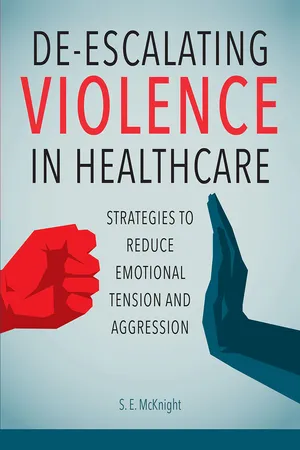
De-Escalating Violence in Healthcare
Strategies to Reduce Emotional Tension and Aggression
- 297 pages
- English
- PDF
- Available on iOS & Android
eBook - PDF
De-Escalating Violence in Healthcare
Strategies to Reduce Emotional Tension and Aggression
About this book
Information
Table of contents
- Cover
- Title Page
- Copyright Page
- Dedication
- Acknowledgments
- About the Author
- Table of Contents
- Introduction
- Chapter 1: De-escalation for Holistic Wellness
- Chapter 2: Variables and Risk Factors for Aggression
- Chapter 3: Assessing an Escalating Situation for Early Intervention
- Chapter 4: De-escalation Techniques
- Chapter 5: Therapeutic Communication for De-escalation
- Chapter 6: Stress-Management Techniques
- Chapter 7: Conflict Resolution
- Chapter 8: Crisis Intervention
- Chapter 9: Managing Mental Health Emergencies
- Chapter 10: Performing a Mental Status Assessment
- Chapter 11: De-escalation of Patients With Mental Disorders
- Chapter 12: De-escalation of Patients Exhibiting Non-suicidal Self-injury (NSSI) Behavior
- Chapter 13: De-escalation of Patients With Dementia
- Chapter 14: De-escalation of Patients With Delirium
- Chapter 15: De-escalation of "Difficult" Patients
- Chapter 16: De-escalation of Angry Patients
- Chapter 17: Staying Safe During De-escalation
- Chapter 18: After the Incident
- Chapter 19: Creating a Calming, Caring, and Healing Healthcare Environment
- Chapter 20: Developing a Healthcare Violence-Prevention Plan
- Index
Trusted by 375,005 students
Access to over 1.5 million titles for a fair monthly price.
Study more efficiently using our study tools.
Frequently asked questions
Yes, you can cancel anytime from the Subscription tab in your account settings on the Perlego website. Your subscription will stay active until the end of your current billing period. Learn how to cancel your subscription
No, books cannot be downloaded as external files, such as PDFs, for use outside of Perlego. However, you can download books within the Perlego app for offline reading on mobile or tablet. Learn how to download books offline
We are an online textbook subscription service, where you can get access to an entire online library for less than the price of a single book per month. With over 1.5 million books across 990+ topics, we’ve got you covered! Learn about our mission
Look out for the read-aloud symbol on your next book to see if you can listen to it. The read-aloud tool reads text aloud for you, highlighting the text as it is being read. You can pause it, speed it up and slow it down. Learn more about Read Aloud
Yes! You can use the Perlego app on both iOS and Android devices to read anytime, anywhere — even offline. Perfect for commutes or when you’re on the go.
Please note we cannot support devices running on iOS 13 and Android 7 or earlier. Learn more about using the app
Please note we cannot support devices running on iOS 13 and Android 7 or earlier. Learn more about using the app
Yes, you can access De-Escalating Violence in Healthcare by S. E. McKnight in PDF and/or ePUB format, as well as other popular books in Medicine & Nursing. We have over 1.5 million books available in our catalogue for you to explore.