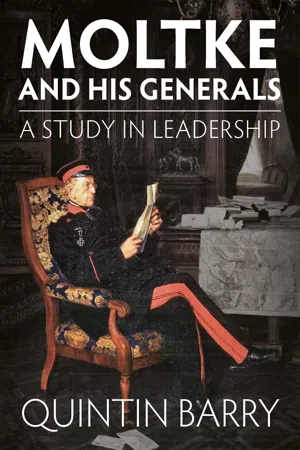
When Helmuth von Moltke took over as Chief of the Prussian General Staff, the Prussian army had not fought for more than forty years. Yet within a decade and a half he had brought it to the point where it was the strongest in Europe. His successes on the battle field led to his methods being painstakingly analyzed by commentators and slavishly imitated by Western armies.His success was not only due to far sighted strategic planning, the comprehensive reorganization of the General Staff and his grasp of new technologies; it was also due to his leadership of a talented, if disparate, group of subordinates, even if some of them sometimes failed to grasp his overall intentions.This book examines these key relationships. Foremost among these was his collaboration with the able though choleric Karl Leonhard von Blumenthal; their correspondence reflected every aspect of their campaigns. He was also close to the Crown Prince, whose aide de camp he had been. Moltke was Chief of Staff to Prince Frederick Charles in Denmark in 1864; his admiration for the 'Red Prince' was perhaps not maintained when the latter's caution caused problems. Albrecht von Stosch, Intendant General in 1870–1871, proved brilliantly successful when he had the chance to demonstrate his talents in the field. Edwin von Manteuffel, on whose recommendation Moltke was appointed, was at the centre of Prussian politics for a decade and a half before becoming a successful army commander in 1866, and 1870–1871. Perhaps the most talented of Moltke's subordinates was August von Goeben, a successful commander in all three wars of German unification. August von Werder never enjoyed Moltke's confidence to the same extent, but was extremely reliable. On the other hand both Eduard Vogel von Falckenstein and Karl von Steinmetz caused Moltke considerable difficulty by their stubborn disobedience of his explicit orders.Behind these relationships there existed the vital rapport which Moltke had with their Chiefs of Staff and his own general staff officers. It was on his ability to rely on these men to execute his intentions that his success ultimately depended. Theophil von Podbielski, Julius Verdy du Vernois and Paul Bronsart von Schellendorf were some of the brilliant individuals who constituted one of the most powerful teams in military history.
eBook - PDF
Moltke and his Generals
About this book
Information
Subtopic
Historical BiographiesIndex
HistoryTable of contents
- Cover
- About the Author
- Title
- Copyright
- Contents
- List of Illustrations
- List of Maps
- Acknowledgements
- 1. Ein Ganz Seltener Mensch
- 2. Military Philosophy
- 3. Organisation and Management
- 4. Moltke and the King
- 5. Blumenthal
- 6. The Campaign in Bohemia
- 7. Sedan
- 8. Versailles
- 9. Stosch
- 10. The Loire
- 11. The Red Prince
- 12. Königgrätz
- 13. Metz
- 14. Le Mans
- 15. Crown Prince Frederick William
- 16. Manteuffel
- 17. From the Main to the Doubs
- 18. Goeben
- 19. Steinmetz
- 20. Werder
- 21. Falckenstein
- 22. The Demigods
- 23. Conclusion
- Epilogue
- Notes
- Bibliography
- Index
Trusted by 375,005 students
Access to over 1.5 million titles for a fair monthly price.
Study more efficiently using our study tools.
Frequently asked questions
Yes, you can cancel anytime from the Subscription tab in your account settings on the Perlego website. Your subscription will stay active until the end of your current billing period. Learn how to cancel your subscription
No, books cannot be downloaded as external files, such as PDFs, for use outside of Perlego. However, you can download books within the Perlego app for offline reading on mobile or tablet. Learn how to download books offline
Perlego offers two plans: Essential and Complete
- Essential is ideal for learners and professionals who enjoy exploring a wide range of subjects. Access the Essential Library with 800,000+ trusted titles and best-sellers across business, personal growth, and the humanities. Includes unlimited reading time and Standard Read Aloud voice.
- Complete: Perfect for advanced learners and researchers needing full, unrestricted access. Unlock 1.5M+ books across hundreds of subjects, including academic and specialized titles. The Complete Plan also includes advanced features like Premium Read Aloud and Research Assistant.
We are an online textbook subscription service, where you can get access to an entire online library for less than the price of a single book per month. With over 1.5 million books across 990+ topics, we’ve got you covered! Learn about our mission
Look out for the read-aloud symbol on your next book to see if you can listen to it. The read-aloud tool reads text aloud for you, highlighting the text as it is being read. You can pause it, speed it up and slow it down. Learn more about Read Aloud
Yes! You can use the Perlego app on both iOS and Android devices to read anytime, anywhere — even offline. Perfect for commutes or when you’re on the go.
Please note we cannot support devices running on iOS 13 and Android 7 or earlier. Learn more about using the app
Please note we cannot support devices running on iOS 13 and Android 7 or earlier. Learn more about using the app
Yes, you can access Moltke and his Generals by Quintin Barry in PDF and/or ePUB format, as well as other popular books in History & Historical Biographies. We have over 1.5 million books available in our catalogue for you to explore.