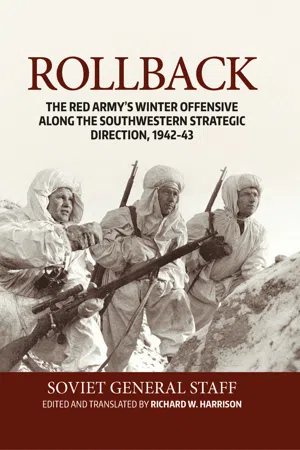
Rollback: The Red Army's Winter Offensive along the Southwestern Strategic Direction, 1942–43 covers the period from mid-December 1942 to mid-February 1943, one of the most critical periods of the war on the Eastern Front. It was here that following the encirclement of an entire German army at Stalingrad, the Soviets sought to take advantage of the ruptured Axis front in southern Russia to finish off the Germans' Italian and Hungarian allies and liberate the economically vital areas of eastern Ukraine.This study is drawn from a number of wartime and postwar articles, published by the General Staff's directorate for the study of wartime experience. Also featured are documents relating to the operational-strategic conduct of the various operations, which were compiled and published after the fall of the Soviet Union.Several articles deal with the preparation for and conduct of the Southwestern Front's Middle Don operation of December 1942. Originally intended as an ambitious offensive to cut off the German forces in the North Caucasus by driving on to Rostov, the operation was later reoriented to meet the threat of the German effort to relieve Stalingrad. The offensive not only accomplished its objective of turning back the German attack, thus dooming the Stalingrad garrison, but also destroyed the Italian army in the East as well.The Soviet Voronezh Front then struck further up the Don River, and in the Ostrogozhsk–Rossosh' operation destroyed what remained of the Italian forces in the area, as well as the Hungarian army. This enabled the Red Army to capture Khar'kov and push nearly to the Dnepr River by mid-February, before being thrown back by a skillful German counteroffensive.The territorial results of this operation set the stage for the front's subsequent Voronezh–Kastornoe operation, which enabled the Soviets to push as far west as Kursk before exhaustion and growing German resistance brought the offensive to a halt. Further to the south, the Soviets were able to capture Voroshilovgrad and penetrate into the industrial Donets Basin.The book also contains a detailed Soviet examination of the employment of tank and mechanized corps during the campaign. The conclusions reached here had a direct bearing on the restructuring of the Red Army's tank armies in time for the summer campaign of 1943.
- 412 pages
- English
- ePUB (mobile friendly)
- Available on iOS & Android
eBook - ePub
Rollback
About this book
Information
Subtopic
Military & Maritime HistoryIndex
HistoryPart I
The Soviet Counteroffensive along the Middle Don: Preparation
The following took part in drawing up the materials for Sbornik no. 8: lieutenant generals Ye.A. Shilovskii and N.G. Korsun; Lieutenant General of Tank Troops M.L. Chernyavskii; major generals K.F. Vasil’chenko, Ya.A Kutsev, Z.Ya. Rudinov, S.G. Timokhin, L.V. Oianov, N.A. Talenskii, B.I. Kuznetsov; major generals of artillery V.G. Guleiko and N.T. Selyakh; Lieutenant General of Engineering Troops A.I. Proshlyakov, major generals of technical services A.S. Kubasov and F.Ya. Gerasimov; Lieutenant General of Communications Troops P.D. Miroshnikov; colonels A.P. Alekseev, A.N. Red’kin, I.A. Cherkezov, V.D. Utkin, I.N. Kharuk, V.N. Zhelannov, M.R. Mazalov, M.N. Kochergin, A.S. Rogov, G.V. Litvinov, and A.N. Trofimov; Captain First Class V. I. Sumin; lieutenant colonels I.V. Parot’kin, D. A Borshchev, V.I. Sidorov, V.G. Romanov, A.N. Sandal’tsev, V.M. Tret’yakov, and N.G. Pavlenko; majors N.A. Fokin, S.I. Patrikeev, A.M. Tselebritskii, and A.M. Rapoport.
Editor: Major General P.P. Vechnyi.
1
The Planning and Preparation of the Southwestern Front’s Offensive Operation in December 1942
The offensive operation by the Southwestern Front’s forces, which unfolded in the second half of December 1942 along the broad steppe expanses of the Don’s middle course, was accomplished by the Southwestern Front command in accordance with the overall plan by the Stavka1 of the Supreme High Command for the defeat of the German-Fascist forces in the south of Russia.
The events of this period were partially examined in Sbornik no. 6, which was dedicated to a description of the Stalingrad operation. However, a separate study of the experience of the Southwestern Front’s December operation is of undoubted interest and has great practical value in the operational training of the Red Army’s officer cadres.
The December offensive by the Southwestern Front’s forces was carried out for the purpose of operationally supporting the activities of the Don and Stalingrad fronts in eliminating the Germans’ Sixth and Fourth Panzer armies around Stalingrad.
A characteristic feature of this operation is the massed employment of tank and mechanized formations, which performed a leading role during all stages of the operation.
A second feature of the operation is that it was conducted in difficult winter conditions, over broken terrain, under conditions of the extensive lengthening of communications and the great remove of the supply bases from the attacking troops, as well as the absence of railroads in the area of operations and extremely limited automobile transport.
All the consecutive stages of the operation’s development are fully expressed here: the breakthrough, the development of the success, pursuit, encirclement, the defeat of the encircled enemy forces, and the consolidation of the success.
Finally, it should also be noted that an instructive feature of the operation is its bold and flexible planning.
The above-enumerated problems are briefly laid out in two articles: “The Planning and Preparation of the Southwestern Front’s Offensive Operation in December 1942,” and “The Breakthrough and the Southwestern Front’s Forces’ Activities in the Operational Depth of the Enemy’s Defense.”2
Only the most important and instructive aspects of the operation are illuminated in these articles, chiefly the planning for the front operation, its preparation and the organization of the breakthrough. The entire remaining material is laid out only in passing, in order to preserve an integral impression of the content and character of the Southwestern Front’s December offensive.
The Overall Situation
As a result of the November offensive,3 the forces of the Southwestern Front broke through the enemy’s heavily fortified defensive zone along a front from Rubezhinskoe (15 kilometers east of Veshchenskaya) as far as Melokletskaya (five kilometers east of Kletskaya) and, while pursuing and destroying in detail the formations of the Romanian Third Army, which was covering this sector, by 25 November their left flank had reached the Chir River and the center the Krivaya River. The Southwestern Front’s right flank remained as before along the Don River.
As a result of this offensive, the Romanian Third Army was routed and only the remnants of its defeated divisions managed to fall back behind the Chir River and consolidate along its right bank, with the support of German units that had arrived during the fighting.
Following the Romanian army’s abandonment of the line of the Don, the Germans were forced to hurriedly begin fortifying new positions along the Chir River and to strengthen the defeated Romanian forces by means of their extremely limited reserves, which were absolutely vital in the developing situation.
Besides this, the extremely difficult situation, in which the encircled German forces in Stalingrad found themselves, forced the fascist command to adopt emergency measures for relieving this group of forces.
At the end of November and the beginning of December, the Germans made repeated attempts to launch an attack with limited forces against the Southwestern Front’s center. However, the Germans’ fierce attacks along the Bokovskaya—Kletskaya axis did not yield the expected results—the fighting resulted in only insignificant tactical successes. The attacking German-Romanian units, upon encountering our forces’ stubborn resistance, wore themselves out and, without achieving their goal, were forced at the end of November to go over to the defensive along this sector of the front.
At the same time, the enemy began to hurriedly transfer troops to the Southwestern Front’s left flank. Thus the following forces were transferred to the Tormosin area: the 11th Panzer Division from the Central Front,4 the 336th Infantry Division from the Voronezh Front’s front, the 45th Infantry Division from the Bryansk Front’s front, and the 7th and 8th Luftwaffe field divisions from France. The enemy was simultaneously trying to create a major group of forces in the Kotel’nikovo area; the following units were arriving here: the 17th Panzer Division from the Bryansk area, the 23rd Panzer Division from the Northern Caucasus, and the 6th Panzer Division from France. Other small units were arriving along these axes from neighboring fronts and from the deep rear. Divisions from France, Belgium and other occupied European countries were also moving there.
The somewhat extended operation by the Don and Stalingrad fronts for eliminating the enemy’s encircled armies and the increased activities of his Tormosin and Kotel’nikovo groups of forces demanded that we speed up the Southwestern Front’s offensive activities.
A description of the area of combat operations
Combat operations by the Southwestern Front’s forces in December 1942 unfolded in the area between the Don and Severskii Donets rivers. The terrain in this area is an open, hilly plateau, very short on vegetation, cut by a large number of rivers and deep ravines, with steep and precipitous banks, which form natural anti-tank defensive lines and make even entire areas difficult for an attacker to reach.
The majority of rivers are shallow. By the start of the operation they had iced over heavily (with the exception of the Bogucharka River, through which crossings had to be erected during the offensive) and did not present formidable obstacles for forcing them with tracked or wheeled vehicles, not to mention the infantry.
The deep and abundant Don River occupied a special place in the area’s river system; its width along the sector from Novaya Kalitva to Veshchenskaya varies from 200-350 meters. Due to the late freezing, the thickness of the river’s ice cover in December 1942 did not allow for crossings without special work to strengthen the ice or laying down bridges, all the more so as the enemy along the 1st Guards Army’s main axis of attack was systematically blowing up the ice. This required additional engineering work for supporting the crossings while forcing the river.
The absence of rail lines in the area of combat operations was deeply felt during the operation’s preparation and conduct. The front was based on the Povorino—Liski and Povorino—Stalingrad rail sectors, which ran 150-200 kilometers from the front line and which created serious difficulties for the materiel supply of the troops and the arrival of reserves. The troops’ communications could only be over the dirt roads, a network of which covered the area of combat operations comparatively thickly.
A feature of the area in which the Southwestern Front’s December fighting took place was that a majority of the area’s inhabited locales were located in the ravines and river valleys and sometimes stretched for tens of kilometers in an uninterrupted chain; the main roads ran, as a rule, along the rivers and the ravines. Thus it was planned to launch the main attacks chiefly around the heights, while the most stubborn fighting usually unfolded along the approaches to the inhabited locales and immediately in them.
The meteorological conditions in December 1942 were quite favorable for combat operations. The air temperature in the middle of December varied from zero to minus ten degrees Celsius and did not fall below -20 throughout the entire month.
The insignificant snow cover, which did not exceed 14-15 centimeters in December, and the absence of snowstorms and heavy drifts, created favorable conditions for the movement of all combat arms along the roads, and partially off the roads.
The disposition of the enemy’s forces
The German command sought through the stubborn defense of its allies—the Italians and Romanians—along the line of the Don and Chir rivers to tie down the Southwestern Front’s forces and to hold these positions at all costs. By thus covering their left flank and the rear of their southern armies, the German command planned to create powerful groups of forces in the Tormosin and Kotel’nikovo areas, and through concentric attacks in the general direction of the northeast, to break through our positions along the boundary between the Southwestern and Stalingrad fronts. In the event of success, this offensive operation was to be combined with a meeting offensive by part of the German Sixth Army’s forces from the east and result in, in the opinion of the German command, the elimination of the encirclement and the restoration of the communications of the forces in the Stalingrad area.
The enemy’s group of forces was to be created in accordance with the plan laid out above.
Opposing the Southwestern Front’s right wing and center; that is, opposite the 6th and 1st Guards armies,5 the forces of the Italian Eighth Expeditionary Army were defending, which also included only a small number of German units.6
Opposite the 3rd Guards and 5th Tank armies were the remnants of the Romanian Third Army, and German forces.
By the start of the operation the 7th and 8th Luftwaffe field divisions, the 336th Infantry Division, 11th Panzer Division, the rear of the 14th and 16th panzer divisions, the headquarters of the XLVIII Panzer Corps, the 63rd Independent Motorized Battalion, up to 15 battalions of special troops, and the scattered elements of Romanian units, which had been thrown beyond the Don as a result of the November offensive, were opposite the front’s left wing. Besides this, German units were located in the areas of Tatsinskaya and Morozovskii.
A shortage of forces forced the German command to commit almost all of its operational reserves into the fighting as early as the Red Army’s November offensive. Thus by the middle of December the enemy’s operational reserves opposite the Southwestern Front were extremely insignificant and consisted chiefly of small garrisons located in the area’s major inhabited areas.
The overall number of enemy forces along the front from Novaya Kalitva to Rychkovskii, taking into account the units located in the second line, comprised up to 16 infantry and three panzer divisions, and two of the latter (1st and 22nd) had suffered losses up to 70 percent. Besides this, up to 25 composite battalions of special troops and up to six artillery regiments as reinforcements were operating along various sectors of the front.
The strength and operational density of the enemy’s group of forces is shown in Table I/1.1.
Table I/1.1 Strength and Operational Density of the Enemy Group of Forces, December 1942
| Total Along the Front (320 km) | Strength and Weapons | Per Km of Front |
| About 200,000 | Men | 523.3 |
| 8,054 | Machine Guns | 21 |
| 1,468 | Mortars | 3.9 |
| 1,037 | Anti-Tank Guns | 2.7 |
| 1,145 | Field Guns | 3 |
| Up to 600 | Tanks | 1.5 |
Due to the front’s significant length and the enemy’s limited forces along this sector, his defense was built along a broad front. The features of the enemy’s defense on the Don are detailed in the article “The Disposition and Composition of the Romanian Third and Italian Eighth Armies on the Don.”
The densest enemy group of forces was being created opposite the Southwestern Front’s left wing, where the overwhelming number of formations defending the Chir River belonged to the Germans, while at the same time the Italians and the remnants of the Romanians were located opposite the 6th and 1st Guards armies on the Don.
Such a distribution of forces may be explained by the following considerations. First of all, the front along the Chir River had only just stabilized and had not yet been much fortified in the engineering sense, as was the case opposite the Southwestern Front’s right wing and center; secondly, the Germans expected that the Red Army’s new attacks, should they follow, would be launched predominantly from the line of the Chir River against the immediate rear of the Nizhne-Chirskaya and Tormosin groups of forces; finally, such a group of forces could be created for the purpose of restoring the situation...
Table of contents
- Cover
- About the author
- Title
- Copyright
- Contents
- List of Maps
- List of Tables
- Preface to the English-language edition
- Part I The Soviet Counteroffensive along the Middle Don: Preparation
- Part II The Soviet Counteroffensive Along the Middle Don: Execution
- Part III The Voronezh Front’s Ostrogozhsk-Rossosh’ Offensive Operation (13-27 January 1943)
- Part IV The Voronezh-Kastornoe Operation by the Voronezh Front and Bryansk Front’s Left Wing (24 January-17 February 1943)
- Part V The Voroshilovgrad Operation
- Part VI Documents
Trusted by 375,005 students
Access to over 1.5 million titles for a fair monthly price.
Study more efficiently using our study tools.
Frequently asked questions
Yes, you can cancel anytime from the Subscription tab in your account settings on the Perlego website. Your subscription will stay active until the end of your current billing period. Learn how to cancel your subscription
No, books cannot be downloaded as external files, such as PDFs, for use outside of Perlego. However, you can download books within the Perlego app for offline reading on mobile or tablet. Learn how to download books offline
Perlego offers two plans: Essential and Complete
- Essential is ideal for learners and professionals who enjoy exploring a wide range of subjects. Access the Essential Library with 800,000+ trusted titles and best-sellers across business, personal growth, and the humanities. Includes unlimited reading time and Standard Read Aloud voice.
- Complete: Perfect for advanced learners and researchers needing full, unrestricted access. Unlock 1.5M+ books across hundreds of subjects, including academic and specialized titles. The Complete Plan also includes advanced features like Premium Read Aloud and Research Assistant.
We are an online textbook subscription service, where you can get access to an entire online library for less than the price of a single book per month. With over 1.5 million books across 990+ topics, we’ve got you covered! Learn about our mission
Look out for the read-aloud symbol on your next book to see if you can listen to it. The read-aloud tool reads text aloud for you, highlighting the text as it is being read. You can pause it, speed it up and slow it down. Learn more about Read Aloud
Yes! You can use the Perlego app on both iOS and Android devices to read anytime, anywhere — even offline. Perfect for commutes or when you’re on the go.
Please note we cannot support devices running on iOS 13 and Android 7 or earlier. Learn more about using the app
Please note we cannot support devices running on iOS 13 and Android 7 or earlier. Learn more about using the app
Yes, you can access Rollback by Richard Harrison in PDF and/or ePUB format, as well as other popular books in History & Military & Maritime History. We have over 1.5 million books available in our catalogue for you to explore.