Kangzhan: Guide to Chinese Ground Forces 1937–45 is the first ready reference to the organization and armament of Chinese ground forces during the Sino-Japanese War of 1937–45. The work integrates Chinese, Japanese and Western sources to examine the details of the structure and weapons of the period. Recent scholarship has contributed greatly to our understanding of China's role in the war, but this is the first book to deal with the bottom-level underpinnings of this massive army, crucial to an understanding of its tactical and operational utility.An introductory chapter discusses the military operations in China, often given short shrift in World War II histories. The work then traces the evolution of the national army's organizational structure from the end of the Northern Expedition to the conclusion of World War II. Included are tables of organization and strength reports for the wartime period.The armament section illustrates and details not only the characteristics of the many and varied weapons used in China, many seen nowhere else, but also their acquisition and such local production as was undertaken. This is complemented by a chapter on the arsenals and their evolution and production programs.The Chinese army was one of the largest of the war and it, and Japan's, fought longer than any other. It faced unique challenges, including fragmented loyalties, huge expanses of territory, poor logistics networks, inadequate arms supplies, and, often, incompetence and corruption. Nevertheless, they fought bravely in major battles through 1941 and were able to counterpunch effectively in important regions through the rest of the war. Aimed at both military historians and wargamers, this work fills an important gap in our understanding of this, the most under-appreciated army of the war.
- 576 pages
- English
- ePUB (mobile friendly)
- Available on iOS & Android
eBook - ePub
Kangzhan
About this book
Information
Subtopic
Asian HistoryIndex
History1
The War in China
Following the death of Sun Yat-sen in 1925 Chiang Kai-shek emerged as the Kuomintang’s new leader. In March 1926 he began his so-called Northern Expedition to consolidate his power and, at least nominally, unify China, aims which he had achieved to some extent by mid-1928. He had accomplished this with a relatively small “national” army that answered to his KMT government by entering into alliances with various provincial warlords that left each of them with varying levels of independence. Chiang may thus have been weak, but he was clearly working tirelessly to cement central power.
Each of the remaining semi-autonomous warlords had to be cajoled, bribed, and bullied into line, clearly a long-term effort, but this did not assuage Tokyo’s alarm. A weak China was part of Japan’s overall strategy in Asia. Zhang Zuolin, the warlord of Manchuria (to the Chinese the Three Eastern Provinces) had failed to stop Chiang’s drive and he was assassinated by the Japanese Kwantung Army in June 1928, to be replaced by his son. In September 1931 the Kwantung Army staged an explosion that they blamed on the locals and used as a pretext for aggression. Within six months the Japanese had pushed Zhang’s troops, who were under orders not to resist, out of their garrisons and finally south of the Great Wall. The Japanese then established the puppet state of Manchukuo in the region.
Escalating violence in Shanghai led to Japanese bombing on 28 January 1932 and 3,000 Japanese troops fanned out to take parts of the city. The 19th Route Army put up stout resistance. In mid-February the Japanese increased their strength to 90,000, while Chiang sent his German-trained 5th Army (87th and 88th Divisions) to Shanghai. In early March the 19th Route and 5th Armies pulled back, ending the fighting. The Japanese eventually largely withdrew, but insisted that Shanghai be demilitarized, including decommissioning of the arsenal facilities there.
In the meantime the Kwantung Army’s leaders had come to believe that they needed both a buffer zone between China and their new Manchurian holdings and the mineral resources of North China. In February 1933 they invaded Jehol province and routed Zhang’s troops there, with Chiang too concerned with the communists to send aid. In May the Kwantung Army pushed south on a broad front, forcing China to agree to a 13,000 square kilometer demilitarized zone that was, in fact, garrisoned by the Japanese. In mid-1935 bellicose posturing on the borders gave the Japanese the rest of Hebei province and forced the governor of Chahar, once again lacking support from Nanjing, to capitulate to the Kwantung Army.
In the meantime Chiang’s full attention had been focused on his internal enemies, primarily the communists. When the latter set up a soviet in the province of Jiangsu he launched five successive campaigns against them. The First Campaign ran from the fall of 1930 to April 1931; the Second Campaign, from February to May 1931; the Third Campaign, from July to September 1931; the Fourth Campaign, from January to April 1933; and the Fifth Campaign, from October 1933 to October 1934. The first four, commanded by generals of indifferent talent and questionable loyalty, all failed. Chiang took command of the Fifth Campaign himself and, by improving the training of the army units involved and emphasizing civil affairs, won the day, at least temporarily. The communists fled the field on the “Long March.”
If Chiang thought he would now have several years to finish off the communists, build up his army, and prepare for what most Chinese considered the inevitable Japanese aggression, he was mistaken. Public hostility to Japan had risen to new heights, spinning far our of his control. He was now a passenger rather than the pilot. In December 1936 he was kidnapped by senior generals and forced to form a coalition with the communists against the Japanese. The era of Chinese concessions to Japan had ended.
Ironically, this came about just as more moderate and realistic elements started to exert substantive influence over Japanese policy. Nevertheless, there were still hawks within the military, and they completely misread the new Chinese political environment. The opinion on the ground among Japanese forces in China was that they could continue to provoke minor clashes and use them as excuses to seize “bite-size” portions of China at a time or, failing that, they could launch a short, powerful, aggressive campaign that would thoroughly demoralize the Nanjing government.
Opening Drives South and West (July–December 1937)
One of the provocations used by the Japanese began with a clash near Beijing in July 1937. That the Japanese were prepared to act following this Marco Polo Bridge incident was clear; their troops poured into Tianjin (Tientsin), where they had treaty rights, and then fanned out unopposed into the Beijing Plain. Defending Beijing was the 29th Army under the warlord Song Zheyuan with its headquarters at Nanyuan 16km south of the great city. Its 38th Division was near Tianjin, the 132nd just south of Nanyuan, and the bulk of the 143rd Division at Zhangjiakou (Kalgan), 190km away. On 25 July the Japanese 20th Division moved northwest along the Tianjin–Beijing railroad and encountered Chinese troops at Langfang and defeated them after a pitched battle the next day. Meanwhile, two Japanese brigades moved south from Rehe (Jehol) province (which had been annexed into Manchukuo in 1933) and occupied the area northeast of Beijing. On the 28th the Japanese attacked Nanyuan, catching the 29th Army and its 132nd Division by surprise, scattering the headquarters. On 29 July the Japanese 5th Division, still in Tianjin, attacked and routed the 38th Division, driving it 80km south. At that same time Song took the remainder of his 29th Army on a retreat from Beijing, finally settling down at Baoding, about 110km south on the Beijing–Hankou railway and well out of harm’s way for the time being. On 3 August Japanese troops marched into an undefended Beijing.
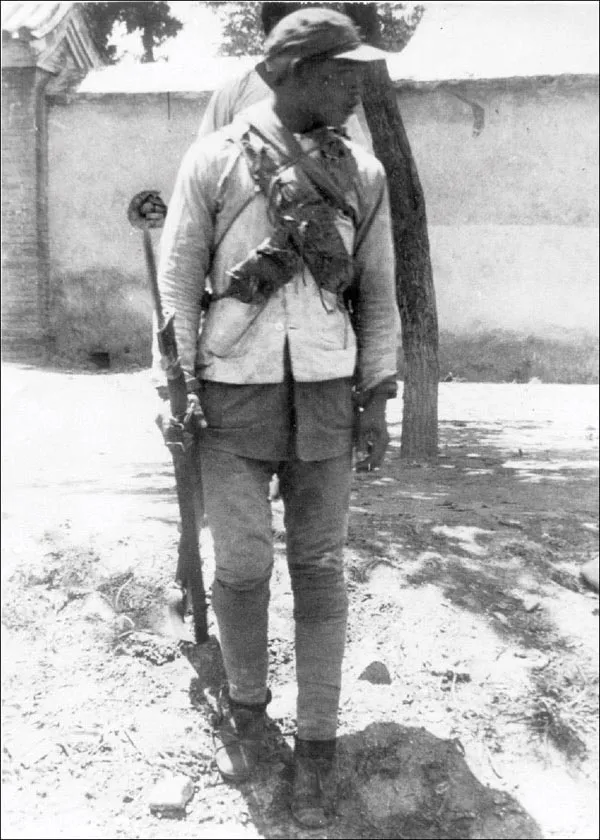
A soldier of the 29th Army shortly after the Marco Polo Bridge incident.

Chinese soldiers on guard duty near Tianjin in July 1937. Note the short swords carried on their backs.
From Beijing the Japanese planned a drive west into Inner Mongolia, cutting about 130km northwest to Zhangjiakou via the southern Juyong pass, thence southwest to Datong in Yan Xishan’s Shanxi province, defended by Yan’s troops (nominally part of the National army) plus the communist 115th Division. Holding Juyong was the 13th Army, which inexplicably chose to mount its defense around the city itself rather than the narrow pass to the west, while the 17th Army was stationed to the north of the city. On 8 August advance elements of the Japanese 5th Division and 11th Independent Mixed Brigade (IMB) ran into the Juyong garrison, halted briefly before the main force arrived, but then took the city on 11 August. Three Chinese divisions were rushed up and fought at the Juyongguan pass, but abandoned it when the Japanese 5th Division entered the parallel Chenpien pass to the south, opening the way to Zhangjiakou from the east. That was not the only concern, for three Japanese IMBs were marching south on that city from southern Chahar, brushing aside the 143rd Division on 18 August. The 17th Army was rushed up to meet the threat, then retreated just as quickly. On 3 September the Japanese entered Zhangjiakou, turned somewhat southward and continued their advance towards Datong.
The Japanese drive to the southwest into Inner Mongolia actually had two “arms.” The western arm, towards Datong, was formed from the force that had advanced from Chahar. The eastern arm, based on the IJA 5th Division, marched parallel but about 50km to the east. Yan’s 61st Army (one division and two brigades) from II War Zone conducted a widely spaced weak delaying action against the western arm, falling back about 30km at a time and on 13 September the Japanese occupied Datong. Chiang was bitterly disappointed, as this cut a main communication route with the Soviets, but there was little he could do. The eastern arm, headed by the 21st Brigade of the IJA 5th Division, moving down from Juyong Pass, was to meet an entirely different enemy.
At Pingxinguan Pass they met Yan’s 73rd Division, later reinforced by the 71st, that stopped them in a see-saw battle for the heights. Needing resupply, the Japanese called on their supply train of 70 carts and 80 trucks to move up the sunken road with ammunition, food, and winter clothing.
The 115th Division of the Communist 8th Route Army had marched 500km from Shaanxi Province, arriving at Mount Wutai in front of the 21st Brigade on 20 September. For a day the commander, Lin Biao, made his preparations. Near the village of Pingxinguan the soldiers of the 115th Division moved in on the head and tail of the Japanese resupply column on the morning of 21 September. Chinese soldiers went the length of the column, throwing grenades down into the road while the Japanese, largely unarmed and unable to scale the 5–10 meter walls of the sunken road, flailed helplessly about. Longer sections of the road were raked from the ends by machine-gun fire. Central Army troops continued to attack the 21st Brigade, now running low on supplies, and losses were heavy on both sides. Relief forces finally reached the Japanese on 28 September and the Chinese withdrew. There are considerable discrepancies in the casualty reports,* but it is clear that the IJA should have learned not to take Chinese passivity for granted. Further, the battle was widely publicized and provided a much-needed morale boost to the Chinese forces and population.
The western arm of the Japanese advance, however, proceeded apace. Having taken Datong, the Japanese force of one division and nine Mongolian/Manchurian cavalry units turned west again, headed for Guisui, the Suiyuan capital. Chiang ordered the 35th Army and the 1st Cavalry Army south to avoid being cut off north of the Japanese drive, leaving four cavalry divisions and three brigades to hold back the Japanese advance. Their efforts were half-hearted at best and on 14 October the Japanese occupied Guisui unopposed.
With the exception of Pingxingguan and some of the smaller clashes with Yan’s troops, the Japanese had outmaneuvered and outfought the Chinese decisively in every engagement. Wei Li-huang’s 14th Army Group from the central government had performed fairly well, but with a few exceptions Yan’s troops had given way quite easily. On the other hand the Japanese had failed to engage the Chinese decisively, resulting in the conquest of huge swatches of land that their numbers were insufficient to garrison.
The Japanese were not only interested in driving west from Beijing. The provinces of Shandong, Hebei and Anhui to the south were tempting targets that were both rich and blessed with good transportation routes that would ease any invasion. To guard against this, the Chinese had deployed the 1st Army Group on the Tianjin–Nanjing railway, with the 3rd Route Army in Shandong as a reserve. Further west, defending the Beijing–Hankou railway was I War Zone, commanded directly by Chiang.
Bloodletting on the Central Coast
Meanwhile, far to the south and east, things were beginning to spiral out of control. The large foreign populations in their enclaves in Shanghai had not been known for their humility, usually treating the local Chinese as little more than a labor pool for servants. Even within this crowd, however, the Japanese stood out for their particular arrogance. The 5,000 Japanese troops stationed there under treaty rights had been a source of irritation for some time before 9 August, when a Japanese lieutenant, enraged that a Chinese sentry tried to stop him in his car, shot and killed the sentry before being killed himself by another sentry. It seems likely that the Japanese had not planned adventures in central China, at least not yet, but Chiang had decided this was the place to make his stand.
Chiang hoped to draw off Japanese troops from their depredations in north China that threatened supply routes from the USSR, but Shanghai was a strange place to chose for such an endeavor. True, it was the commercial center of China and putting on a good show there guaranteed favorable press coverage for China’s plight around the world due to the large foreign population, but it had serious tactical drawbacks. The Japanese owned the seas, and the city’s location on the sea at the mouth of a deep, navigable river gave the enemy flexibility and the availability of naval gunfire support over most of the front. The well developed port facilities allowed them to reinforce and supply almost at will. The level ground, combined with the ability to bring engineering equipment in, would allow the Japanese to create landing fields for their vastly superior air force. Nevertheless, Shanghai it would be.
On 11 August the 36th Division and two German-trained elite divisions, the 87th and 88th, closed around the Japanese positions north of the city, while the 55th, 56th, and 57th Divisions began moving north along the east bank of the river. On 13 August the Japanese landed two more divisions at Shanghai to bolster their forces. On that same day fighting broke out between the 87th Division and the Japanese in the Zhabei (Chapei) district; Troops attacking near Shanghai, September 1937. The soldier on the left has just been shot. after five days the Japanese had been forced back but their lines remained unbroken. Both sides then began to pour reinforcements into the area. On 22 August the Japanese landed elements of their 3rd and 11th Divisions upriver from the city, where they met the Chinese 15th Army Group, leading to a bitter two-week battle that ended in a stalemate.

Troops attacking near Shanghai, September 1937. The soldier on the left has just been shot.
Over a month of heavy fighting followed all along the front line, with the Japanese force, now known as the Shanghai Expeditionary Force, attempting to break out of the area around the city, and the Chinese III War Zone (commanded by Chiang personally) attempting to hold them in, and counterattacking on a regular basis. By late September the Chinese had thrown over 500,000 troops into the battle formed into Left Wing, Center, and Right Wing commands, and the Japanese over 200,000, including six divisions, four IMBs, the Formosa Brigade, and tank and artillery units.
That the Chinese managed to hold the line, and indeed counterattack successfully on occasion, was unexpected, not only to the Western observers in Shanghai, but also to the Japanese. The Rising Sun planes flew unaccosted above the battlefield, strafing and bombing at will. The old Wusong (Woosung) Fort had been captured early in the battle from the land side, its antique coastal guns no longer able to prevent Japanese warships from sailing up and down the river and pounding the Chinese lines with gunfire. Japanese tanks and artillery outnumbered their Chinese counterparts by a wide margin, both dealing death and destruction to Chiang’s troops. By 20 October the Chinese had sustained over 120,000 casualties on the Shanghai front, and yet they hung on grimly, fighting, and dying in close combat for every meter they gave up. The next day the 21st Army Group of Guangxi troops, with a reputation as brave fighters, arrived and were thrown into battle.
Faced with such determined opposition and suffering horrendous losses themselves, the Japanese gave up on the idea of simply punching through Chinese lines. Instead, they landed their 10th Army of three divisions on the north shore of Hangzhou Bay, 50km south of Shanghai, on 5 November. This was something Chiang had not considered. The new army brushed aside light resistance and began marching north to Shanghai to attack the encircling Chinese from the outside. They quickly smashed through the Right Wing forces and joined up with the Shanghai Expeditionary Force. Emboldened, the Japanese in Shanghai began a massive assault along the whole line, heavily supported by air attacks and naval gunfire. This time, the Chinese line, already outflanked on the right, began to give. On 12 November the Japanese 16th Division made an amphibious landing about 70km upriver from Shanghai. This put them squarely behind the Chinese left flank, and the Chinese force began to crumble. Chiang issued an ambiguous order that could have been, and was, interpreted to mean retreat.
The Chinese troops had proven themselves brave, tough, and enduring soldiers. Western advisers, however, complained bitterly ...
Table of contents
- Cover
- About the Author
- Title
- Copyright
- Contents
- List of Illustrations
- List of Maps and Tables
- Abbreviations
- Preface
- 1. The War in China
- 2. Coalition Warfare—Burma
- 3. Guerrilla Warfare
- 4. Organization Overview
- 5. Central Government Divisions and Armies
- 6. Cavalry
- 7. Armored Units
- 8. Non-Divisional Artillery
- 9. Chinese Army in India
- 10. American-Sponsored Divisions
- 11. Provincial Units
- 12. Guerrilla Duties for Residual Forces
- 13. Communist Forces
- 14. The Ordnance Industry during the War
- 15. Submachine Guns
- 16. Rifles
- 17. Grenade Launchers
- 18. Light Machine Guns
- 19. Medium Machine Guns
- 20. Infantry Anti-Tank Weapons
- 21. Anti-Tank Guns
- 22. Infantry and Hybrid Guns
- 23. Light Mortars
- 24. Medium Mortars
- 25. Heavy Mortars
- 26. Pack Artillery
- 27. Light Artillery
- 28. Medium Artillery
- 29. Light Anti-Aircraft Weapons
- 30. Heavy Anti-Aircraft Guns
- 31. Coastal Artillery
- 32. Armor
- APPENDICES
- Sources
Trusted by 375,005 students
Access to over 1.5 million titles for a fair monthly price.
Study more efficiently using our study tools.
Frequently asked questions
Yes, you can cancel anytime from the Subscription tab in your account settings on the Perlego website. Your subscription will stay active until the end of your current billing period. Learn how to cancel your subscription
No, books cannot be downloaded as external files, such as PDFs, for use outside of Perlego. However, you can download books within the Perlego app for offline reading on mobile or tablet. Learn how to download books offline
Perlego offers two plans: Essential and Complete
- Essential is ideal for learners and professionals who enjoy exploring a wide range of subjects. Access the Essential Library with 800,000+ trusted titles and best-sellers across business, personal growth, and the humanities. Includes unlimited reading time and Standard Read Aloud voice.
- Complete: Perfect for advanced learners and researchers needing full, unrestricted access. Unlock 1.5M+ books across hundreds of subjects, including academic and specialized titles. The Complete Plan also includes advanced features like Premium Read Aloud and Research Assistant.
We are an online textbook subscription service, where you can get access to an entire online library for less than the price of a single book per month. With over 1.5 million books across 990+ topics, we’ve got you covered! Learn about our mission
Look out for the read-aloud symbol on your next book to see if you can listen to it. The read-aloud tool reads text aloud for you, highlighting the text as it is being read. You can pause it, speed it up and slow it down. Learn more about Read Aloud
Yes! You can use the Perlego app on both iOS and Android devices to read anytime, anywhere — even offline. Perfect for commutes or when you’re on the go.
Please note we cannot support devices running on iOS 13 and Android 7 or earlier. Learn more about using the app
Please note we cannot support devices running on iOS 13 and Android 7 or earlier. Learn more about using the app
Yes, you can access Kangzhan by Leland Ness, Bin Shih in PDF and/or ePUB format, as well as other popular books in History & Asian History. We have over 1.5 million books available in our catalogue for you to explore.