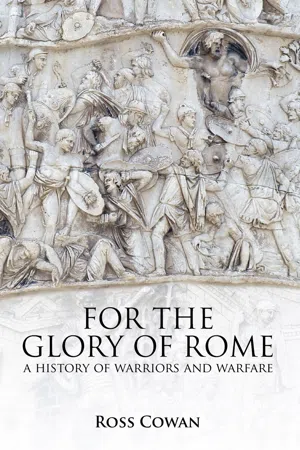
Ancient Rome was uniquely bellicose. Her legionaries are often cited as the original professional soldiers and famed for their iron discipline, but they were also formidable individual warriors, sometimes berserks, who gloried in single combat, taking heads and despoiling their enemies. They were men who believed they were sired by a god of war, driven by the need to create and sustain heroic reputations, and who disrobed in public to display battle scars. Yet these same warriors read philosophy, wrote history, and recited poetry.
For the Glory of Rome introduces the heroic yet utterly ruthless men who carved out the Roman Empire. The author examines the deeds of men like Siccius Dentatus, the victor of eight single combats and a hero of the common people; Decius Mus, the consul who charged into the midst of the enemy at Sentinum to devote himself to the gods of the Underworld; and the feuding centurions Pullo and Vorenus, rivals for every post and honor but bound together by their loyalty to Caesar.
Ross Cowan explores the mindset of the Roman fighting men, examining their motivation, beliefs and superstitions, illuminating why they fought and died for the glory of Rome.
- 272 pages
- English
- ePUB (mobile friendly)
- Available on iOS & Android
eBook - ePub
About this book
Information
Subtopic
Military & Maritime HistoryIndex
HistoryChapter I
THE PYRRHIC WAR
‘They fought desperately with their swords against the Greeks’ sarissai, careless of their lives, thinking only of wounding and killing the enemy.’ (Plutarch, Pyrrhus, 21. 6)
In 280 BC Pyrrhus of Epirus, spiritual heir of Alexander the Great, sailed to Italy. He came to defend the Greek colonies of the south from Roman aggression and to create an empire. He was one of the most famous men in the Greek world, a king and a general renowned for his courage, daring and tactical acumen. He was hero-worshipped by his soldiers. Few in the Greek world doubted that he would achieve his aim.
Rome had excited little interest in mainland Greece and the Hellenistic kingdoms. She was known for her republican constitution and as a power in Italy, but she was not an international player; most Greek leaders would have considered Syracuse in Sicily more important. Rome’s legions had routed the armies of Gallic tribes and Italic confederations, but when had they ever faced anything like a modern Hellenistic army? How could part-time legionaries defeat the Epirote warrior-king and his army of hardened professionals? How could they withstand the devastating combination of phalanx, elephant corps, light troops and cavalry? Yet it did not pay to underestimate the capabilities of Rome and her army. The Pyrrhic War thrust Rome on to the world stage and she rose to the challenge.
THE EAGLE OF EPIRUS
Pyrrhus of Epirus was king of the Molossians and, through a combination of force of arms, luck and his not inconsiderable charm, sometimes king of Macedonia. He claimed direct descent from Achilles, son of Zeus and hero of the Trojan War, and from that other belligerent demi-god, Heracles. He strove to live up to their example and win their fame, especially that of Achilles, ‘not merely through his ancestry but through his prowess on the battlefield’.1
While still an infant Pyrrhus was ousted from his princely throne and then restored by the army of the Illyrian king who had adopted him. He was usurped again as a teenaged king and exiled but made a name for himself as a soldier in the wars of the Diadochi – ‘the Successors’. They were the companions of Alexander the Great who fought perpetually over their old master’s fragmenting empire: Ptolemy, Antigonus Monophthalmos (the ‘One-Eyed’), Seleucus, Cassander and Lysimachus. A mature Pyrrhus returned to Epirus to kill the usurper and throughout the 290s and 280s BC spent his time seizing large chunks of neighbouring kingdoms or defending his own.2 He was partial to fighting single combats with enemy generals and, on those rare occasions when he was not on campaign, he read military manuals or wrote about tactics and his own exploits. Pyrrhus’ writings were bestsellers in antiquity and much plundered by later Greek, Carthaginian and Roman generals for inspiration: Hannibal described Pyrrhus as his teacher.3 ‘No one has ever shown better judgement in choosing his ground, or in marshalling his forces,’ said the Carthaginian commander. Pyrrhus’ elder contemporaries were more cautious in their praise. When asked who was the best general, Antigonus the One-Eyed, a commander to both Philip II and Alexander the Great, saw the promise in the young officer who had recently joined his army and replied, ‘Pyrrhus – if he lives to be old.’ Hannibal also respected Pyrrhus’ ability to win men over.
Pyrrhus was a thorough autocrat (at least when he could escape the confines of Epirus) and dangerously impulsive (few of his endeavours were seen through to a conclusion before he embarked on another adventure), but he was also chivalrous and possessed of a magnetic and charismatic personality which drew men and women to him. He was always conspicuous on the battlefield in his gaudy armour, horned helmet and flamboyant purple and gold cloak. In that age of warriors there were always men willing to follow him on the next adventure, but Pyrrhus was even confident of his powers to inspire unwilling conscripts. ‘You pick out the big men,’ he told his recruiting officers. ‘I’ll make them brave!’ Nor were the great men and women of the age immune to his powers of persuasion. ‘He was adept at turning his superiors to his own advantage,’ wrote Plutarch. Thus, only a year after being sent to Ptolemy of Egypt as a political hostage (298 BC), he had charmed Ptolemy’s queen, married his stepdaughter and returned to Epirus at the head of a Ptolemaic army.4
Pyrrhus was obsessed with war and its dangerous glamour. He revelled in planning and tactics, and lusted after the adrenaline rush of combat and the glory and prestige that came with victory.5 He was not the most powerful or successful of the Hellenistic kings who succeeded Alexander the Great, but he was reckoned the most like Alexander in spirit and deeds.6 Pyrrhus was in fact a cousin of the famous king. Alexander’s mother, Olympias, was of the Molossian royal house.
Although Pyrrhus was the staunchest Epirote patriot, he was chafed by the confines of his kingdom. Pyrrhus was never called king of Epirus as the Roman sources erroneously refer to him. He was king of the Molossians, the principal tribe of Epirus, and acknowledged hegemon (leader) by the lesser tribes of the Thesprotians and Chaonians; the three tribes were known collectively as the Epirote Allies. The kings of the Molossians were bound by a strict constitution, which even included clauses allowing the people to depose the monarch and expel his family – as happened to the young Pyrrhus in 317 and 302 BC. The king had to consult with the Epirote Alliance before he could call out the army and embark on a campaign, hence the desire of Alexander the Molossian (see below) and especially Pyrrhus to conquer territory outside Epirus, where they could rule in the true autocratic fashion of contemporary Hellenistic monarchs. It is telling that Pyrrhus made his lavish capital at Ambracia, close to but beyond the bounds of his native land; his chief minister, Cineas, was not an Epirote but a Thessalian; and the alliances that the king attempted to forge, for example with the Romans after Heraclea, were intended to be alliances with Pyrrhus alone, not Pyrrhus as the representative of the Epirotes.
In 289 BC Pyrrhus, aged about thirty, fought one of the most celebrated single combats of the age against Pantauchus, the feared general of Demetrius Poliorcetes (‘the Besieger’). Demetrius (son of Antigonus the One-Eyed) had recently seized the throne of Macedon, occupied Aetolia in central Greece, and was marching on the Aetolians’ ally, Epirus. Pyrrhus counter-marched against the invading force, but somehow both kings managed to by-pass each other – seemingly deliberately on the part of Pyrrhus. The Epirote continued his advance south into Aetolia, where Demetrius had left Pantauchus with a large force of occupation. Pantauchus met Pyrrhus’ army at an unspecified location and, perhaps seeking to reduce the conflict to a decisive battle of champions, challenged Pyrrhus to single combat. The arrogant Pantauchus was confident in his strength and courage but Pyrrhus took heart from his descent from Achilles:
At first they hurled their spears, then, coming to close quarters, they plied their swords with might and skill. Pyrrhus got one wound, but gave Pantauchus two, one in the thigh and one along the neck, and put him to flight and overthrew him. However, he did not kill him, for Pyrrhus’ companions dragged him away. Then the Epirotes, exalted by the victory of their king and admiring his valour, overwhelmed and cut to pieces the phalanx of the Macedonians, pursued them as they fled, slew many of them, and took 5,000 of them alive. (Plutarch, Pyrrhus, 7. 4–5)
Strangely enough, the surviving Macedonians did not take unkindly to Pyrrhus’ overwhelming victory.7 Saddened by a long line of weak kings and usurpers, the oldest soldiers yearned for a return of the glory days of Alexander the Great:
This battle did not fill the Macedonians with fury and hate towards Pyrrhus for their losses. Rather, it persuaded those who witnessed his exploits or engaged him in the battle greatly to respect him and admire his bravery and to talk much about him. They compared his demeanour, his swiftness and all his motions to those of the great Alexander, and thought they saw him as a shadow, as it were, and imitation of that leader’s impetuosity and might in conflicts. The other kings, they said, could only imitate Alexander in superficial details, with their purple cloaks, their bodyguards and the angle at which they held their heads, or the lofty tone of their speech: it was Pyrrhus alone who could remind them of him in arms and action. (Plutarch, Pyrrhus, 8.1)
As a result of this victory Demetrius was forced to evacuate Aetolia and abandon his plundering of Epirus, from where he raced to defend the borders of Macedonia. When the triumphant Pyrrhus returned home, the Epirotes honoured their king with a new title: the Eagle. Knowing when to return a compliment the king declared, ‘Through you I am an eagle. It is by your arms that I am held aloft by swift pinions.’ When the Eagle marched into Macedonia in 288 BC – a co-ordinated invasion with Lysimachus (see below) attacking from Thrace – the veterans of the Macedonian army were still so taken with him that they saluted Pyrrhus as king and Demetrius was compelled to flee. The rumour that the great Alexander had appeared to Pyrrhus in a vision and blessed his enterprises probably helped to sway them.8 Pyrrhus and Lysimachus divided the kingdom between them, but soon Lysimachus’ power began to tell.
Lysimachus had been a bodyguard of Alexander the Great. During one of his less stable moments (and there were many), Alexander had locked the unarmed Lysimachus in a cage with a hungry lion: Lysimachus killed the beast with his bare hands. On Alexander’s death he seized the satrapy of Thrace. In time he consolidated a considerable empire stretching from the Danube to the Taurus Mountains, though his trans-Danubian campaigns came to an inglorious conclusion when he was captured and ransomed by a barbarian chieftain. Benefiting from wealthy Asian provinces such as Pergamum which he taxed rapaciously, the size of his treasury was legendary and it enabled him to finance a superb army and bribe the senior officers and officials of his opponents.
By 284 BC Lysimachus had thoroughly undermined Pyrrhus’ position in Macedon, tampered with his officers and cut his supply lines.9 Pyrrhus was forced back to Epirus, but the indefatigable king sought to expand his domains north into Illyria, adding to those lands he had already acquired through dynastic marriages to Illyrian princesses, and sought to reclaim Corcyra (Corfu). The island was the dowry of his second wife, Lanassa, daughter of Agathocles, the tyrant of Syracuse in Sicily, but Pyrrhus’ polygamy alienated her and she had left him in 290 BC for Demetrius of all people, who garrisoned the island! (After his expulsion from Macedon Demetrius attempted to carve himself out another kingdom in Asia Minor but was eventually captured by Seleucus, the most successful of the Diadochi, and kept in luxurious confinement until he drank himself to death in 283 BC.)
Pyrrhus re-conquered Corcyra in 282 BC, but then found himself in an unaccustomed situation: except for powerful Lysimachus, he had no one to fight. The mighty Eagle discovered that ruling a peaceful and prosperous kingdom was not entirely to his liking and he yearned for adventure: ‘Like Achilles, he could not endure inaction,’ says Plutarch.10 Early in 281 BC Lysimachus failed in his attempt to add the vast kingdom of Seleucus to his empire, and was killed in battle at Corupedium. Pyrrhus made ready to attack Macedonia but then arrived an embassy of Tarentines imploring the warrior-king to lead them in their Hellenic struggle against a barbarian city called Rome.
TARENTUM
Tarentum (Taras, Taranto) was established in 706 BC on the site of an ancient Mycenaean trading station by the best harbour in southern Italy. It was Sparta’s only overseas colony and for centuries Tarentum struggled to match the martial prowess of her parent city. In about 473 BC Tarentum’s ruling aristocrats were annihilated in a battle with the neighbouring Messapians, but the common people successfully defended the city and then re-established it as a radical democracy.
Already rich as a major producer of wool and purple dyed garments (greatly prized in antiquity as the colour of royal and magisterial robes), Tarentum supplemented her wealth by the manufacture of ceramics and metalwork, which were much sought after as luxury goods. On the hub of the major trade routes between east and west and with the money and manpower to maintain a considerable navy, the democratic city went on to become the leading mercantile power of southern Italy. Her coinage was the preferred standard in southern and Adriatic Italy and was found even beyond the Alps. She was jealous of her control of the sea and dominant over the other Italiote Greek cities in the region, including famous Croton, and Metapontum. In fact Tarentum controlled the Italiote League from about the end of the fifth century BC and levied troops from the cities. However, the expansion of the warlike Sabellian tribes from the central highlands into southern Italy put the territory of Tarentum under great pressure, and halted her attempts to expand into the rich pasture lands of Apulia. The territory of the Sabellian Samnites bordered Apulia and their main produce was wool. They would not tolerate competition.11
Tarentum resorted to the use of mercenaries to bolster her own army against her most persistent opponents, the Lucani, kin of the Samnites; the name means ‘wolf men’ because they believed Mamers (the name of the war god Mars in Oscan, the language spoken by the Sabellians) had sent his sacred wolf to guide them out of the central Italian highlands to a new homeland in the prosperous south. On paper Tarentum could field 20,000 hoplites and 2,000 cavalry (it is unclear if these were all Tarentine soldiers or levies from the cities of the Italiote League), but they were increasingly disinclined to leave the pleasures of the city and serve against demented Italic tribesmen who dedicated themselves to Mamers and thought it a great thing to die gloriously in battle.12 So rich Tarentum employed only the best mercenary captains with the most professional armies. Among others, they hired Archidamus and Cleonymus of Sparta, and Alexander, king of the Molossians, uncle of both Alexander the Great and Pyrrhus. They all faile...
Table of contents
- Cover
- Title
- Copyright
- Contents
- List of Illustrations
- Acknowledgements
- Preface to 2017 Edition
- Introduction
- Chapter I The Pyrrhic War
- Chapter II Divine Intervention
- Chapter III Single Combat
- Chapter IV Warlords and Their Warriors
- Chapter V Warriors and Poets
- Epilogue
- Abbreviations
- Notes
- Bibliography
- Plate section
Trusted by 375,005 students
Access to over 1.5 million titles for a fair monthly price.
Study more efficiently using our study tools.
Frequently asked questions
Yes, you can cancel anytime from the Subscription tab in your account settings on the Perlego website. Your subscription will stay active until the end of your current billing period. Learn how to cancel your subscription
No, books cannot be downloaded as external files, such as PDFs, for use outside of Perlego. However, you can download books within the Perlego app for offline reading on mobile or tablet. Learn how to download books offline
Perlego offers two plans: Essential and Complete
- Essential is ideal for learners and professionals who enjoy exploring a wide range of subjects. Access the Essential Library with 800,000+ trusted titles and best-sellers across business, personal growth, and the humanities. Includes unlimited reading time and Standard Read Aloud voice.
- Complete: Perfect for advanced learners and researchers needing full, unrestricted access. Unlock 1.5M+ books across hundreds of subjects, including academic and specialized titles. The Complete Plan also includes advanced features like Premium Read Aloud and Research Assistant.
We are an online textbook subscription service, where you can get access to an entire online library for less than the price of a single book per month. With over 1.5 million books across 990+ topics, we’ve got you covered! Learn about our mission
Look out for the read-aloud symbol on your next book to see if you can listen to it. The read-aloud tool reads text aloud for you, highlighting the text as it is being read. You can pause it, speed it up and slow it down. Learn more about Read Aloud
Yes! You can use the Perlego app on both iOS and Android devices to read anytime, anywhere — even offline. Perfect for commutes or when you’re on the go.
Please note we cannot support devices running on iOS 13 and Android 7 or earlier. Learn more about using the app
Please note we cannot support devices running on iOS 13 and Android 7 or earlier. Learn more about using the app
Yes, you can access For the Glory of Rome by Ross Cowan in PDF and/or ePUB format, as well as other popular books in History & Military & Maritime History. We have over 1.5 million books available in our catalogue for you to explore.