How can you be sure you have enough of the right expertise and technical ability on your team to meet your business goals?
As a leader, you do your best to manage risk diligently in most business areas, but "people risks" are often held to a lower standard. The problem is real and growing, in part because you just don’t know what to do about it. Whether leading a team, a department, a division, or a whole global company, managers and executives need a better way to think and talk about their critical talent needs. This isn’t just about filling head count. You need to know what it costs in time and money to develop, replace, and/or align experts who have unique technical knowledge—and you also need to know what can go wrong in the meantime.
Insufficient skills and bench strength threaten every organization’s productivity, innovation, and competitive edge. How can your strategy succeed without the right people—the scientists, engineers, technicians, designers, analysts, and other experts—to execute it? If you’re looking for confidence, clarity, and speed backed by data, you don’t have to settle any more.
?Steve Trautman offers revolutionary yet practical ideas for every level of an organization (including the corporate board) so that you can manage talent risk with clear, measurable, and relevant data. This book goes far beyond academic theory to include a talent risk methodology, scripts for critical conversations, case studies, and useful tools derived from boots-on-the ground experience.
eBook - ePub
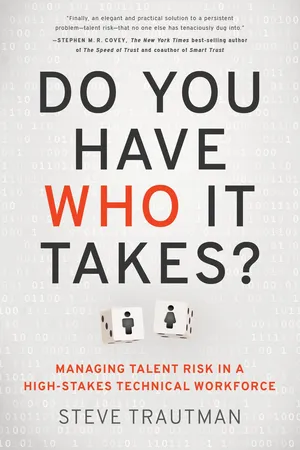
Do You Have Who It Takes?
Managing Talent Risk in a High-Stakes Technical Workforce
- 232 pages
- English
- ePUB (mobile friendly)
- Available on iOS & Android
eBook - ePub
About this book
Information
PART I
____
The Talent Risk Problem and Why Many Fail
CHAPTER 1
_____
Eight Talent Risk Myths
THERE IS SOME IRONY WHEN EXECUTIVES SAY “PEOPLE ARE OUR MOST important asset,” because everyone with a complicated workforce struggles to understand and manage this “most important” asset. Sure, organizations approach the problem with their best HR analytics or hope that a succession plan for the top executives and a little luck will carry them through. But even with all the effort expended, in the end, few can say with justifiable confidence that they will have the workforce they need to execute their business strategy three to thirty-six months from now.
I can’t blame you for feeling confused and frustrated by this problem. How many times in the last thirty to forty years has a magical solution come down the pipeline only to be revealed as a giant “flavor of the month” flop? It often feels easier to assume there is no answer and just plow ahead with a big contingency budget and plenty of aspirin—even though you don’t accept defeat so readily in other areas of business.
“It often feels easier to assume there is no answer and just plow ahead with a big contingency budget and plenty of aspirin—even though you don’t accept defeat so readily in other areas of business.”
I have found that many fail in this space because of eight damaging talent risk myths. Let’s dispel these misconceptions and clear a path for positive action.
TALENT RISK MYTH #1
“People issues” are inherently slippery and can’t be managed with the same hard data that we require from every other part of our businesses.
Current attempts at managing talent risk, including competency models, demographic profiles, job ladders, and formal training, all fall short when it comes to measurably reducing your talent risks. What do you really know if you put a person on a job ladder, inventory their competencies, provide them with a proper performance review, and send them to training on some regular basis? Are you confident they will perform the work required of their role consistent with your expectations? I’m not arguing that there is no value in all this investment. The trouble is that it stops short of answering the fundamental question: Where is the data that proves you will have the technical workforce you need both now and in the future?
Imagine if the legal department decided that all the contracts were “probably fine” or the financials included “mostly accurate” numbers. Imagine if your suppliers said the order “might” be on the truck or your tax advisor said you “probably” won’t go to jail for fraud. Who would settle for so much ambiguity? Yet when we talk about our people, we settle for gut feelings more often than not.
I recently had a lunch conversation with Kevin Oakes, the CEO of i4cp. His organization identifies best practices and next-gen ideas that fuel productivity and bottom-line results. He became quite animated when I raised the topic of managing talent risk. “Lately, talent risk is a notion that many of our member organizations have been strongly embracing,” he said, “and that’s being driven by their board of directors and senior leaders. At the board level, leaders are essentially saying, ‘As we grow as an organization, how do we look at talent risk like we look at financial risk?’”
I will make the case that “people issues” are not an excuse for a lack of objective clarity. The truth is you can obtain hard technical capacity data on every employee at every level of the organization. You can expect to get a report that explains the talent risk profile of any team and how it has changed over the last three months. You can expect a new hire to be up to speed in half the time it currently takes—and measure the success or failure of onboarding. You can expect to know the potential cost of a mistake for people working in critical areas who are not fully prepared to work. You can expect every manager to be able to explain how they’re maximizing their team’s head count to bring full value to the bottom line. And you can expect all this data in an app like Excel with hard numbers—including dollar signs where appropriate. Don’t settle for less.
TALENT RISK MYTH #2
Technically capable people are too complicated and emotional to be “produced” the way a car can be manufactured. I’ve got to let them do what they do their own best way.
Over the last several decades, motivational speakers, consultants, thought leaders, and the like (read: people like me) have convinced us that, as executives, we must improve our “engagement scores” by helping our employees find their collective bliss. The idea is that if you give people enough freedom and opportunity, their unique path will unveil itself and they’ll be fulfilled, happy, and productive. Executives proudly trumpet that they “hire great people and then get out of their way.” Bureaucracy is the devil, and if you cut all the red tape, you’ll finally unleash the true potential of your team. You must give people the freedom to “fail early and fail often” if you want to spark innovation.
While there may have been plenty of great reasons to head toward these ideas in the past, the pendulum has swung too far in this direction. It has allowed business leaders to abdicate responsibility for setting clear expectations by saying stuff like “My people are unique and I would never want to treat them like robots.”
For example, I was on the phone recently with a senior VP for a major hotel chain who listed a broad array of programs that were designed to usher about 1,000 back-office workers from the “old way” of working to the “new way.” She had hired consultants to redesign the organization, had provided formal training to support a new workflow, and had trained all her managers to lead through the change. It all sounded good until she laid out the results of all this effort. They had been working at completing this transformation for three years and she still had substantial pockets of people who refused to make the shift. Too many claimed a lack of role clarity. Bastardized versions of the “new way” were springing up as people tried to cope with the extended period of transition. To add more fuel to the fire, she had just found out that she needed to plan for the acquisition of a major competitor. Still, she felt confident that if they “stayed the course” with the broad guidance they had set up, they would get through to the other side.
The truth is this executive didn’t have a transition problem. She had a production problem. Much like a factory needs to produce high-quality cars, she needed to produce high-quality workers who could do the work the right way. What would happen if, when a car factory changed from one model year to the next, they let some of the workers continue to make last year’s model? What if it was OK for some workers to bolt the steering wheel where the front tire belongs because that seemed best to them? What if we only told the workers what we didn’t like about their output and never bothered to give them the hard data they needed to make the cars right in the first place? This is what was happening for this executive. She knew that plenty of people were doing things the wrong way, but when I asked her to put a stake in the ground and tell me who was right, she demurred. “We need to give people room,” she said.
I realize that the idea of producing people like cars is radical—and may sound a little crazy. Well, what if being clear about constraints and being as exacting as new car specifications made our employees more engaged, happier, and likely to stay in their roles for longer periods of time? What if being clear about the right way to do the work freed them up to be more creative in areas where innovation is welcome, because they aren’t spending endless hours in meetings where no one makes a decision, or cleaning up messes because the standards were never clear in the first place? In a factory, no one would settle for a production line that was still making poor-quality cars after three years. Why settle for less when looking at managing your technical talent? With the right framework and process, technical talent can be developed and replicated much like a production model.
TALENT RISK MYTH #3
Having a succession plan for top executives is enough talent risk management.
As I’ve worked with and studied organizations around the world, succession planning for top executives is clearly the most evolved form of talent risk management that I see. There are many forms of “high potential” lists and regular meetings of senior executives who talk over who could replace them if needed. Rotational programs are set up to provide broad experience with the business, including stints living abroad and lateral moves intended to fill gaps in a resume. Big organizations host events to encourage upcoming leaders to network, build relationships, and settle in for a long and successful career. Senior leaders I meet are often proud of their succession plans and feel confident they have the problem covered—but do they really?
I want to address this myth in two parts: the myth that current succession plans for senior leaders are enough and the myth that succession plans should stop at leadership instead of being developed for all critical employees, including many who aren’t on the leadership track at all.
From what I’ve observed, succession plans for senior leaders work around the actual risk. These plans provide opportunities to build readiness but do little to validate readiness. For example, we’re working with an SVP for a major digital imaging company who would like to retire or at least move to more of an “emeritus” status by the end of the year. His successor has been chosen and “groomed,” but there are still reservations about the successor’s ability to take over. The plan was to “give her another year to prove herself ” but there was no clear measure of readiness. The SVP of HR said, “We’ll just have to see.”
In this book, I’ll show you how we gave the successor a way to prove her readiness with a plan that is measurable and won’t take a year to complete. It doesn’t replace the existing succession planning programs but validates their efficacy in plain language. The truth is that there is no need to “wait and see” if the succession plan is working. We can prove it.
My second point regarding the value of current succession plans is that it is considered acceptable to stop succession planning at some level of senior leadership—usually at the VP or GM level. This means that there are no succession plans for the technical experts and other frontline employees who often pose a greater material risk to the business than their bosses on the twenty-ninth floor. I’ve seen a $50 million revenue stream put at risk because one software architect was hired away by a competitor before he could finish rolling out his product. Succession plans should be in place for all critical roles. In the 2016 i4cp research study on talent risk, one of the top five best practices identified for effectively addressing talent risk was “having succession plans for technical/professional experts.”7 It is a myth that this is too complicated an undertaking. The truth is you can create succession plans for every critical role, including your technical talent, so you can manage your talent risk regardless of job title or level.
TALENT RISK MYTH #4
You think you’ve been clear about what you need in terms of technical/professional talent because you’ve laid out a head count budget and org chart.
It certainly makes sense to start with a head count budget when thinking about talent. As you build out your business plan, you have to figure out how many people it is going to take to get the job done and at what cost. Your plan might include a need for one hundred engineers, ten project managers, fifteen business analysts, twenty quality experts, and so on. You’ll probably need eight managers and a director to lead the charge. Then you can clarify even further and note that some of them should be “experienced” so they’ll cost a little more. You can outsource some of it to a country with lower wages so there might be some savings there. The trouble is that, like boxes on an org chart, head count budget is only a shadow of the data you need to ensure that you have a sufficiently low talent risk profile.
One of the reasons for this is because not all “senior employees” are created equal. No surprise there. But if you are looking at head count as job titles on an org chart, hash marks on a job ladder, or lines in a budget, you’re treating your experts as if that is all they are. Some have common skill sets that are appropriate for “plug and play” roles. However, those that impact your talent risk profile have unique knowledge and skills that make them—and only them—critical to your success. Yes, you can prepare a budget for these folks. But if you don’t know what they really do for you, you don’t understand the risks associated with each one if they transfer, take a redefined job role, or leave. You may find later that the risk was too high. For example, one of our client CIOs needed a top expert repurposed to a pet project of his. He could see from the org chart that the team was fully staffed...
Table of contents
- Cover Page
- Title
- Copyright
- Dedication
- Contents
- INTRODUCTION: THE CHALLENGE AND PROMISE OF MANAGING YOUR TALENT RISK
- PART I: THE TALENT RISK PROBLEM AND WHY MANY FAIL
- PART II: THE TALENT RISK SOLUTION
- PART III: MANAGING TECHNICAL TALENT RISK: CASE STUDIES
Trusted by 375,005 students
Access to over 1.5 million titles for a fair monthly price.
Study more efficiently using our study tools.
Frequently asked questions
Yes, you can cancel anytime from the Subscription tab in your account settings on the Perlego website. Your subscription will stay active until the end of your current billing period. Learn how to cancel your subscription
No, books cannot be downloaded as external files, such as PDFs, for use outside of Perlego. However, you can download books within the Perlego app for offline reading on mobile or tablet. Learn how to download books offline
Perlego offers two plans: Essential and Complete
- Essential is ideal for learners and professionals who enjoy exploring a wide range of subjects. Access the Essential Library with 800,000+ trusted titles and best-sellers across business, personal growth, and the humanities. Includes unlimited reading time and Standard Read Aloud voice.
- Complete: Perfect for advanced learners and researchers needing full, unrestricted access. Unlock 1.5M+ books across hundreds of subjects, including academic and specialized titles. The Complete Plan also includes advanced features like Premium Read Aloud and Research Assistant.
We are an online textbook subscription service, where you can get access to an entire online library for less than the price of a single book per month. With over 1.5 million books across 990+ topics, we’ve got you covered! Learn about our mission
Look out for the read-aloud symbol on your next book to see if you can listen to it. The read-aloud tool reads text aloud for you, highlighting the text as it is being read. You can pause it, speed it up and slow it down. Learn more about Read Aloud
Yes! You can use the Perlego app on both iOS and Android devices to read anytime, anywhere — even offline. Perfect for commutes or when you’re on the go.
Please note we cannot support devices running on iOS 13 and Android 7 or earlier. Learn more about using the app
Please note we cannot support devices running on iOS 13 and Android 7 or earlier. Learn more about using the app
Yes, you can access Do You Have Who It Takes? by Steve Trautman in PDF and/or ePUB format, as well as other popular books in Business & Human Resource Management. We have over 1.5 million books available in our catalogue for you to explore.