![]()
1
PASSION AND PERSEVERANCE (STEP I):
A POSITIVE FEEDBACK LOOP
It doesn’t get easier. You get stronger.
—Anonymous
In the first half of 2001, the Silicon Valley dot-com bust, I would often wake up around 2 a.m. in sweat-soaked sheets sticking to my skin. CustomerSat’s second round of financing, long planned for that January, had refused to come together despite a flurry of meetings as we ran out of cash. Those nights I would get up, shower off the sweat, and try to get back to sleep. When my executive team and I finally grasped that our Series B round was not going to close, we huddled to decide what to do. First, we cut our salaries, then several weeks later those of all our employees, by 10 percent; I cut my own salary and that of my CFO by 50 percent. Debating and agonizing over every individual, we laid off 40 percent of our workforce—40 percent of the company I had spent the last four years of my life building. In our all-hands meeting immediately after, as I explained to our remaining employees that this was the only way we could keep together and stay afloat, my composure collapsed and I broke down sobbing. Our employees stood stunned, sympathetic, and embarrassed.
After many consecutive quarters of profit and growth, our recurring revenues had dropped that first quarter of 2001 by a whopping 20 percent.1 Our first customers to stop paying were themselves dot-com companies, like highflier Webvan, who would file for bankruptcy in July 2001 just sixteen months after their initial public offering (IPO). Later, even Fortune 500 companies discontinued our online survey services or simply stopped paying. To help us get through, one of our Series A investors lent me $300,000—for but not to the company—meaning that I, the CEO and founder, would be personally liable for repaying the loan. The cash would last us ninety days. Later I would pay back the investor—to whom, despite the arrangement, I was deeply grateful—by mortgaging my townhouse in Menlo Park, California.
The next quarter our revenues fell again. To make payroll this time, we factored receivables, a costly maneuver, and cut salaries by an additional 10 percent. I reduced my salary to minimum wage, the legal limit. Our company moved into the second floor of our building and rented out the more attractive ground floor to another start-up. That company quit paying us rent after three months, came in late one weekend night, cleaned out their offices, and vanished without notice. The nightmare would not end.
After those fitful nights and drastic actions of the first half of 2001, we could finally see profitability ahead in the third quarter. Then, on September 11, terrorists viciously attacked US targets including the World Trade Center. Enveloped in smoke, dust, and debris, the twin 110-floor towers crumpled and collapsed. With much of the US northeast communications grid down, just accounting for all our employees took hours of emailing, phone calling, and pleading to know who had heard from whom. Our VP Sales Russ Haswell was marooned in London, unable to get back to the United States; our client invited him to stay at their home. The next day I was finally able to broadcast the message, “All CustomerSat team members are safe.” The US West Coast escaped the full brunt of the horror, but even in Silicon Valley, every company I knew had customers or suppliers who lost employees or family members in the attacks. Our client Akamai Technologies lost its brilliant cofounder Danny Lewin on American Airlines flight 11. Our salespeople were calling insurance and other firms in the World Trade Center; tragically, their phones just rang and rang. After the dot-com bust, September 11 was the final blow for many start-ups.
We broke even in the third quarter, a milestone and quiet relief. A very small profit followed in the fourth. The going stayed tough through all of 2002 and the first half of 2003, during which time we didn’t hire a single new employee. But we made it through. CustomerSat stayed profitable and grew nearly every quarter until the company was acquired in March 2008. Only a fraction of Internet companies survived; even fewer went on to successful exits. Why did CustomerSat do so when others did not?
Unleash Your Inner Company distills four decades of real-world lessons I have learned about entrepreneurship. During that time I have founded, grown, and sold two online software companies; cofounded a third; invested in dozens of privately held companies, several of which have had successful initial public offerings (IPOs—also known as “going public”); started and run consultancies in strategic marketing and entrepreneurship; and mentored thousands of entrepreneurs on six continents. My mission today and for the past ten years is to help aspiring entrepreneurs achieve the freedom, independence, and ability to do what they love through entrepreneurship. This book is part of that mission.
Unleash Your Inner Company offers unique guidance and perspective for anyone who wants to start and grow a business:
•Entrepreneurs are not interchangeable like batteries or light bulbs; the best opportunity for you is unique to you and must be discovered by you.
•You have many more resources than you likely realize to start a company and make it successful.
•Positive feedback loops pervade multiple aspects of your start-up and life; find, nurture, and ride them.
•Psychology is an essential part of strategy.
•Any business, no matter how modest, can be evolved and scaled into a large business, if desired.
This book provides a proven, step-by-step process:
(1)Identify/develop your areas of passion and perseverance
(2)Discover and refine unsatisfied customer needs in those areas
(3)Generate and refine possible solutions to those needs
(4)Inventory all of your resources (your “STARS”) and (4a) Discover additional needs suggested by those resources
(5)Match each need & solution with your resources & passions; assess each fit
(6)Acquire/develop additional resources to strengthen the best fits
(7)Identify your competitors; determine/develop your advantages for each need
(8)Match needs & solutions with your advantages to assess your best fit overall
(9)Build, customer test, and launch your Minimum Viable Solution (MVS)
(10)Scale up the uniquely differentiated business you have created.
This 10-step process, illustrated opposite the inside back cover, in figure 2.4, and by the flowchart of figure 2.5, guides you in finding and creating the best start-up for you, whether in agriculture, AI, apparel, computing, construction, consulting, cosmetology, electronics, entertainment, home furnishings, mobile apps, publishing, telecommunications, transportation, or any other field. It is best not to be wedded to a particular product, service, or technology at the outset; here, we start with customer needs which will determine your product or service and which technologies you apply. By following the steps in this book, you will far raise the likelihood of your and your company’s success.
Why did CustomerSat survive and thrive while others did not? More generally, why do a few companies do so while many others do not? I surely do not believe that we were smarter than other companies’ execs. We absolutely did not have more in the way of resources than other companies had. We did act very quickly to minimize damage to our company. But if I had to narrow it down to just two factors, I would say it was these. First, I believe we cared more deeply about our business than other management teams did: about every customer, about the coolness of our products and technology, about each of our employees, and about each other. Second, we stuck with it longer than other management teams did. As I mentioned, it was another seven years before the company was acquired. Many other teams just gave up before then. Among our team members who went through the dot-com meltdown together, there was very little turnover, very strong employee loyalty, for many years. In my view, it was this combination of passion and perseverance that got us through—the same combination that you can summon for your business.
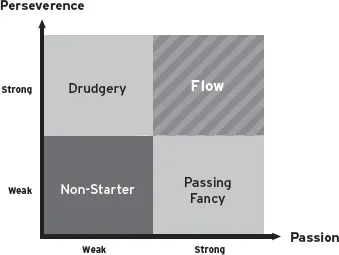
We hear much more today about passion, which sounds easy and fun, than perseverance, which sounds hard. Your passions are what you care most deeply about, have the highest expectations for, have powerful and compelling feelings about, or that give your life meaning. They may include your job, team, company, family, sports, school, hobbies, communities, faith, travel, investing, gaming, gadgets, or virtually any other subject or activity. Perseverance is persistence in purpose, ideas, or tasks in the face of obstacles or discouragement. Passion (an attitude) and persistence (a behavior) usually go together. But you can have one without the other: passion can be fleeting; perseverance can be uninspired. Without passion, perseverance is drudgery; with it, working long hours becomes effortless. Successful founders and teams have both. Various terms have been applied to the combination of passion and perseverance: flourishing, grit, and the term that to me best captures how time flies and organizations click when the two qualities come together—flow.2 Figure 1.1 illustrates perseverance, passion, and flow.
Figure 1.1 Perseverance, passion, and flow.
You and your start-up need passion and perseverance for several reasons. With passion and perseverance, the following are true:
•You are more likely to be first to reach or discover the limits of what is currently possible or convenient in your chosen field. This means you can recognize customer needs before others do. Passion and perseverance thus help you get your new venture off the ground.
•You’re able to break through or find ways around obstacles. Layoffs, salary reductions, factoring receivables, and moving to downsized, more modest offices are hard and humbling actions to take. Passion and perseverance empower you to do whatever it takes for your venture to survive and grow.
•You’re in it for the long haul and don’t plan to quit. Ventures usually take longer than expected to reach their goals; the short term can turn into the long term very quickly. I ended up running CustomerSat for over a decade. Perseverance keeps you going for as long as it takes; passion makes the journey as important to you as the destination.
•You stay motivated. Perseverance and passion are contagious and motivate those around you, including coworkers, customers, suppliers, and partners.
•Your strengths and advantages are amplified.
CREATING POSITIVE FEEDBACK LOOPS
Passion and perseverance reinforce each other. Practicing the piano, designing cir...