![]()
Chapter One
DISCOVER YOUR UNTAPPED COMPETITIVE ADVANTAGE
When you distill business to its basic element, you’re left with one thing: people. No matter what product or service you’re offering—selling cars, renting hotel rooms, manufacturing 3D printers, or providing digital marketing services—it’s the people working in your business that make things happen. They’re the faces that your customers see on a daily basis. In today’s hypercompetitive world, where your competitors can copy even the most innovative new offerings in near real time, it’s your people that are the true secret. Good people clear the field and drive success. They are the one truly unique competitive advantage left for your business to pursue.
Even though payroll is one of the largest expenses for a business, most businesses have woefully inadequate processes to ensure that the right people get hired. People account for around 70 percent of the cost structure of a typical company; think of your people as stacks of cash walking around in shoes. When a manager makes a bad hire, an employee can end up costing the company even more—up to ten times a typical employee’s compensation, by some estimates. Why is the financial damage of a poor hiring decision so high? Bad hires result in the following costs:
- Disruption to your company culture that negatively influences your other employees
- Loss of essential management time and focus because of turnover and recruiting
- Damage to your company’s reputation, which affects your customers and future potential employees
- Wasted wages and training costs
Despite these high stakes, most managers report that nearly 50 percent of the people who report to them fail to meet performance expectations, a problem that often occurs when employees do not understand how their performance is measured.1 With results like these, why even bother with a hiring process or job interviews? Why not just flip a coin, hire all the heads, and save yourself the trouble? If good people are so crucial to the success of your business, isn’t it about time to even those odds by rethinking how you might go about hiring them?
Finding qualified candidates is harder than ever.
“Labor shortages in crucial functional areas such as technology, sales, and marketing are making it all but impossible for companies to meet their talent needs solely with traditional recruiting techniques like job postings—a trend we expect to intensify, given the growth of the worldwide knowledge economy,” says Corey Greendale, a technology venture capitalist and analyst with the firm First Analysis.
“The global economic recovery is shifting power from employers to employees with high-demand skills and increasingly turning labor into a seller’s market.”
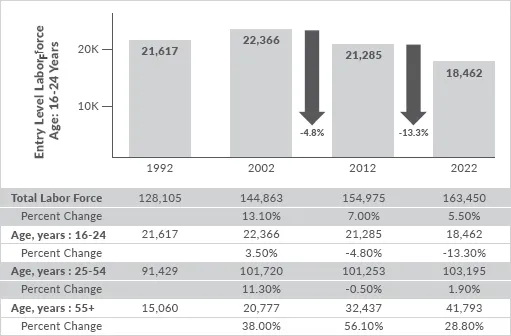
Greendale also notes that demographics are likely to exacerbate this trend, with the Bureau of Labor Statistics projecting that US workers aged sixteen to twenty-four will shrink 13.3 percent in the decade ending 2022.
FIG 1.1–SIZE OF ENTRY LEVEL US LABOR FORCE
(IN THOUSANDS)
“Business leaders worldwide increasingly recognize that talent will be a key competitive consideration over the coming years,” says Greendale. “HR systems and structures are often insufficient to address the looming challenges.”
The 2013 Conference Board CEO Challenge report, a survey of seven hundred CEOs from around the globe, identified human capital as the number one challenge facing them today, above factors such as operational excellence (number two) and customer relationships (number four).
“We view these results as a signal that human capital is shifting from a seat filling function to a core strategic consideration and will increasingly occupy the attention of high-level corporate decision makers,” says Greendale.
Getting the right people in your organization isn’t someone else’s job anymore: It’s time for you to own it.
Case Study: People Make the Difference
David Barr has seen it all when it comes to running retail and restaurant businesses. He has advice for business owners and hiring managers: It’s time to rethink your hiring practices. The factor that sets any business apart from its competitors is its people.
“Hiring the right people is the number one thing we do in retail,” says Barr, whose holding company is called PMTD (People Make the Difference). “Our people are the most crucial factor to our success. It doesn’t matter whether we sell burgers, chicken, or jewelry. We will win every time if we have the best people. They are the representation of our brand and the interface with our customers.”
Given his extensive experience as a business owner and advisor, Barr has been asked to brief White House policymakers, senators, and members of Congress and their staffs on how different policies like the Affordable Care Act (ACA) influence the retail industry. The retail industry employs more than fifteen million people in the US,2 which means about one in ten people in the workforce are employed in the retail sector—more than any other market segment except government and healthcare.
The retail industry is a bellwether for the rest of the economy. This important status means the forces buffeting the labor market, such as the crunch caused by retiring Baby Boomers and pressure to raise the minimum wage, are hitting retail businesses particularly hard. It’s becoming harder and harder to find good people. It’s going to get even harder in coming years.
Barr has done a great deal of hiring over his career, from frontline workers all the way up to the C-suite level. Although the process of interviewing and hiring an hourly employee may be different than bringing on a new CEO, Barr believes that everyone, regardless of their position, wakes up with the same needs and desires.
“Everyone wants to work for something that is bigger than themselves,” says Barr. “They don’t want to just punch a clock. You have to find people who don’t just want a job—they want an opportunity.”
When Barr evaluates candidates at any level of his organization, he first looks to see if the candidate has the kind of intelligence and attitude that fits their culture. The applicants’ technical ability and their match with the job description come second.
“We want to hire for attitude and train for aptitude in the retail business,” he says.
Barr prioritizes candidates who display basic attributes like an ability to make good eye contact and be polite. To illustrate his preferences, Barr shares a legend about Debbie Fields, the eponymous founder of Mrs. Fields Cookies. Fields would interview candidates in a public space, such as the middle of a mall food court. She would ask her candidates to stand up and belt out a hearty rendition of “Happy Birthday.”
“If someone wasn’t willing to be courageous and bold enough to do something self-deprecating like that, they wouldn’t be a fit at a retail counter,” says Barr.
For frontline workers, Barr says it’s essential to cast a wide net when you’re building your applicant pool. This large scope increases your chances at identifying qualified candidates who fit your culture. For executives, Barr says he relies on a more targeted approach where he uses internal referrals or networking sites like LinkedIn to tap potential new hires
Before you go looking to hire someone, it’s important that you first understand exactly what you are hiring that person to do.
“You don’t want to fall in love with someone and then stretch the position beyond what they are capable of,” says Barr.
When managers focus too much on just filling out their open position, they can make bad hires. A bad hire costs an organization enormous amounts of money and time. Worse, a bad hire can also become a cancer inside your organization.
“If you hire a bad manager who treats people poorly and doesn’t make them believe they are achieving great things as a team,” says Barr, “then you won’t attract great people. You will see the results of that in your business.”
Barr says that developing a scalable hiring process that prioritizes identifying the people who are the best fit for your organization is the biggest factor in whether your business will be successful or not.
Taking Control of the Hiring Process
Hiring is the last crucial component of your business where you have total control. Think about it: We live in an era where your business faces increasing pressure and risk, from competition to regulation. You control fewer and fewer of the variables that determine your business’s success. You can’t control interest rates, access to capital markets, constantly shifting consumer behavior, or rapid industry consolidation. You also can’t control the decisions made by the Consumer Financial Protection Bureau, or the fact that Congress passes game-changing laws like the Affordable Care Act. The only thing you have 100 percent control over is the employees you put on your payroll. It’s time to give hiring the same importance that you give every other element in your business, to put it on par with everything from finance and operations to marketing and customer service.
By changing how you hire, you can generate a ripple effect that will give you a sustainable advantage over your competitors.
“Hiring has always been a bit social and riddled with bias,” says William Tincup, the principal at Tincup & Co, and an HR technology analyst and consultant based in Arlington, Texas. “We’re not just talking about biases about whether someone has the kind of educational pedigree you want or about race, gender, or sexual orientation. Our biases include work style and a preference for people who work like you do.”
Such biases create a homogenous workforce, the antithesis to innovation.
“If you have an inclusive and diverse culture,” says Tincup, “you create friction, which creates innovations and leads to greater market share. That’s why if we want to make better hiring decisions, we need to come to grip with those biases. Otherwise, we can inadvertently kill our organizations’ ability to innovate and compete.”
You need to radically rethink how you hire to create an innovative workforce.
Consider what happened at Pillar To Post, a twenty-two-year-old home inspection franchisor with some 536 franchisees spread across forty-eight of the US states and eight Canadian provinces.
“At its core, Pillar To Post is a people business,” says founder and CEO Dan Steward. “We make a difference in people’s lives by helping them buy a home.”
Steward recognized early on that finding and retaining quality inspectors—the company employs about nine hundred of them—was crucial to the success of individual franchises and the company in general.
“The recruitment, selection, and onboarding of good people is the secret sauce in this business,” says Steward. “Good people build relationships with customers and real estate agents. When you can establish trust with them, you get more referrals and less price sensitivity.”
If Pillar To Post was going to keep up its track record of doubling in size every four years, it needed a steady stream of incoming talent. Yet retention rates throughout the company were just 33 percent. Worse, just one in ten people hired lasted long enough to have a positive effect on the business. These lost employees resulted in enormous amounts of wasted time and resources throughout the company. These added costs made franchise owners exceedingly reluctant to bring on new people, and that created operating issues that cascaded down the rest of the business.
“It was becoming a chokehold on our growth,” says Steward. “Poor retention meant we were wasting resources and performing poor quality work that was negatively influencing our brand. If we wanted to build a great company, we needed a clear philosophy on the people side of our business. We realized that there had to be a better way for us to approach hiring.”
An added challenge for Steward was that he needed to get his franchisees on board with introducing a new process for recruiting and selecting home inspectors for their individual businesses. Because there was no universal hiring process the company adhered to, every franchise approached hiring in their own way based on their past experiences. The lack of a focused hiring process led to inconsistency and poor results. Steward admits he even made poor decisions with a few key senior-level hires.
“I have come to recognize that it’s better to leave a position unfilled than to make a bad hire,” he says. “It’s easy to look ba...