![]()
CHAPTER 1
A New Way to Look at Social Media
The LinkedIn Power Formula
I had been on LinkedIn for just over a year and had taught more than 120 classes, with over four thousand participants, when I had a revelation: All of these social media tools are just that—tools! No different than a hammer, which is only as good as the person swinging it. As I started to think about this more and more, I realized that there is one group of people—we will call them the Facebook generation—and then there are the rest of us, the non-Facebook generations. The first group is darned good at social media and grasp it so much more easily than we do, since they grew up with the Internet. They embrace new social technologies in a big hurry, which scares the heck out of many of us in the non-Facebook group. So, instead of deciding we should get on board, we just hope it will go away, thinking that maybe we’ll wake up one day, it will all be gone, and things will be back to “normal.”
I’m not telling you this because I want to bring you down even further but because I have some good news about the person swinging the hammer: you. You already have lots of experience and relationships that you can leverage to make your use of LinkedIn—or any other social media site—much more effective. It is this revelation that helped me come up with the idea of the Power Formula:
Your Unique Experience + Your Unique Relationships + The Tool (in this case, LinkedIn) = The Power
Anyone with business experience and the willingness to learn can realize great benefits from LinkedIn. And getting started with LinkedIn is really not that big of a deal. You can either read a book about how to use LinkedIn, attend a seminar, consult an expert you trust, or check out the Help Center on LinkedIn.com. Learn as much as you can, and then take the time to execute the strategies you have been shown. Make the commitment to get this done, and make it a priority to establish some good LinkedIn habits. No matter how tech-savvy they are, members of the Facebook generation cannot go to a two-hour seminar and come away with the wealth of experience and relationships that comes from years of meetings, handshakes, small talk, weekend retreats, planning sessions, bad proposals, good proposals, winning jobs, losing jobs, etc. But members of the non-Facebook generations, who have the benefit of these experiences and relationships, can be right where they want to be after just one weekend and an ongoing commitment to a LinkedIn strategy. That’s how I started six short years ago. I got on LinkedIn.com, bought a few books, digested the information, and was on my way to creating my own LinkedIn strategy.
Let me address the components of the Power Formula in greater detail so you can better grasp its importance.
Your Unique Experience
Every one of us has unique experiences that we bring to the marketplace. These experiences include our education, jobs, culture, ethnicity, interests, and family, to name a few. Today, with virtual marketing and promotion more important than ever, developing a strong personal brand is essential, and your unique experience is a substantial component of that brand. The longer you have been in the marketplace, the more experiences you have amassed, each of which may come to bear on your next business opportunity.
Your Unique Relationships
Because none of us has walked the same path or encountered the same people, we have each developed a unique set of relationships. These relationships have been the foundation of our friendships, business partnerships, and customer bases. When we need help, whether personally or professionally, we turn to these people—our network. They in turn know that we are just a phone call away when we have the knowledge, experience, or resources to assist them. Our networks are one of our most valuable possessions, and as they continue to expand and diversify, they become even more important to our business and personal lives.
The Tool
The tool could be anything that helps accelerate or “power up” your ability to accomplish your goals, and social media tools certainly fall into this category. Traditionally, when the old tool is “working just fine,” we can be reluctant to embrace the new tool, despite its promise to be better, faster, or perhaps even cheaper. For instance, your old, paper address book (the tool) worked just fine, but you eventually made the switch to a new tool—perhaps Microsoft Outlook. The process of learning to use the new tool may have been challenging at first, but your commitment and persistence were rewarded when you finally figured out how to retrieve all that valuable information with the click of a button.
So, why did I take all this time to share with you my revelation about the Power Formula when I told you I would be teaching you about the capabilities and functions of LinkedIn? Because I want you to understand that the unique experience you have gained coupled with the unique relationships you have carefully developed gives you a tremendous advantage over the person who understands the tool (in this case, LinkedIn) but is only beginning to gain experience and develop professional relationships.
Am I trying to discourage those of you who are younger business professionals or just starting your business careers? No way! This book will help you understand how to begin to develop your personal brand by creating a compelling LinkedIn profile and expand your network in order to accomplish your professional goals.
To help you keep focused on the Power Formula as you read this book, there will be a box at the end of each chapter that reemphasizes key points in terms of your unique experience and unique relationships. These sections will help you define your own power formula for succeeding in whatever you hope to accomplish in your career.
![]()
CHAPTER 2
The Million-Cubicle Project
LinkedIn—Making the Invisible Visible
LinkedIn has described their mission as follows: “Connect the world’s professionals to make them more productive and successful. When you join LinkedIn, you get access to people, jobs, news, updates, and insights that help you be great at what you do.” Let me start by addressing how LinkedIn works from a practical standpoint.
In their current user agreement, LinkedIn states, “You agree that you will not invite people you do not know to join your network.” In earlier versions of the user agreement, they referred to “your network of trusted professionals.” They are obviously encouraging their members to only connect with people they know. This is where LinkedIn differs significantly from social media sites like Facebook, where members attempt to get as many “friends” as they can—and where the word friend is loosely defined. With LinkedIn, the goal is to connect with only those people whom you consider to be trusted professionals. That leads to the first strategic decision you have to make: You need to personally decide whom you will consider a trusted professional based on the strategy you intend to pursue on LinkedIn. Some people choose to focus on expanding their networks even if this means embracing a loose definition of the word trusted. In contrast, I like to say a person is trusted if I can pick up the phone and ask him for a favor or an introduction and be confident that he would say “yes,” or if he is someone for whom I would do the same.
The person you just met in the vegetable aisle at your local grocery store typically does not meet my standard of a trusted professional. He might be a nice person and you may have enjoyed the two minutes of conversation, but that doesn’t qualify him as “trusted” when he runs home and decides to look for you on LinkedIn. The decision about who is “trusted” is a very important starting point with LinkedIn, and there are lots of debates about this matter. However, in my opinion, most LinkedIn users will be best served by following a more conservative definition of trusted. I will provide additional comments and thoughts later on the always-raging debate between quality and quantity as it relates to your network.
Once you have opened a LinkedIn account and begun connecting with your trusted friends and colleagues, your database on LinkedIn begins to grow in ways that are obvious (your number of connections gets larger) but also in ways that are not so obvious. In order to truly comprehend the power of LinkedIn, it is important to understand the part you cannot see—your extended network.
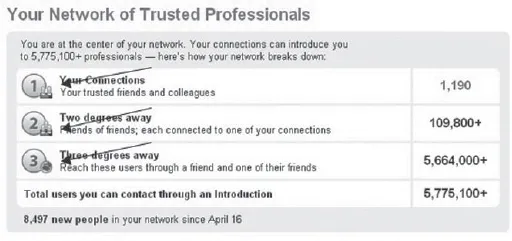
LinkedIn is constantly evolving, and the information shown in Figure 2.1 is no longer available on the LinkedIn site in this form, but I include it here to help you visualize degrees of separation—the Kevin Bacon concept that we are all connected by six degrees of separation or less to virtually everyone in the world. You will notice here that there are three circled numbers: 1, 2, and 3. The first group is one degree away from you; these are your personal connections, labeled with the subheading “Your trusted friends and colleagues.”
Here is an example of how first-degree connections work. Let’s say I have a friend named Joe Smith. Joe and I have been friends for a long time. Maybe we hung out in the rain at our kids’ soccer games or perhaps we are close business associates. I decide that Joe and I should connect on LinkedIn. I search for his name, find him, and extend an invitation to Joe, asking him to join my LinkedIn network. Once Joe accepts my invitation, he does not need to turn around and invite me into his network as well. At that point, we are both connected to each other at the first level.
Your first-degree connections should be people who are already part of your offline network. You have a network that you have built over the course of your lifetime, whether that be high school, college, places you worked, clubs to which you belong, or acquaintances you have made in your day-to-day life. This is what I call your “flat” network. The premise of LinkedIn is that you transform your “flat” list of contacts into a dynamic, multidimensional network. Putting your contacts into LinkedIn will enable you to access additional degrees of depth within your network and will allow your contacts to assist you in new and valuable ways.
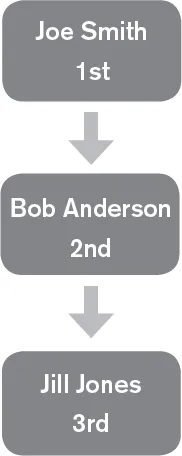
Let’s go back to Joe Smith, my first-degree connection. When I owned an office furniture dealership, if Joe were building a building and needed my products and services, he would probably call me because I know him so well. The fun begins when you think about the second degree. Let’s say Joe Smith knows Bob Anderson. I have never met Bob Anderson. However, let’s say that Bob is going to build a new building in town, and rumor has it that this building will contain over a million cubicles. As a furniture guy, a million-cubicle job in a town the size of mine would be a really big deal. Your equivalent of my million-cubicle sale might be finding the perfect job, meeting a strategic partner who will bring you additional revenue, finding a vendor that will enable you to decrease your production costs, or connecting with a foundation or individual who is interested in assisting your favorite charity.
Let’s say I hear that Bob’s company, The Anderson Company, is going to construct this building, and I put either “Bob Anderson” or “The Anderson Company” into the LinkedIn search engine and find out that my friend Joe Smith is connected to Bob Anderson. I find this out because when I do a search, I see that Bob’s name is next to a “2nd” icon, which means he knows one of my Number 1 connections. I may know some of Joe’s friends—having golfed, gone to parties, or hung out with many of them—but I definitely don’t know all of them. For this example, let’s assume I do not know Bob and do not know how he knows my friend Joe.
So, learning of this connection after searching LinkedIn, I excitedly call Joe and ask him if he would connect me with his friend Bob Anderson, to which he replies, “Are you kidding? Of course. He’s a good friend of mine. We’ve been friends for a long, long time. If my connecting you with Bob can help you, I’d love to do it.” Isn’t that what networks have always done? The added benefit of LinkedIn is that I can now see a list of Joe’s connections and request an introduction to any of his connections I would like to meet.
Stop and think about the power of that. Without LinkedIn, what are the chances I would know that Joe Smith knows Bob Anderson? But with this tool, I can find it out almost immediately and can then use my network to connect with Bob.
Let’s take it one step further, to the third degree, and imagine that Bob Anderson is friends with Jill Jones. Remember that I don’t know Bob or Jill—I only know Joe. However, I now have the ability to search Jill Jones and The Jones Company, only to find out that Jill is building a building with—you guessed it—a million cubicles. I now have a chance to talk with her by contacting Joe, who contacts Bob, who contacts Jill.
Let’s just take a look at the total number of people...