Stop wasting time “fixing” your so-called weaknesses. And start leveraging the powerful ways you’re already innately great!
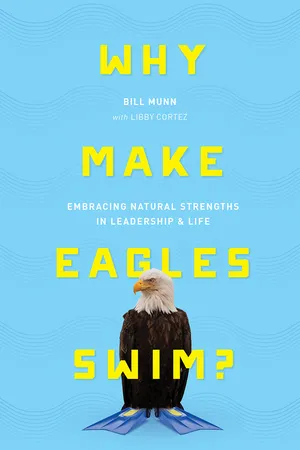
Bill Munn says the key to maximizing performance is already planted within us—and within everyone around us—in the inherent strengths we often ignore while we focus on overcoming so-called weaknesses. This bias toward improving on negatives gets in the way of our ability to fully excel in our work life and at home. We devalue our innate strengths in part because we take our gifts for granted, and in part because we’ve been conditioned to focus on getting good at things we struggle with, at the expense of excelling in the ways we're intrinsically great. An eagle doesn’t need to put energy toward improving his swimming skills because he is a natural master of soaring. Munn explains, with heart and authority, how we can live like the eagle, finding true success as we focus on our gifts—and help those we manage do the same.
Munn provides a selection of specific traits (Creator, Decisive, Developer, among others) and tools to help readers identify unique strengths in themselves and others. He follows with techniques that help us nurture our strongest gifts—our power-alley attributes—and better grow and manage teams according to the group’s overall attribute profile. With his advice, we kick unproductive habits to the curb and experience the power of our personal best. Munn presents tactics for recognizing and appreciating power-alley traits in others as well as insights into the power and pitfalls of each attribute, the best and worst attribute pairings, which attributes fit with specific job functions, and more.
Munn’s book speaks to those seeking to improve their teams and their leadership skills, as well as to any person who wants to leverage his or her own natural gifts while better understanding, engaging, and nurturing others.
?Bill Munn is a management-coaching veteran of twenty-six years and former top-level executive of a Dow 30 and Fortune 500 company.
- 216 pages
- English
- ePUB (mobile friendly)
- Available on iOS & Android
eBook - ePub
About this book
Information
CHAPTER 1
TRUE TO FORM
This above all; to thine own self be true.
—William Shakespeare
—William Shakespeare

If we’d met him as a child, what might you or I have thought of little Al, the dreamer? A thoughtful kid and reluctant talker who used to repeat sentences quietly to himself, Al was viewed by many as somewhat dull. He didn’t conform well to the structure and discipline of primary school; struggled with the quick, automatic responses prized in this educational atmosphere; and never excelled in memorizing words, texts, and names, so his teachers considered him only moderately talented. One particularly harsh Greek teacher predicted that Al would never get anywhere. And he did in fact fail the entrance exam at the polytechnic institute where he aimed to study.
Those dearest to him recognized his differences as well: Al’s sister and closest friend described him as calm, dreamy, and slow— although at once self-assured and determined. And his own parents were so concerned about Al’s slow progress with language that they consulted a doctor on the matter. But his mother was ambitious and encouraged her son’s self-reliance, and his father provided a sound counterbalance of a comforting, supportive environment where Al could develop his own personality.1
So what happened to him? Little Albert Einstein grew up to be a giant in the field of physics. Although he never excelled in basic math, his creative imagination was the natural strength that allowed him to make great scientific leaps, like recognizing that light waves must bend as they pass a planet’s gravitational field. A key to Einstein’s success was the fact that he learned to accept and leverage the unstructured way his mind worked. For example, when he was stumped while working on a complex math problem, he formed the habit of leaving the blackboard and playing his violin. Many times, the solution came to him in the midst of making music.
• • •
And speaking of making things, let’s look at Steve. Exacting Steve, who was such an extreme perfectionist that he lived without furniture because nothing he found was just right. As a boss, he was demanding, a micromanager so goal driven that he showed virtually zero empathy toward people. In his determined pursuit of perfection, Steve was often abrasive toward his team, who grumbled that his goals and deadlines were completely unrealistic.
But, as it turned out, they were not impossible. Steve’s driven perfectionism led his company to widely acclaimed excellence in product design and development. His blindness to others’ feelings kept him ruthlessly focused on priorities. And his exacting deadlines and micromanagement yielded unimaginable feats of innovation.
He was Steve Jobs, founder and former CEO of Apple. And, although he admitted that his strongest attributes were sometimes his shortcomings as a leader, he also lived according to his strengths, leveraging his gifts into a groundbreaking agile empire that reimagined and permanently altered numerous industries, including personal computing, music, film, retailing, and more.2
• • •
But no one personifies innovation like Tom. Young Tom’s teacher described him as mentally confused and muddled; overall, her assessment would probably equate to extreme attention deficit disorder in today’s terms. He was so disruptive in class that he was expelled after a total of three months of schooling. But his expulsion led his mother to homeschool her son, and Tom later credited his success to this education, since she gave him the freedom to exert his creativity.
Throughout his adult life, Tom continued to resist structure and large organizations, and he remained very disorganized. For example, after one of his laboratories burned down, he remembered that he’d failed to purchase fire insurance. But despite his challenges, Tom let his creative side soar.
The result? Thomas Edison became a hugely successful inventor, accumulating over 2,300 patents worldwide. His innovations include the phonograph, the movie camera, and a storage battery for an electric car—in addition to a little gadget known as the electric light bulb.3
SEEDS OF A GIFT
Would you plant an apple seed and try to nurture it into an orange tree? No matter what type of fertilizer you used, no matter how carefully you monitored the water and sun, you would never succeed in making that apple seed bear oranges. (Although you may interfere with its ability to produce great apples.)
Human beings are like this. We each have seeds for different types of fruit in us, but too often, we spend our lives trying to become something we’re not—in part because we take our natural gifts for granted, and in part because we spend so much time focusing on what we’re not good at that we lose sight of the ways we’re great.
Albert Einstein, Steve Jobs, and Thomas Edison were each built to bear a certain type of fruit, and they didn’t waste their energy trying to become something else. Instead, they unapologetically functioned according to their strengths—they focused on augmenting their natural gifts. And they changed the world.
So can you.
Here’s some news that shouldn’t be news at all: You’re better than you think you are. So is your team. So are those people in your family you’re always harping on. But instead of being better, you’re spending too much time trying to be—well, something else. Something you’re not built for. Some version of you that you think you’re supposed to be, rather than the best you for which you’re already designed.
Fortunately, you can change this. You can learn and practice tools that nurture your strongest traits—what we’ll refer to as power-alley attributes. As you do this, you’ll ditch unproductive habits and constructs, and you’ll experience what your personal best really feels like.
THE EAGLE AND THE LOON
My wife and I live on a lake where we’re blessed to see beautiful wildlife in our front yard every day: deer and rabbit, mink and fox, herons, loons, and even bald eagles. What a breathtaking sight those eagles are—so grand in scale, so powerful in the air.
But what if I told you that every day an eagle walked out to the end of our dock, tiptoed hesitantly to the edge, and spent the morning doing nosedives into the calm water, trying to improve his swimming skills? Turns out, as he’s soaring over our northern lakes at a thousand feet of altitude, using his remarkably sharp eyes to scan the water for shallow-swimming fish, he keeps seeing loons working below him, and he’s amazed by their skill in the water.
For those of you less familiar with the North Country, loons are a symbol of pristine northern wilderness lakes, and they are fascinating creatures. You may have heard a recording of their haunting song, which is sure to crop up in any film where a Walden-like lakeside retreat comes into play. But many people don’t know that unlike most flying birds, loons have solid bones that help them dive to depths of up to two hundred feet. The extra weight makes it difficult for them to take off in flight, but it also makes them incredible deep-water fishers.
Impressive, right? That’s what the eagle thinks. So now, he’s spending his days on the end of our dock instead of up in the sky. He’s lamenting his shallow dives, groaning because he doesn’t have those red eyes designed to scan the lake’s darkest depths, and complaining about his underwater lung capacity.
But when the eagle’s out soaring on his fishing rounds, the loon’s entire family is looking up at him, talking about how great it would be if their loon boy could fly that way. He could hunt the whole lake in a few minutes, swoop down suddenly, surprise his prey, and be gone in seconds, avoiding competitors. Clearly, that eagle has a good thing going. Why doesn’t the loon learn those traits?
This whole thing sounds crazy, right? So here’s my question: Why are we all spending so much time trying to make eagles swim? Why don’t we put more energy into the ways we’re naturally built to be great?
Here’s what I think is crazy: sitting down with a top salesperson for a performance review, only to spend eighty percent of that time discussing how she might improve the accuracy of the expense reports she’s forever struggling with. That’s eighty percent of a meeting spent telling an eagle to work on her backstroke—to take time away from flying in favor of fumbling around in the water. Meanwhile, elsewhere in the organization, someone’s asking a gifted administrator to focus on improving his big-picture thinking. And someone else is (yet again) chastising a standout creative on the product-development team for his struggle with follow-through.
What is going on here? Why are we spending so much time focusing on weaknesses and so little time discussing how to leverage those natural strengths? Instead, let’s get the eagle back in the air and the loon focused on deep dives. Encourage the exemplary salesperson to close her computer, get face-to-face with prospects, and exceed her new target; invite the detailed administrator to help with those expense reports; and put the creative person in a brainstorming room to focus on imagining the next great innovation worth selling in the first place. Suddenly, everyone wins. Sales are stellar, expenses are accurate and timely, and the company is working on some breakthrough new products.
That’s the power of attributes.
Now listen: Eagles actually can swim when they need to. But their competence in the water is nothing like their expertise in the air. And loons can fly, but they need up to a quarter mile of water-surface runway to get all that weight in the air. It’s deep diving where they blow the competition away, so that’s what they should (and do) expend the most time and energy on.
We too can fly higher and dive deeper by focusing our energy on the unique talents intrinsic to each of us. These are our natural attributes. Most great success stories start with this approach.
WHAT’S AN ATTRIBUTE? (AND WHAT ISN’T?)
An attribute is an inherent trait. It’s a natural characteristic that can greatly influence your perception of and behavior toward the world around you. Think of your attribute profile as the way you’re wired— the built-in programming of your own internal microchip.
If we were studying physical attributes, we might look at height, eye color, gender, etc.—things that are easy to see. Such traits affect how we perceive and interact with the world around us. For example, a friend of mine had a son who was six feet eleven inches tall and played in the NBA. When he walked through a house, he ducked at each doorway. But when I asked him about it, he wasn’t even aware of ducking. For him, it was instinctive—like blinking. Back when he was first outgrowing doorframes, he’d only had to hit his head on a few before he learned. The height attribute led to a behavior modification.
The nonphysical attributes we’re studying here can (and usually do) lead to the same thing. Although more hidden from view, these attributes are very real qualities of who we are—at least as definitive, and certainly much more important, than the color of our eyes. Let’s look at Lauren, who has a huge dose of empathy (sharing other peoples’ emotions). When talking to someone who has just heard sad news, Lauren’s face looks much like that of the person speaking. Tears come. She can feel the other person’s pain. She cares, and she hurts. This response is real and natural—like blinking. It’s an automatic, reflexive reaction. That’s an attribute.
And therein lies our essential success secret. According to Lewis Schiff, author of Business Brilliant: Surprising Lessons from the Greatest Self-Made Business Icons (New York: HarperBusiness, 2013), “nearly sixty percent of middle-class people strive to get better at tasks they are not good at. Exactly zero percent of high net worth individuals [say] the same.”4 Of course, I’m not implying that net worth is everyone’s ultimate measure of success; your own unique life vision will determine your goals. But since high net worth often reflects a successful career, it’s worth noting that this group claims to invest no time at all in improving on so-called weaknesses.
Just think how often you hear caveats when learning about highly successful people. Walt Disney was a creative visionary whose legendary ideas changed the entertainment industry forever, but he was a completely incompetent artist who couldn’t draw Mickey Mouse if asked.5 John Adams served on more committees in the Continental Congress than any other individual and played a huge role in bringing the United States into existence as a nation, but he was only a mediocre speaker, tended to take offense easily, and was generally regarded as vain.6
The “but” is always there—for every person. Yet for those who become great, it’s a side note to the real story. We don’t remember Walt Disney as a poor artist; we remember him as a visionary genius. We don’t look back on John Adams as a touchy guy; we recognize him as a man who helped mold the US democratic system. We remember great men and women for the strengths that they leveraged, not the weaknesses they improved upon.
What if Walt had spent his life trying to figure out h...
Table of contents
- Cover Page
- Title
- Copyright
- Dedication
- Contents
- INTRODUCTION
- PART I » What’s an Attribute?
- PART II » Identifying Attributes
- PART III » Attributes in Action
- CONCLUSION
- NOTES
- ABOUT THE AUTHORS
Trusted by 375,005 students
Access to over 1.5 million titles for a fair monthly price.
Study more efficiently using our study tools.
Frequently asked questions
Yes, you can cancel anytime from the Subscription tab in your account settings on the Perlego website. Your subscription will stay active until the end of your current billing period. Learn how to cancel your subscription
No, books cannot be downloaded as external files, such as PDFs, for use outside of Perlego. However, you can download books within the Perlego app for offline reading on mobile or tablet. Learn how to download books offline
Perlego offers two plans: Essential and Complete
- Essential is ideal for learners and professionals who enjoy exploring a wide range of subjects. Access the Essential Library with 800,000+ trusted titles and best-sellers across business, personal growth, and the humanities. Includes unlimited reading time and Standard Read Aloud voice.
- Complete: Perfect for advanced learners and researchers needing full, unrestricted access. Unlock 1.5M+ books across hundreds of subjects, including academic and specialized titles. The Complete Plan also includes advanced features like Premium Read Aloud and Research Assistant.
We are an online textbook subscription service, where you can get access to an entire online library for less than the price of a single book per month. With over 1.5 million books across 990+ topics, we’ve got you covered! Learn about our mission
Look out for the read-aloud symbol on your next book to see if you can listen to it. The read-aloud tool reads text aloud for you, highlighting the text as it is being read. You can pause it, speed it up and slow it down. Learn more about Read Aloud
Yes! You can use the Perlego app on both iOS and Android devices to read anytime, anywhere — even offline. Perfect for commutes or when you’re on the go.
Please note we cannot support devices running on iOS 13 and Android 7 or earlier. Learn more about using the app
Please note we cannot support devices running on iOS 13 and Android 7 or earlier. Learn more about using the app
Yes, you can access Why Make Eagles Swim? by Bill Munn in PDF and/or ePUB format, as well as other popular books in Business & Leadership. We have over 1.5 million books available in our catalogue for you to explore.