![]()
CHAPTER 1
DON’T HESITATE, DECIDE
In football, the clock is always ticking.
You’re the coach, and the game is going to be over before you know it. You’ll probably run seventy-five offensive plays, and every single one of them is designed to score a touchdown. If you’re lucky, maybe three or four of them will result in points on the board. But at any moment in the game, you call the play that you think is the best option. If it doesn’t work out the way you wanted, at least you have more information when choosing the next one. And maybe you’re in a better position. No matter what, you don’t waste time hesitating or debating. You keep calling plays and you keep moving down the field.
Art Williams used to tell me this all the time. It has a powerful message behind it that has always stuck with me:
If you want to win, you have to keep moving forward. To keep moving forward, you have to keep making decisions.
Unfortunately, too many people who have the urge to do big things get stuck somewhere along the way. Some people get stuck early. For others it happens later in life. Maybe somebody convinced them they simply aren’t good enough. Maybe nobody was around to show them how to take the next step. Maybe something went wrong and they can’t seem to figure out what to do next. Whatever the reason, they lose their nerve. Doubt takes over and they hesitate, they lose time, they get farther behind. They become convinced that they don’t have what it takes to win or they lose touch with what it is they really want. Eventually, they stop making decisions that will move them forward. They stop trying.
Serial winners don’t let little, limiting things like doubt and uncertainty stand in their way. Lack of advantage doesn’t matter. The people who say, “You can’t” don’t matter. They focus more on what they want than on why they can’t have it, and then they decide to do what it takes to get it. Then they dive in. They see something they want—a promotion or two or three, a new career, their own business—and they make the big decision to go for it. Then they make smaller decisions every day that keep them moving toward the goal, and the next one, and the next one.
![]()
WINNERS CONQUER DOUBT
The three killers of dreams are detail-itis, excuse-itis, and the hesitation virus. And they all stem from doubt.
Not one of us is free of it. We all have moments when we question our ability to succeed and our ability to make good decisions. Why? Because we can’t know the future. Winners feel doubt just as often as anybody else. They understand you have to earn success. They know you can’t be haphazard if you want to make progress toward your most important goals. These truths inevitably lead to questions about their ability to succeed.
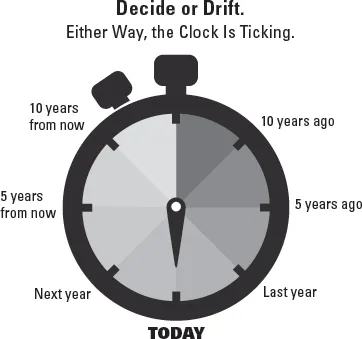
If we aren’t on guard, though, those moments can expand and can kill our spirit. They can demoralize. They can give us a faulty perspective. They can distract us and disrupt our forward momentum. They can waste our precious time. The clock is ticking and you can spend your time worrying and doubting or you can spend your time working.
When you allow doubt to send you into a tailspin of indecision and hesitation, you invite fear. You grind to a halt. All work stops, and with no work, you have no hope.
With fear comes paralysis, and with paralysis comes certain failure.
When winners feel doubt, they manage themselves—as fast as possible—away from the overwhelming tendency to hesitate, overthink, and overanalyze. They combat doubt with decision that drives positive action. They take the next step as quickly as possible, whatever it is. Serial winners know that the worst thing you can do is to let yourself get frustrated, confused, and stalled out. They do allow themselves to question, however, because finding out the facts helps them set a definite path. Galileo said, “All truths are easy to understand once they are discovered; the point is to discover them.” Confusion is the beginning of clarity. This is how progress is made in the world and this is how progress is made in our lives.
The decisions we make and the actions we take are how we create the life we want. You’re either living the life you create for yourself or you’re living the life that other people create for you, with their decisions and actions. It’s your life. You have to live it. It might as well be the one you choose.
Throughout the rest of the chapters, I’ll explore different sources of doubt that can blindside us. But if you feel stalled out or stuck right now, a good first step to getting going again is to take a close look at your fundamental beliefs about what’s possible.
BREAKING OUT OF THE COCOON
When I was growing up, we moved every year because my father was in the military. By the time I was twenty-one we had moved twenty-seven times and I had gone to twelve schools in four different states and three different countries. Eventually, I was old enough to notice that the people in each place we lived had their own views about the world. Sometimes those views were very different. And even as a kid I knew that sometimes those views were just not accurate—because I had already been exposed to quite a bit of the world. Many of the people I met had not. They lived in a cocoon.
Whether you recognize it or not, you probably live in a cocoon, too—or did at some point. We all have.
The cocoon starts with the protected environment in which we grow up. It’s constructed of opinions, values, beliefs, and priorities. We absorb them from our parents and the few adults we encounter in our early formative years. Within this cocoon, we learn what’s right and what’s wrong, who we trust and who we don’t, what’s important and what isn’t, where we belong and where we don’t, and most important, what’s possible and what isn’t. The people in our lives—family, teachers, community—create that cocoon based on what they’ve been told and what they’ve experienced. These attitudes and beliefs are embedded deep in our core as we grow up. Even if we grow up to be very different from our parents or other adults in our community, we’ve been influenced by them in a thousand little ways. We often don’t even realize how much so.
Now, your cocoon might be made up of encouraging beliefs, like “Anything is possible if you want it badly enough” and “You’ve got what it takes to succeed.” But from what I’ve seen and from the people I’ve met, that’s not the case most of the time. I would bet that some of the beliefs that make up your cocoon aren’t doing you any good. They are limiting. They convince you that statements like “I don’t have what it takes” or “Things like that don’t happen to people like me” are true. These are just lies we have internalized, based on myths about what it takes to win in life.
Not sure you believe in the power of the cocoon? Take a look at the research done on how what we believe affects our performance, our ability to learn, and so many other things. Carol Dweck, author of the popular book Mindset: The New Psychology of Success (Random House, 2006) conducted a study with middle-school students with lousy math grades. One group was taught study skills. The other group was taught the same skills and the idea of the “malleability of intelligence”—they were told they had the ability to get better at math because they could grow their intelligence and get smarter.1 Which group do you think got better at math? The second group. Why? Because they believed they could! Somebody shared facts that helped them conquer their doubt. The truth is that the biggest factor in what we achieve is what we believe we’re capable of achieving.
Our cocoons have the power to influence us—unless they are challenged. It doesn’t matter where your cocoon came from or what it looks like. Until you break out of it, you’ll have a hard time fulfilling your potential. People who do break out either are forced out by the things they experience or fight their way out. Let me help you make a dent by breaking down some of the myths that exist in most cocoons.
The Myths of Advantage
Misinformation about what makes some people successful and others not seems unavoidable. Depending on where we came from and the experiences of our family and friends, we’ve been bombarded by any number of myths about winning. They hang out in our subconscious and influence our thought processes and our actions.
Even though everybody’s cocoon is different, most of us share certain myths. The most common and debilitating are the myths of advantage:
- Myth #1: Winners are just born that way.
Let’s talk about the people who start life with every advantage. You know who they are. They’re smarter. They learn faster. They’re naturally talented in sports or music or computer programming. They have sparkling, magnetic personalities. They stand out in a crowd. Studies have shown that people who are better looking, people who are taller, and people who have higher IQs generally make more money. They are born to win, and if you aren’t one of them, you’ll always be runner up.
- Myth #2: Winners come from better families.
People from better families are destined to succeed, of course. They grow up with loving parents who have good jobs. They live in the right neighborhoods. Their parents never criticize or belittle them. Instead, they support them in all their endeavors, encouraging them to study, to compete, to be the best they can be. If they need extra coaching or special equipment to improve, you can bet it’s available.
A better family usually means a better network of well-connected friends and relations who are happy to help these people get ahead. Grandparents, uncles, aunts, cousins, neighbors—everyone wants and expects them to win. People from better families grow up safe and secure, knowing they’ll never have to “go it alone.” They are so well loved, well coached, and well cared for by their family and friends that they have no fear of the future. They are ready to step into their roles as guaranteed winners. The road to the top is paved for them in advance.
- Myth #3: Winners are better educated.
Education creates an unbeatable advantage. All winners are in part successful because they graduate with important degrees, usually from the best schools. They’ve benefited immeasurably from specialized, elite training that most people only dream of. Their superior education allows them to think on a higher level. They know how to strategize. They never run out of ideas. They’re incredible problem-solvers and leaders, with the ability to organize and run huge projects.
Their formal education has allowed them to meet and develop relationships with experts—mentors who took extra time and care to reveal all the secrets of success. When problems arise, this network of experts can be called upon to deliver the right answers right away. As a result, winners almost never get stuck.
So what do you do if you don’t fit the winner’s mold? What if you aren’t naturally gifted? What if you don’t have a great, supportive family and a spectacular, high-dollar education? You should give up! It’s pointless to compete with people who are sure to get the best positions, the best opportunities, and the lion’s share of support. Unlike you, they won’t have to experience the pain of a slow start or the disgrace of failure.
Does this sound like BS? Of course it does! And yet on some level, most of us believe it. We live in a cocoon of belief that our disadvantages will prevent us from creating the life we want.
Here’s the truth:
No advantage is a guarantee that you’ll win. No lack of advantage is a guarantee that you’ll lose.
Bust the Myths
It’s up to each of us to overcome our particular circumstances and to make the most of what we’re given. No myth about winning can stand up to that truth. As Calvin Coolidge once said, “Nothing in this world can take the place of persistence. Talent will not; nothing is more common than unsuccessful people with talent. Genius will not; unrewarded genius is almost a proverb. Education will not; the world is full of educated derelicts. Persistence and determination alone are omnipotent.”
Everybody is born blessed with some level of talent and ability. Those natural advantages can certainly help you win—but only if you’re willing to develop them and put them to work for you.
Unfortunately, that’s often not what happens. Sometimes too much of a good thing can backfire. Being gifted can make life difficult. Gifted athletes may struggle to prove they aren’t “dumb jocks.” Geniuses can struggle to relate to other people. Most of us assume that really beautiful people aren’t very intelligent. (How surprised are you when you find out that a model attends an Ivy League college?) And being naturally good at something can make it difficult to learn the pattern of hard work necessary to reach elite levels.
Likewise, having a supportive family can give you a strong foundation, but parents can only drive you so far in life. Eventually you have to take the wheel. And while privileged children may get lots of attention, many times it’s of the wrong kind. They grow up with unrealistic expectations for themselves, piled on top of unrealistic expectations from those around them. They may be pressured into activities and even careers for which they have no passion or aptitude. That pressure can cause them to burn out early. Growing up in a wealthy family can breed even more challenges: an entitlement attitude, poor financial judgment, an inability to connect fulfillment with contribution to the world. Why do you think Warren Buffett plans to give away 99 percent of his wealth before or after he dies? He has famously said, “I want to give my kids just enough so that they would feel that they could do anything, but not so much that they would feel like doing nothing.” Whatever the circumstances, no family or upbringing is perfect.
An education can be a valuable thing, it’s true. But as someone with a degree from both a four-year college and the school of hard knocks, I can tell you that there are many things you need to learn about how to succeed that the best colleges in the world will never teach you. People don’t get an automatic pass into the boardroom just because they graduated from Harvard. Degrees give you credentials, but they don’t necessaril...