![]()
CHAPTER 1
People-Process Culture
As stated in the Foreword, the people process culture recognizes that all people have intrinsic worth and deserve to be treated with respect. In 1964, Phillips Plastics Corporation paved the way for a high-performance organizational culture that recognized these values. The leadership at Phillips Plastics placed emphasis on character, teamwork, and extraordinarily high ethical standards, from which a unique organizational culture evolved in which business was viewed as a moral enterprise, as well as a profit-generating one.
Bob Cervenka, cofounder of Phillips Plastics Corporation, firmly believed that it was important to make long-term investments in people and the community to yield even greater financial dividends. He stated, “Morality in business, the integrity of having a moral culture, should never be compromised.” He also fervently believed in open communications and sharing the wealth with people through profit sharing and a team-based incentive plan. “The what’s mine is mine, what’s yours is half mine philosophy of many businesses hurts too many people” (Original PPC Handbook, Phillips Plastics Corporation, 1994).
Leslie Lagerstrom, former vice president of marketing of Phillips Plastics Corporation, fondly remembered the impact that Bob had on the organization. “The people-process culture was strongest in the building that Bob resided in—it glowed the brightest there” (L. Lager-strom, personal communication, June 26, 2014).
Organizational Culture
Organizational culture is a collective experience that emerges from the beliefs and social interactions of its members (Schneider, Brief, & Guzzo, 1996; Trice & Beyer, 1993). These interactions contain shared values, mutual understandings, patterns of beliefs, and expectations of behavior that are created over time within an organization (Schein, 2004). Organizational culture also distinguishes members from one organization to another, which provides a sense of identity (Alvesson, 2011).
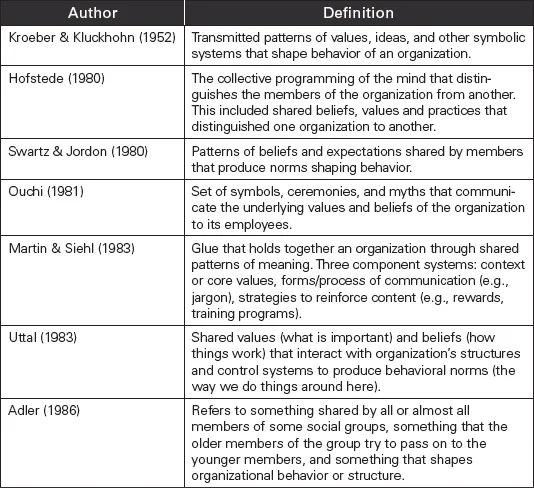
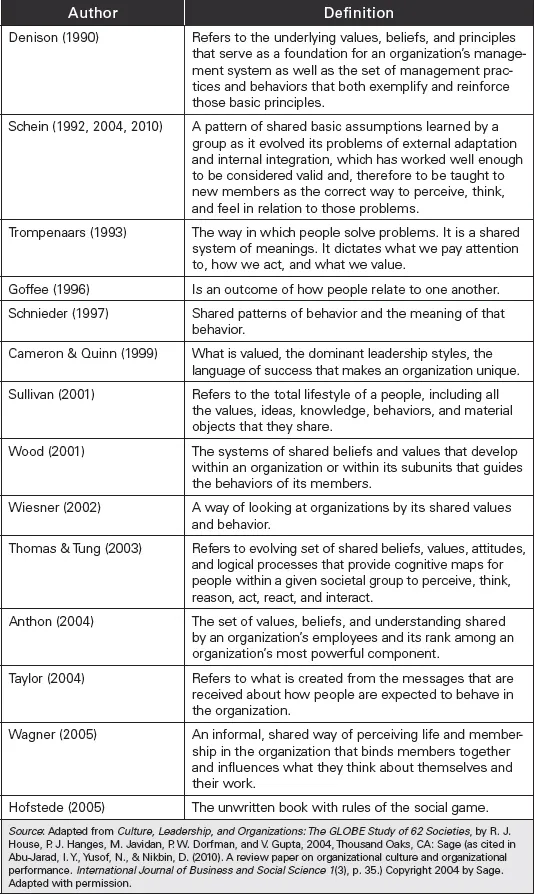
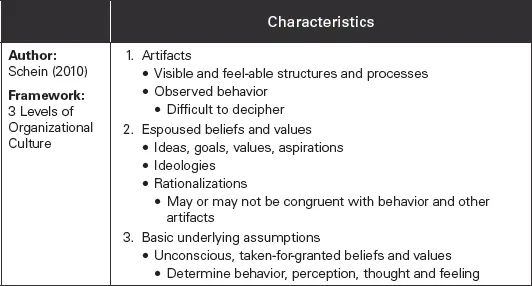
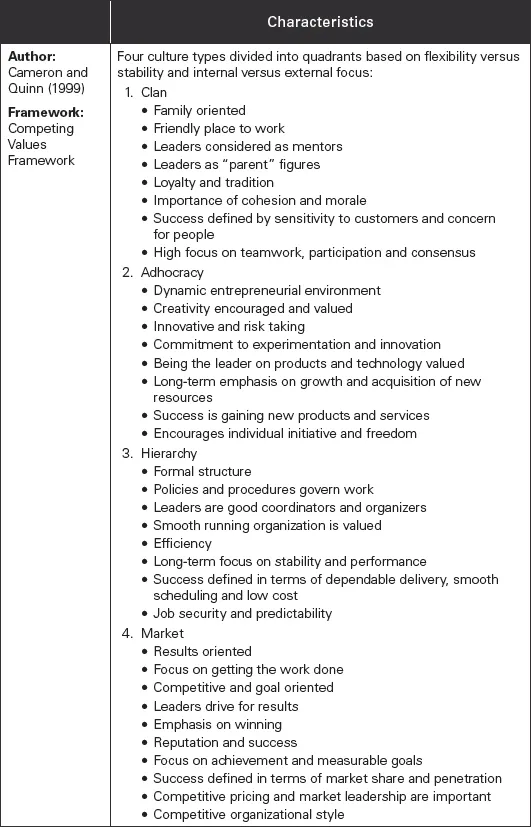
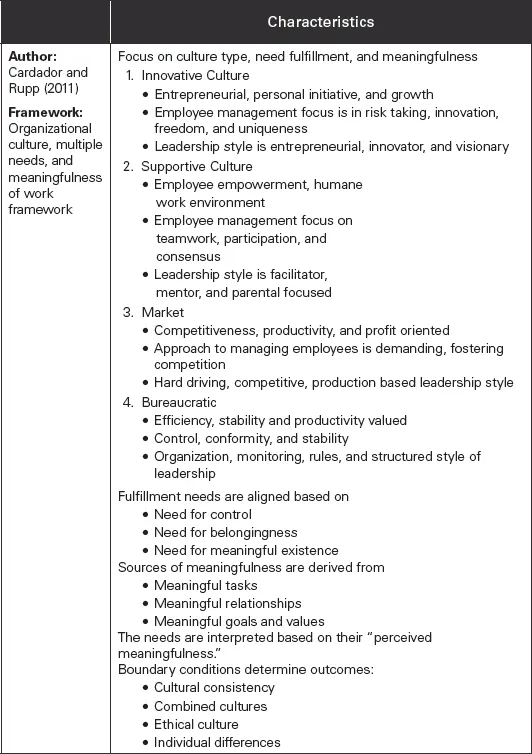
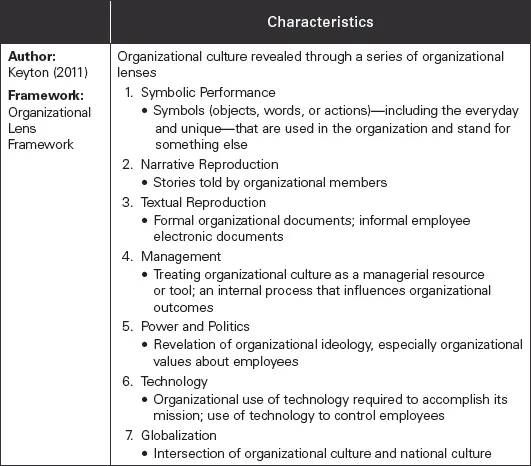
There are many definitions and perspectives about organizational culture (Table 1-1). As a result, organizations can be viewed as dynamic interactive components that possess a sense of energy from the interactions between individuals and the commonality of shared values (Schein, 2010). Organizational culture, when it is rooted in shared values and a deep sense of purpose that people find meaningful, serves as a powerful framework and filter for making decisions at all levels within an organization. Culture provides the unwritten rules of the workplace. These rules are those expected behaviors, such as codes of conduct and dress codes, that provide structure within the organization. Table 1-2 provides an overview of selected frameworks that adhere to these various definitions and their specific components related to organizational culture.
Organizational culture can appear transparent or even nonexistent to those embedded in the culture. This general acceptance of the culture reflects the deeply held beliefs and behavior norms of the group, which is frequently referred to as the organization’s soul or its organizational glue—what holds its disparate pieces (the employees) together. It is often only when someone new joins the group that the unspoken expectations for practices or decision-making processes—how things are done around here—surface (Schein, 2010). Culture manifests in various ways, because employees bring different interests, experiences, responsibilities, and values with them into the organization (Martin, 2005), and culture is interpreted, evaluated, and enacted on the basis of these unique employee views. Practices within the culture that indicate what is perceived as right or wrong, good or bad, define that culture (Gehman & Trevino, 2013).
The importance of organizational culture cannot be overstated. In this book, we advocate a culture built around people—the employees, management, and leadership. This is the human factor of profitability. A people-focused approach has been proven to lead to long-term, lasting success.
The Tenets of the People-Process Culture
Traditionally, the dilemma of the CEO has been described as balancing shareholder demands with achieving longevity or sustainability. Perhaps the dilemma should be rewritten as providing an environment that espouses individual freedom while ensuring that the financial and nonfinancial targets of the organization are met. Individual freedom provides the basis for creativity, innovation, and building trust between individuals. However, the organization and the senior executives need to shift their focus from numbers and results to the establishment of an environment designed to build trust to maintain the appropriate performance measures that are acceptable to its staff (Weymes, 2005). Following these core principles allows people-process organizations to consistently perform at exceptional levels over an extended period of time.
Tom Walter stated his belief that he and his leadership team “are here to grow our people, not use our people. We are here to motivate our people, not manipulate our people. Our people are . . . our most . . . valuable asset” (T. Walter, personal communication, July 15, 2014).
Walter also shared how he creates a sustainable, employee-centered culture. “Our short-term objectives are to create behaviors that embrace our employee-centered culture. . . . Then the people of the organization make it successful. So if you are looking for affordable, sustainable culture, you are looking to align with a people-process culture. . . . The short term is to set that system of behaviors within the staff that will lead to evolving a continuous change model and create sustainability. . . . It is not just about one personality or one dynamic; it is about how the organization grows . . . to create that behavior and embrace that design of employee culture, leading to sustainability. . . . If we hire the right people and provide them the right culture, they will have the antecedents and the behaviors [to achieve high performance]” (T. Walter, personal communication, July 15, 2014).
People-process cultures are founded on the ideas that
- all people are important,
- a strong belief in people shapes the organizational culture,
- happy people working together perform at higher levels, and
- all people benefit as a result.
All People Are Important
The view that all people are important provides the foundation for creating an exciting, supportive, dynamic, and innovative work environment. It also supports substantial growth and profits. To accomplish this, organizational leaders, middle management, and frontline supervisors shift their focus from numbers and results to the organization’s greatest asset—its employees. When the corporate environment is designed to focus on its people, it builds trust, leverages the talent within the organization, and can be used to develop performance measures and business success factors that are reflective of the employee culture.
Lawler (as cited in Weymes, 2005) listed six characteristics that can be used to describe high performance in people-centered organizations, a focus on individual involvement, effective leadership, and moving away from systems and processes as the basis for control:
- Organizational cultures can be the ultimate competitive advantage.
- Involvement can be the most effective source of control.
- All employees add significant value.
- Lateral processes are the key to organizational efficiencies.
- Organizations should be designed around people, products, and customers.
- Efficient leadership that is focused on employees is the key to organizational leadership.
As a result, workers feel that they get to do what they do best— every day, that their opinions count, that their coworkers share their commitment to quality, and that they feel a personal connection between their work and the company’s mission. The impact of the people-process culture is substantial and synergistic (Weymes, 2005).
According to the 2014 Talent Management and Rewards Study by Towers Watson © (2014a), high-performance, people-focused organizations support that focus by
- reinvigorating career management strategies,
- rethinking managers’ roles and equipping them to succeed, and
- reallocating and differentiating rewards to reflect the employee value proposition.
The organizational dilemma can be simply stated: The company must create an environment where trust, creativity, and innovation flourish while meeting the performance criteria specified by the stakeholders. Applying this philosophy to organization design ensures that the nature of the organization is shaped by the people in the organization. The starting point for designing, developing, and transforming an organization lies in the understanding of the people in the organization and the relationships between these individuals and external stakeholders (Weymes, 2005). Developing the vision and goals, creating a focus on the customer, and developing systems and processes are not to be ignored. The starting point lies in the nature of the relationship among people (Sagiv, Schwartz, & Arieli, 2011).
When an organization is focused on the numbers, rules, and regulations, inevitably systems and processes tend to be developed to ensure staff conformance to those rules. Such quantitative targets usually dictate behavior. Rules and regulations control behavior, stifle creativity, and build an environment based on mistrust, self-interest and ambition, deceit, and complaints. But the organization that creates an environment that allows its staff freedom may generate new and innovative approaches, foster harmonious working relationships, and build trust and integrity. Unfortunately, too many organizations use customer service, production efficiencies, and HR (learning) to control financial outcomes (Weymes, 2005).
Therefore, an organization’s performance depends on the nature of the relationships formed by individuals within that organization and its relationships with external stakeholders. Employees are rational individuals who are seeking self-actualization (achieving one’s purpose in life), happiness, and wisdom. However, in a bureaucratic organization, the rules and regulations are designed to control behavior, while the reward structures are designed to buy the individual’s desire for the perfect life. Unfortunately, the workplace can often create a work environment where employees have little commitment to their employer and, therefore, little loyalty (Weymes, 2005). The challenge facing organizations is creating an environment where individuals can fulfill their own dreams as well as those of the organization, while respecting the social norms of society (Weymes, 2005).
The success and synergy of the people process is the foundational belief that all people—employees, customers, suppliers, and community members—are important. This belief in people and the accompanying values of treating each person and task with dignity, trust, and respect serve as both the bedrock foundation for business decisions and a springboard for performance, growth, and innovation. Thus all people benefit in the challenges, risk, and success of the organization, resulting in increased employee engagement and commitment.
“I believe the people process,” said Bob Cervenka, “how people work together—how they treat each other, the values they share—is critical to business success.” Such relationships are based on high levels of trust between individuals that is vested in shared values, beliefs, and attitudes.
A Strong Belief in People Shapes the Organizational Culture
Built to last, people-process cultures see their people as a long-term investment, a source of competitive advantage that must be supported and protected at all times. Conservatively financed—yet hard-hitting and aggressive—companies with people-process cultures view r...