![]()
PART ONE
Managing Your Relationships Through Change
![]()
One
Choose Your Response to Change
JUSTIN WONDERED HOW HE would break the news to his wife and kids. He was still trying to digest it himself. After twenty-two years at Carson-Co, it was over. Just like that. He was called to a meeting and told his services were no longer needed.
A corporate exec named Ken was in the front of the room trying to explain it to Justin and the others. Something about market consolidation and the need to reduce expenses and duplicate services. It was hard to focus. Justin’s mind raced. He hadn’t seen this coming.
Oh, he knew changes were taking place in his industry. Competitors had been quicker to pick up on newer technologies than Carson-Co had. Carson-Co’s products and services had fallen behind as a result.
But Justin had felt secure when the notice came that the company was being acquired. His division had been profitable. His department had been immune from the periodic layoffs—until now.
Justin blinked and tried to refocus. Ken was saying something about the severance package and going on about outplacement and extended benefits. Anger cracked through Justin like lightning.
It’s not fair! Twenty-two years, and for what? He got up and walked quickly to the door. I don’t need this!
Justin brushed past the Carson-Co HR rep and went straight to his office. He packed hastily. Thirty minutes later he was gone.
The following days passed in a blur. Justin refused outplacement, where career counselors could help him prepare a resume and look for a new job. Instead, he spent time talking with others who had been let go. Many were angry like him. The more they talked, the angrier they got.
A few, like his friend and colleague Brandon, were philosophical. They saw this as a chance for a fresh start. Justin thought they were naïve. Getting fired for no good reason was not his idea of a fresh start.
Justin eventually began looking for a new job on his own. He didn’t expect any trouble. After all, his record was strong and his skills were up-to-date. Or so he thought.
Justin had kept up with his technical training at Carson-Co, but he hadn’t bothered to take any of the soft-skills courses they offered. He was always too busy for something like that. Why waste my time? he thought.
As a result, Justin’s technical skills were up-to-date, but his people skills lagged. His old-school mentality of “command and control” was out of synch with a business world that was increasingly relying on teamwork and collaboration.
When Justin interviewed, he made little effort to mask his attitude toward Carson-Co. They were foolish for letting him and the others go. They rid the company of too much experience. They were relying on kids and would pay a price for that down the line.
Justin thought his analysis demonstrated his experience and business savvy. But interviewers believed he had a negative attitude they did not want to bring into their company.
Justin did not get many second interviews and he received no offers. He was determined to never let a company get the best of him again. They didn’t. No company wanted a piece of Justin at all.
It’s a tough economy, he thought.
Time went by and nothing happened. Justin went on fewer interviews. He spent more time in his home office or tried to stay busy doing projects around the house. After a while it was hard to find enough to do.
The idleness began to gnaw at him. He began to worry. He had his kids’ college tuition coming up and a mortgage to pay. His severance package was time limited. He hated to dip into savings, but it was beginning to look like he might have to.
Unwittingly, Justin began taking his frustrations out on his wife, Donna, and his kids. His temper was short. His sense of humor, gone. One day, after another major blowup over a minor violation, his youngest son ran from the room.
“I want my old dad back!” he cried, slamming the door behind him.
The sound of the slamming door hung in the air. A lone clock ticked in the corner. Justin stared at the closed door for a long time. Then he rubbed his eyes and wearily rested his head in his hands.
Where do I go from here?
DIG A LITTLE DEEPER:
You Don’t Always Get to Choose Change, but You Always Get to Choose Your Response
Like Justin’s, many people’s initial reactions to change are predictable. I can’t believe this is happening. How can they do this? It’s not fair. I’m going to fight it.
These reactions are understandable. Our safe and predictable world has disappeared. Our routines are disrupted. We feel threatened, angry, and afraid.
Out of our feelings, we may begin acting against our own best interests.
When this happens, the critical question to ask is—
Is my reaction to change getting me the results I want?1
If so, great. Keep it up. But if you find yourself in a place you’d rather not be (like Justin), perhaps it’s time to make a change.
THE ROADMAP:
A Simple Tool to Help You Change
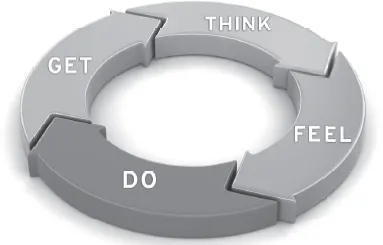
The Roadmap is a tool to help you change at work and in life. Like all maps, it helps you understand how you got to where you are and, more importantly, how to get to where you want to go next. We will refer to the Roadmap frequently as a tool for helping you adapt to and advance through change throughout the rest of this book.
The Roadmap may help you understand why you do what you do, and it can help you change what you do to get better results. You read the Roadmap like a clock, starting at twelve o’clock, then moving clockwise.
The journey to results goes like this—
•Thinking triggers feelings.
•Feelings fuel behavior.
•Behavior determines results.
It’s a circular process, therefore:
The road to better results always begins with better thinking.
For example, let’s look at Justin’s Roadmap:
•Thinking: Carson-Co was wrong to let me go; this is unfair; I got a raw deal
•Feelings: Anger and betrayal
•Behavior: Refusing outplacement services; being negative in interviews; taking it out emotionally on my family
•Results: No job offers; frayed family relationships; a creeping sense of desperation
How might Justin change his thinking to get different results? A few possible answers come to mind. What if Justin adjusted his Roadmap to something like this?
•Thinking: Change is my opportunity to try something new; yes, this is hard, but I have gotten through tough changes before and I can do it again
•Feelings: A sense of hope and determination
•Behavior: Putting all my energy into finding a new job versus lamenting the one I lost
•Results: Discovering new opportunities
What other kinds of thoughts might he choose that could lead to better results? Perhaps you can write your answers down.
Change in Real Life: Using the Roadmap to Change Results
One time, when my teenage son did something that really set me off—I don’t even remember now what it was—I was ready to go upstairs and tell him what I thought he needed to know in no uncertain terms. Then, my wife, Peggy, intervened.
“What are you going to say to him?” she asked.
“I’m going to tell him what he did wrong and what he needs to know!” I barked.
Peggy asked, “If you go up there and say what you want to say, as angry as you are now, what will he hear? What will he think?”
I paused and took a deep breath.
“He’ll hear and think that D...