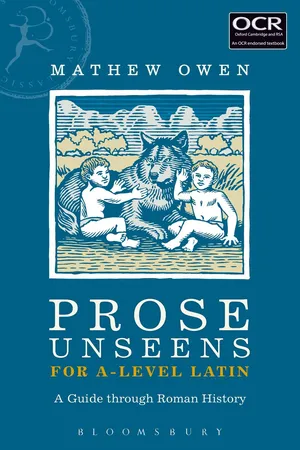
This volume is designed to accompany the OCR A-Level specification in Latin (first teaching September 2016), with practice unseen passages from Livy, the set prose for Paper 1, together with passages from a selection of other writers to support Paper 2, for which no author is set. A bank of 80 passages aims to take Sixth Form students from the level of heavily adapted post-GCSE ('AS'-equivalent) passages and develop their knowledge and skills to reach A-Level standard. But this is not just a book of unseen passages: there is a chronological progression through the unseens in order to give the reader a sense of the narrative of Roman history, exploring key events through the words of original texts. Every passage begins with an introduction, outlining the basic content of the passage, followed by a 'lead-in' sentence, paraphrasing the few lines before the passage begins. Part 1 passages are straight translation exercises on the model of the A-Level Paper 1. They also feature, however, a 'Discendum' box, highlighting a facet of Latin prose with which students may not be familiar, or extension questions on grammar and style. Part 2 passages are accompanied by questions on comprehension, translation and grammar, replicating the demands of Paper 2 in full. An extensive word list is provided in the form of checklists which build the reader's knowledge of the most commonly occurring words and phrases in Latin prose. The passages are punctuated with discussions of Roman history during the periods covered in the passages, and a comprehensive introduction includes portraits of the authors featured in the book, as well as grammatical reminders to help readers deal with both the trickier elements of unseen prose and with A-Level grammatical analysis questions.
- 352 pages
- English
- ePUB (mobile friendly)
- Available on iOS & Android
eBook - ePub
About this book
Information
Part One
Unseen Translation Exercises (Livy)
In the Beginning
(Passages I.1–I.12)
Foundation
All peoples need a foundation story. Across the Adriatic Sea, the Athenians were claiming that their ancestors were born from the very ground of Attica, Mother Earth impregnated by spilt divine seed. Further still to the rising sun, the people of Israel told of Adam and Abraham and Isaac and their one God. Few stories, however, are as memorable or as problematic as the one the Romans told of themselves.
Before the name of Rome was breathed, while her seven hills were still covered by thickets and herds, the armies of Greece set sail against the great city of Troy. For ten years war raged outside Troy’s mighty walls furiously and ineffectually, until at last the trickery of the Greek Ulysses succeeded in smuggling an advanced party of his countrymen into the city, hidden in the belly of the Wooden Horse. These men opened the gates to the flood of Greek warriors and before long Troy was ablaze, its king, soldiers and citizens strewn lifeless through its smouldering streets.
But not all the Trojans were lost. A prince named Aeneas, son of the goddess Venus, his elderly father on his shoulders, his young son at his side and a band of loyal comrades behind him, escaped and set sail westwards to find a new homeland, a new Troy, promised to him by Jupiter and the Fates. After travails to rival Ulysses’ own, Aeneas at last reached the land of the setting sun, Hesperia, known to later generations as Italy, and after defeating those natives unwilling to accept a horde of immigrants claiming their ancestral lands as a divinely-ordained entitlement, he married a local princess and founded the city of Lavinium. Succeeding him, his son, Ascanius, moved the seat of the Trojans’ power to a new city, Alba Longa, where his descendants ruled from generation to generation – no longer Trojans, but Italians.
Many centuries after Aeneas and Ascanius, a prince of their bloodline called Amulius tried to steal the throne from his elder brother, driving him into exile and throwing his niece into prison so that no rival of his brother’s blood could avenge his usurpation. But the gods had other plans (Passage I.1). Despite her confinement, the young princess fell pregnant – some even said Mars, the god of war, was the father. When twins, Romulus and Remus, were born to her, the enraged Amulius ordered their death by exposure, a sentence of death commuted by the divine providence which destined these babes for great things. The boys’ cradle floated to safety in the Tiber’s flood plains, where a she-wolf, who had come down from the hills to drink, found them. Somehow sensing the destiny engendered in these helpless infants, the wolf did not attack, but instead offered her teats to the hungry boys. Found soon after by a startled shepherd, and raised as hardy country lads, the brothers did not take long to bring vengeance on their uncle.
They resolved, moreover, to found a new city and each chose a site: from the Aventine Hill Remus saw six vultures; then, from the Palatine, his brother saw twelve. Each thought the bir...
Table of contents
- Other Latin Language Learning titles available from Bloomsbury
- Dedication
- Title
- Contents
- Preface
- Abbreviations
- Introduction to Latin Prose Writers
- Grammatical Reminders
- Rome’s Story: An Introduction to the Historical Overviews
- Part I Unseen Translation Exercises (Livy)
- Part II Unseen Comprehension Exercises (Other Prose Writers)
- Vocabulary Checklists
- Index Locorum
- Copyright
Trusted by 375,005 students
Access to over 1.5 million titles for a fair monthly price.
Study more efficiently using our study tools.
Frequently asked questions
Yes, you can cancel anytime from the Subscription tab in your account settings on the Perlego website. Your subscription will stay active until the end of your current billing period. Learn how to cancel your subscription
No, books cannot be downloaded as external files, such as PDFs, for use outside of Perlego. However, you can download books within the Perlego app for offline reading on mobile or tablet. Learn how to download books offline
Perlego offers two plans: Essential and Complete
- Essential is ideal for learners and professionals who enjoy exploring a wide range of subjects. Access the Essential Library with 800,000+ trusted titles and best-sellers across business, personal growth, and the humanities. Includes unlimited reading time and Standard Read Aloud voice.
- Complete: Perfect for advanced learners and researchers needing full, unrestricted access. Unlock 1.5M+ books across hundreds of subjects, including academic and specialized titles. The Complete Plan also includes advanced features like Premium Read Aloud and Research Assistant.
We are an online textbook subscription service, where you can get access to an entire online library for less than the price of a single book per month. With over 1.5 million books across 990+ topics, we’ve got you covered! Learn about our mission
Look out for the read-aloud symbol on your next book to see if you can listen to it. The read-aloud tool reads text aloud for you, highlighting the text as it is being read. You can pause it, speed it up and slow it down. Learn more about Read Aloud
Yes! You can use the Perlego app on both iOS and Android devices to read anytime, anywhere — even offline. Perfect for commutes or when you’re on the go.
Please note we cannot support devices running on iOS 13 and Android 7 or earlier. Learn more about using the app
Please note we cannot support devices running on iOS 13 and Android 7 or earlier. Learn more about using the app
Yes, you can access Prose Unseens for A-Level Latin by Mathew Owen in PDF and/or ePUB format, as well as other popular books in History & Ancient Languages. We have over 1.5 million books available in our catalogue for you to explore.