This textbook is endorsed by OCR and supports the specification for GCSE Classical Civilisation (first teaching September 2017). It covers the Thematic Study Component 11 and all three Literature and Culture options (Components 21–23):
Thematic Study: Myth and Religion by Ben Greenley
Literature and Culture 1: The Homeric World by Dan Menashe
Literature and Culture 2: Roman City Life by James Renshaw
Literature and Culture 3: War and Warfare by James Renshaw
Why does Greek and Roman mythology remain so popular today? Why is the hero Odysseus such an interesting character? What was it like to watch a gladiatorial fight? Why was the Roman army so successful?
This book guides GCSE students to a greater understanding of such issues. The opening chapter examines the lives of women in Greece and Rome, and also focuses on women in myth and legend. The following three chapters invite readers to explore the culture of the Mycenaeans, city life in the Roman world, and ancient Greek and Roman warfare, focusing both on aspects of ancient society and on related literature.
The ideal preparation for the final examinations, all content is presented by experts and experienced teachers in a clear and accessible narrative. Ancient literary and visual sources are described and analysed, with supporting images and examples of non-prescribed sources. Helpful student features include study questions, activities, further reading, and boxes focusing in on key people, events and terms. Practice questions and exam guidance prepare students for assessment.
A Companion Website is available at www.bloomsbury.com/class-civ-gcse.
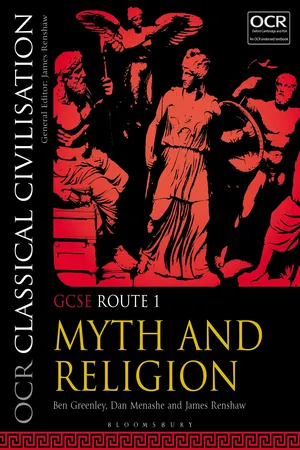
eBook - ePub
OCR Classical Civilisation GCSE Route 1
Myth and Religion
- 480 pages
- English
- ePUB (mobile friendly)
- Available on iOS & Android
eBook - ePub
About this book
Information
PART 1
THEMATIC STUDY: MYTH AND RELIGION
Introduction to Myth and Religion
Half of your GCSE in Classical Civilisation involves a Thematic Study. This component provides the opportunity to study both Greece and Rome, looking at literature and visual/material culture. You will also be expected to draw informed comparisons between Roman and Greek ideas, including the characteristics of the different societies, and the impact of the different cultural contexts on the theme studied.
OCR offers the choice between two options:
| Myth and Religion | J199/11 |
| Women in the Ancient World | J199/12 |
This textbook includes the content for the option Myth and Religion.
EXAM OVERVIEW J199/11
Your assessment for the Thematic Study option will be:
50% of the GCSE 1 hr 30 mins 90 marks
58 marks will test AO1: demonstrate knowledge and understanding of:
•literature and visual/material culture from the classical world
•how sources reflect their cultural contexts, and
•possible interpretations of sources by different audiences and individuals.
32 marks will test AO2: analyse, interpret and evaluate literature and visual/material culture from the classical world, using evidence and producing coherent and reasoned arguments.
The Thematic paper is divided into three sections:
| Section A | Greece | 30 marks |
| Section B | Rome | 30 marks |
| Section C | Greece and Rome | 30 marks |
In Section C you will be expected to draw comparisons between the two cultures.
Myth and religion have always been areas of study popular with learners, and so this exploration of religion and mythology in the ancient Greek and Roman world will surely prove to be engaging and appealing. ‘Rome’ here is primarily taken to mean the city of Rome, although reference may be made to other towns and cities which betray typical ‘Roman’ characteristics, e.g. Pompeii.
Many learners come to Classical Civilisation with a love of the mythology of the ancient world, and so this forms a central part of this thematic component. Learners will study myths regarding the role of the gods and heroes in the founding of Athens and Rome and the importance of Heracles/Hercules to both the Greek and Roman world. These are well-known stories that learners will enjoy engaging with and studying in increased depth. Myth as a symbol of power will also be explored, as will ever popular myths about the underworld.
Learners will also look at the role of religion in the everyday lives of ancient Greeks and Romans. The study of temples, sacrifice, festivals, death and beliefs in the afterlife will give a broad overview of religion in the ancient world, and provides opportunity for the study of a wide variety material remains, including awe-inspiring temples and art works.
1.1 The Gods
TOPIC OVERVIEW
Greek and Roman gods, their responsibilities and symbols and how they are typically represented in ancient Greek and Roman art.
Greece
•Zeus, Hera, Demeter, Poseidon, Hephaistos, Apollo, Artemis, Athena, Aphrodite, Ares, Dionysos, Hestia, Hermes, Hades
Rome
•Jupiter, Neptune, Vulcan, Mercury, Mars, Pluto, Apollo, Juno, Venus, Minerva, Diana, Bacchus, Vesta and Ceres
The prescribed source for this topic is:
•Homeric Hymn to Demeter, 1–104, 301–474
Don’t forget that you will be given credit in the exam if you study extra sources and make relevant use of them in your answers.
pantheon the term given to the gods when we speak of them collectively, not to be confused with the Pantheon in Rome, which was a temple built by the Romans and dedicated to all the gods (see also p. 63)
iconography the symbols attached to a particular character when represented in an image
This topic will examine the pantheon of gods, focusing on the twelve Olympian gods, as well as Dionysus*/Bacchus and Hades/Pluto. The topic will explain what unique skills each of them had, and how the Greeks and Romans typically represented them in their art and literature. This can be referred to as the iconography of the gods.
For the comparative element of the topic you will be expected to compare and contrast the Greek and Roman gods and why certain gods would appeal to each civilisation.
INTRODUCTION TO GREEK AND ROMAN RELIGION
To the modern reader the relationship between the Greeks and Romans and their gods may seem a strange one. There are several key features to understand:
•hiera and religio
•polytheism
•anthropomorphism
•epithets
polytheism the belief in many gods
anthropomorphism giving human form or attributes to something that is otherwise not human
epithet an adjectival word or phrase regularly added to a name to den...
Table of contents
- Cover
- Half Title
- Also Available from Bloomsbury
- Title Page
- Copyright
- Contents
- Introduction
- How to Use this Book
- PART 1 THEMATIC STUDY: MYTH AND RELIGION
- Introduction to Myth and Religion
- 1.1 The Gods
- 1.2 The Universal Hero: Heracles/Hercules
- 1.3 Religion and the City: Temples
- 1.4 Myth and the City: Foundation Stories
- 1.5 Festivals
- 1.6 Myth and Symbols of Power
- 1.7 Death and Burial
- 1.8 Journeying to the Underworld
- What to Expect in the Exam for Myth and Religion
- PART 2 LITERATURE AND CULTURE
- Introduction to the Literature and Culture Options
- LITERATURE AND CULTURE 1 THE HOMERIC WORLD
- Introduction to the Homeric World
- CULTURE
- 2.1 Key Sites
- 2.2 Life in the Mycenaean Age
- 2.3 Decorative Arts
- 2.4 Tombs, Graves and Burial
- LITERATURE
- 2.5 Literary Techniques and Composition
- 2.6 Themes
- 2.7 The Character of Odysseus
- 2.8 The Portrayal of Key Characters
- What to Expect in the Exam for the Homeric World
- LITERATURE AND CULTURE 2 ROMAN CITY LIFE
- Introduction to Roman City Life
- CULTURE
- 3.1 Roman Housing
- 3.2 The Roman Home and Family
- 3.3 Roman Society
- 3.4 Leisure and Entertainment
- LITERATURE
- 3.5 Satire and Fiction
- 3.6 Pliny and His Letters
- 3.7 Experiencing Roman City Life
- 3.8 Relationships and Roman Society
- What to Expect in the Exam for Roman City Life
- LITERATURE AND CULTURE 3 WAR AND WARFARE
- Introduction to War and Warfare
- CULTURE
- 4.1 Sparta at War in the 5th Century
- 4.2 Athens at War in the 5th Century
- 4.3 The Roman Military in the Imperial Period
- 4.4 The Romans at War
- LITERATURE
- 4.5 Homer
- 4.6 Tyrtaeus
- 4.7 Horace
- 4.8 Virgil
- What to Expect in the Exam for War and Warfare
- Glossary
- Sources of Quotations
- Sources of illustrations
- Index
Trusted by 375,005 students
Access to over 1.5 million titles for a fair monthly price.
Study more efficiently using our study tools.
Frequently asked questions
Yes, you can cancel anytime from the Subscription tab in your account settings on the Perlego website. Your subscription will stay active until the end of your current billing period. Learn how to cancel your subscription
No, books cannot be downloaded as external files, such as PDFs, for use outside of Perlego. However, you can download books within the Perlego app for offline reading on mobile or tablet. Learn how to download books offline
Perlego offers two plans: Essential and Complete
- Essential is ideal for learners and professionals who enjoy exploring a wide range of subjects. Access the Essential Library with 800,000+ trusted titles and best-sellers across business, personal growth, and the humanities. Includes unlimited reading time and Standard Read Aloud voice.
- Complete: Perfect for advanced learners and researchers needing full, unrestricted access. Unlock 1.5M+ books across hundreds of subjects, including academic and specialized titles. The Complete Plan also includes advanced features like Premium Read Aloud and Research Assistant.
We are an online textbook subscription service, where you can get access to an entire online library for less than the price of a single book per month. With over 1.5 million books across 990+ topics, we’ve got you covered! Learn about our mission
Look out for the read-aloud symbol on your next book to see if you can listen to it. The read-aloud tool reads text aloud for you, highlighting the text as it is being read. You can pause it, speed it up and slow it down. Learn more about Read Aloud
Yes! You can use the Perlego app on both iOS and Android devices to read anytime, anywhere — even offline. Perfect for commutes or when you’re on the go.
Please note we cannot support devices running on iOS 13 and Android 7 or earlier. Learn more about using the app
Please note we cannot support devices running on iOS 13 and Android 7 or earlier. Learn more about using the app
Yes, you can access OCR Classical Civilisation GCSE Route 1 by Ben Greenley,Dan Menashe,James Renshaw in PDF and/or ePUB format, as well as other popular books in Art & Histoire de l'art antique. We have over 1.5 million books available in our catalogue for you to explore.