While many other areas of design have commercial aspects, the success of a piece of packaging design is inextricably linked with its ability to sell a product. Packaging the Brand discusses the implications of this commercial function for a designer. It explores methods of visually communicating the value of a product to its target audience and examines the entire lifespan of a piece of packaging: from its manufacture and construction, to its display in various retail environments, to its eventual disposal and the associated environmental concerns.
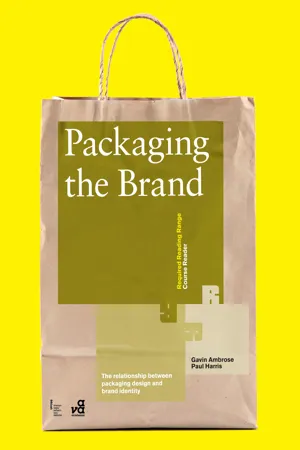
- 208 pages
- English
- ePUB (mobile friendly)
- Available on iOS & Android
eBook - ePub
Packaging the Brand
About this book
Information

The ‘packaged’ brand
Physical products require packaging to protect them from damage and to present both the product and its brand attractively to a target group of consumers. Packaging provides a surface upon which to communicate information about the product and the brand, and as such, it is an essential element of product branding. Through the use of text, images and other communication devices, packaging can articulate the attributes and benefits of a product to consumers. Packaging also works to convey the brand characteristics that will position it within the minds of consumers and that will ultimately differentiate it from its competitors.
Packaging is often the first point of contact that a consumer has with a brand, so it is hugely important that it initially draws their attention and also quickly conveys the messages that both present and support the brand. Communicating a brand message extends beyond the information and visual content of packaging. The physical materials used for packaging products also importantly contribute to the overall brand statement projected. A brand cannot be positioned as a high quality or luxury product if its packaging is fragile and low quality. There has to be a direct correlation between the packaging’s physical attributes and the messages that the brand seeks to project.
This chapter will explore some general concepts about packaging and branding, and look at the dynamic relationship between them.

‘You have two goblets before you. One is of solid gold, wrought in the most exquisite patterns. The other is of crystal-clear glass, thin as a bubble, and as transparent. Pour and drink; and according to your choice of goblet, I shall know whether or not you are a connoisseur of wine. For if you have no feelings about wine one way or the other, you will want the sensation of drinking the stuff out of a vessel that may have cost thousands of pounds; but if you are a member of that vanishing tribe, the amateurs of fine vintages, you will choose the crystal, because everything about it is calculated to reveal rather than to hide the beautiful thing which it was meant to contain.’

Beatrice Warde, 1932
Key text
The Crystal Goblet
Beatrice Warde
The quotation on the facing page is an excerpt from a speech delivered to the British Typographers Guild in 1932 called ‘The Crystal Goblet’, or ‘Printing Should Be Invisible’, by the twentieth-century typographer, Beatrice Warde. Warde’s essay questioned whether design’s role should be crucially one of embellishment or elaboration, with design adding to a brand or product; or whether design’s role should be essentially neutral, like the clear crystal of the glass in the analogy that she uses. This question about the real purpose of design remains a hot topic and presents an interesting debate that can be equally applied to packaging design.
What do we mean by ‘packaging design’?
What is packaging design? At first, the answer might seem obvious, but this is an overly simplistic question and one that actually has many answers. The answer you give will depend on where you work, what you work on, how you approach your work and how you came to be where you are. As with all areas of design, the answer ultimately stems from the project that you are working on; but it also rests with you, the designer.
What then do designers bring to packaging design? To some people, design represents a mental wrestle, an intellectual pursuit that requires the shaping and forming of ideas and concepts. To others, it is about the craft of making something, applying and refining the smallest of details, and the nuances of choice involved. Both approaches are valid and, throughout the history of design, there have been active proponents of each.
Warde challenged whether typography should add to a message or whether it should transparently present it, without further elaboration. The relevance of this analogy to packaging design (or any form of design, be it typography, advertising or graphic design) is clear. Is it our role as designers to add to a design or to be merely neutral messengers of it? Warde’s question raises many issues and the answer is far from simple. Indeed, for many people there simply is no single answer.
A piece of packaging is a story that conveys a narrative to an audience. It is more than a mere container adorned with graphics; it is a message, a medium, and a conversation between buyer and seller. Should a designer add to this message or be content to be a neutral conveyor of information?
In a globalised and saturated market, there is often little inherent difference between like-for-like products. The points of difference are slight; it is design that helps us to differentiate one product from another. For many end users, the design and packaging of a product are the product and go to make up the distinguishing qualities that enable one product to stand out from the next. It is often while looking at packaging that we make decisions about and form alliances with brands, which can be emotional and long-lasting.
This is arguably the main responsibility of designers; to enrich, inform and entertain, and so make people’s experience of products easier. But it is also a designer’s responsibility to be truthful in their intentions and accurate in their delivery of them, as they deal not only with design in terms of colours and shapes, but crucially also with users’ relationships with brands.
This chapter will raise the following questions:
•What role do designers play in packaging design?
•What moral stance do you take as a designer?
•Is the product or the brand more important?
•What is truth in design?
•What do you as a designer bring to design?

‘Packaging is branding’
Richard Gerstman, chairman, Interbrand
Is packaging branding?
It could be argued that packaging is part of the overall graphic communications mix for many brands; and that the brand manifests through advertising, marketing, public relations and online viral communications. As such, packaging becomes merely another way of usefully communicating a brand’s values to consumers.
Conversely, it can be argued that a package and a brand are essentially inseparable. Consider, for instance, a can of Coca-Cola: the can is a means to contain liquid, while Coca-Cola (the brand) represents a set of values related to the product. Can the two really be separated or are they inextricably linked? If you separate the brand from its packaging, you are left with the physical packaging (a metal container) and a set of fonts, colours and graphics that constitute its branding. But together they magically form a ‘packaged brand’, and the product thus gains value.
Creatives have differing opinions about the relationship between branding and packaging. Packaging and branding can be treated as discrete elements, but to most end users, what is important is the point at which these two elements coalesce or successfully combine.
As users, we do not make the conceptual distinctions that designers might. We simply view products as single entities, whether it be a can of drink, a bar of soap or a box of washing powder. Even the way in which we describe or ask for such items incorporates the container it comes packaged in with the product or brand name.
‘Packaging and branding are different’
Darrel Rhea, CEO, Cheskin
Branded packaging design can take this a step further by creating unique packaging for a brand, in place of the all-too-ubiquitous options typically available, such as the common tin can. In this book, we will explore how branding can be extended through the creation of new packaging shapes, forms and containers, which ultimately help to differentiate a brand.
What does this debate mean for those involved in packaging design? To create truly effective packaged brands, designers need to consider how both packaging and the brand can be dovetailed together in a way that mutually and effectively serves both the packaging and branding goals of a product. Branded packaging design creates something greater than the sum of its parts.
Some would argue that packaging is branding; that packaging represents the manifestation of the brand and the brand lives through and is enlivened by the packaging. For the end user, packaging is part of a product, from which to gain confidence in and develop loyalty towards the product. To generate such brand loyalty represents the packaging designer’s real challenge.
What is packaging design?
Packaging design is one of the key elements of a marketing strategy for a product as it is the visual face that will be promoted, recognised and sought out by the consumer.
The ‘four Ps’
Packaging works within what is known as the marketing mix, a collection of activities to maximise product awareness and sales. The marketing mix comprises the ‘four Ps’: product, price, promotion and place. Some marketers also talk of a fifth ‘P’: packaging. Product is the combination of physical characteristi...
Table of contents
- Cover
- Title Page
- Contents
- Introduction
- 1 The ‘packaged’ brand
- 2 Research and concept
- 3 Design approaches
- 4 Form and elements
- 5 The future
- Conclusion
- Contacts and credits
- Glossary of terms
- Index
- Acknowledgements
- Working with ethics
- eCopyright
Trusted by 375,005 students
Access to over 1.5 million titles for a fair monthly price.
Study more efficiently using our study tools.
Frequently asked questions
Yes, you can cancel anytime from the Subscription tab in your account settings on the Perlego website. Your subscription will stay active until the end of your current billing period. Learn how to cancel your subscription
No, books cannot be downloaded as external files, such as PDFs, for use outside of Perlego. However, you can download books within the Perlego app for offline reading on mobile or tablet. Learn how to download books offline
Perlego offers two plans: Essential and Complete
- Essential is ideal for learners and professionals who enjoy exploring a wide range of subjects. Access the Essential Library with 800,000+ trusted titles and best-sellers across business, personal growth, and the humanities. Includes unlimited reading time and Standard Read Aloud voice.
- Complete: Perfect for advanced learners and researchers needing full, unrestricted access. Unlock 1.5M+ books across hundreds of subjects, including academic and specialized titles. The Complete Plan also includes advanced features like Premium Read Aloud and Research Assistant.
We are an online textbook subscription service, where you can get access to an entire online library for less than the price of a single book per month. With over 1.5 million books across 990+ topics, we’ve got you covered! Learn about our mission
Look out for the read-aloud symbol on your next book to see if you can listen to it. The read-aloud tool reads text aloud for you, highlighting the text as it is being read. You can pause it, speed it up and slow it down. Learn more about Read Aloud
Yes! You can use the Perlego app on both iOS and Android devices to read anytime, anywhere — even offline. Perfect for commutes or when you’re on the go.
Please note we cannot support devices running on iOS 13 and Android 7 or earlier. Learn more about using the app
Please note we cannot support devices running on iOS 13 and Android 7 or earlier. Learn more about using the app
Yes, you can access Packaging the Brand by Gavin Ambrose, Paul Harris in PDF and/or ePUB format, as well as other popular books in Design & Graphic Design. We have over 1.5 million books available in our catalogue for you to explore.