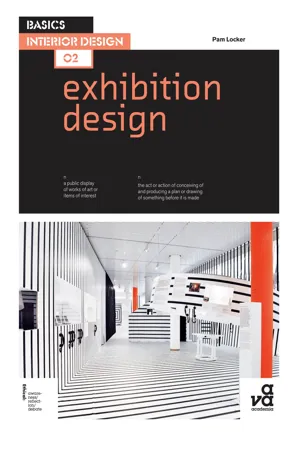
Basics Interior Design 02: Exhibition Design explores the role of the exhibition designer as a creative practitioner, and seeks to communicate a better understanding of exhibition design as a discipline. This umbrella term incorporates the development of commercial trade fairs, brand experiences, themed attractions, world expositions, museum galleries, visitor centres, historic houses, landscape interpretation and art installations. Millions of people visit exhibitions of one sort or another every year, constituting a multi-billion dollar global industry. This book offers a comprehensive guide to the practice of exhibition design, and considers the blurring of its borders with other disciplines, such as graphic design.
- 184 pages
- English
- ePUB (mobile friendly)
- Available on iOS & Android
eBook - ePub
Basics Interior Design 02: Exhibition Design
About this book
Information
Exhibition design
Exhibitions are for people, so the exhibition designer needs to have an understanding of the physical, emotional and intellectual needs of a range of very different audiences in order to deliver environments that are accessible, educational and enjoyable. In order to understand how to communicate with an audience, the designer must have an understanding of how audiences learn and ways in which to facilitate this learning.
The design process begins with a thorough understanding of the constraints and opportunities offered by the brief. Once research has been completed and the storyline identified, the process of developing the exhibition within the space can begin.
Exhibition families
The term ‘exhibition’ has multiple definitions. For simplicity, the discussions that follow will use the umbrella terms ‘commercial’ or ‘cultural’ when describing a range of exhibition projects. Although most types of exhibition will fall loosely into one of these two categories, there will be an inevitable blurring of the boundaries between them.
The ‘commercial’ will broadly consider exhibitions that are telling the story of a brand or are predominantly engaged with issues relating to commerce. They include commercial exhibition stands, brand experiences, theme parks, themed retail interiors and leisure attractions. Many commercial exhibitions will charge entry or are only open to audiences whose work is related to commerce. Whilst expo is also concerned with the promotion and better understanding of cultural relations, their particular historical engagement with trade means that in this text they will be considered under the commercial banner.
Museums, galleries, historic sites, landscape and heritage attractions will be broadly considered under the term ‘cultural’ exhibitions. These types of exhibition relate to the collective material culture of societies, whether this is a significant collection of art, a historic house, a palace or site, or a wayfinding visitor centre for a natural landscape. Here the activity of storytelling will most often engage with history, conservation, preservation and education.

= THE EXHIBITION DESIGN PROCESS
As this diagram shows, through a constant process of feedback and evaluation, the exhibition designer will encounter six stages in the design process: analysis, idea, development, proposal, detail, installation. This approach was inspired by a travelling exhibition of Leonardo da Vinci’s sketchbooks. The simple but engaging exhibition used a series of interpretive animations to bring the sketchbooks to life.
The exhibition design process
The first step in becoming an exhibition designer is to develop an understanding of the design process. The diagram opposite has simplified this complicated process to a linear pathway that considers how a project moves from analysis to installation.
Exhibitions are designed for people. The figure in the diagram is a useful reminder that throughout the design process we should ask the question; what will be the nature of the physical and emotional relationship between the exhibition and its audience?
The circle represents all that is already known about the project; the client, the organisation, the site, a body of research that will create a story. The square represents the dialogue between the audience and the exhibition space.
The boundaries between analysis and concept design development are fluid and require constant feedback or return loops; testing and re-testing of ideas. Slowly the design will evolve to a point where a realistic proposal emerges for presentation to the client. Following input from the client team, the designer can begin to engage with the detail design process and the technical requirements of tendering. Installation forms the beginning of the end of the process. At each stage of the project there will be critical feedback, which at the end of the project takes the form of reflection on the whole in order to inform future projects.
?
IS AN AGRICULTURAL SHOW A ‘CULTURAL’ OR ‘COMMERCIAL’ EXHIBITION?
It is an opportunity for exhibition, competition and performance. It is an opportunity to educate, stimulate and entertain. It has collections of farm animals and farm equipment. It is an important annual meeting place for farming communities.
The role of the exhibition designer
The specialist role of the exhibition designer is to create a three-dimensional environment that tells a story. This may be about a collection, a brand or simply an idea. Exhibition designers use a range of media and technologies, often borrowed from other disciplines, in order to effectively communicate messages in space.
The organised creative
As in other creative areas, exhibition designers need to be highly computer literate and require a varied two-and three-dimensional digital and analogue skills set.
However, it is the ambition to generate clear explanations to exhibition audiences, coupled with a focus on interior communicative content, which makes the exhibition designer distinct from designers in other disciplines.
The client is interested in their specialist expertise to create an exhibition according to an agreed set of communication requirements. It is the responsibility of the designer to identify, clarify and communicate these needs within the creative team.
As professional practitioners, exhibition designers need to work to deadlines, manage budgets, have an understanding of legal, access and sustainability issues, and possess a range of design, management and interpersonal skills that are pivotal to the creative team and influence the smooth running of a design project.

= ROWING GALLERY, RIVER AND ROWING MUSEUM Henley-on-Thames, UK
DESIGNER
= LAND DESIGN STUDIO
DATE
= 1998
The complex nature of many exhibition projects requires the designer to be an excellent communicator, negotiating not only with the client but often with a team of creative specialists. For their design of the galleries of the privately funded River and Rowing Museum, Land Design Studio had to work closely with architects, researchers, graphic designers and specialist contractors.

= S1NGLETOWN, VENICE ARCHITECTURE BIENALLE Venice, Italy
DESIGNER
= KESSELSKRAMER AND DROOG
DATE
= 2008
As part of the 2008 Venice Bienalle, KesselsKramer and Droog were asked to create S1NGLETOWN, an exploration of single living. Sources predict that by 2026, a third of the population of the developed world will be ‘single’, living apart from the traditional family unit. The implications of this shift are explored by this exhibition – visitors can walk the streets of S1NGLETOWN, visit its citizens and ‘discover the technology, designs and services that might contribute to a single-oriented urban space of tomorrow’. An accompanying newspaper also features an in-depth exploration of single living.
Analysing the brief
All design projects begin with a thorough analysis of the ‘project brief’. This will form the agreed foundation on which to build the project. As all projects are unique, briefs vary in detail and content according to the project’s nature and scale, as well as the experience of the client. In the fast turnover of the commercial world, a brand manager may write briefs on a regular basis, but for the client of a new museum the project may be a ‘one-off’. It is only through clear dialogue, to tease out detailed aims and expectations, that the brief can be fully understood. Essential initial questions include:
What is the nature and purpose of the project?
What is the scale of the project?
Who is the target audience and what are their needs?
Who is the client team?
What is the context and position o...
Table of contents
- Cover
- Title Page
- Table of contents
- Introduction
- How to get the most out of this book
- 01 What is an exhibition?
- 02 Exhibition design
- 03 Designing a narrative
- 04 Exhibition media
- 05 Exhibition graphics
- 06 Putting on a show
- Conclusion
- Useful resources
- Glossary
- Acknowledgements
- Picture credits
- Working with ethics
- eCopyright
Trusted by 375,005 students
Access to over 1.5 million titles for a fair monthly price.
Study more efficiently using our study tools.
Frequently asked questions
Yes, you can cancel anytime from the Subscription tab in your account settings on the Perlego website. Your subscription will stay active until the end of your current billing period. Learn how to cancel your subscription
No, books cannot be downloaded as external files, such as PDFs, for use outside of Perlego. However, you can download books within the Perlego app for offline reading on mobile or tablet. Learn how to download books offline
Perlego offers two plans: Essential and Complete
- Essential is ideal for learners and professionals who enjoy exploring a wide range of subjects. Access the Essential Library with 800,000+ trusted titles and best-sellers across business, personal growth, and the humanities. Includes unlimited reading time and Standard Read Aloud voice.
- Complete: Perfect for advanced learners and researchers needing full, unrestricted access. Unlock 1.5M+ books across hundreds of subjects, including academic and specialized titles. The Complete Plan also includes advanced features like Premium Read Aloud and Research Assistant.
We are an online textbook subscription service, where you can get access to an entire online library for less than the price of a single book per month. With over 1.5 million books across 990+ topics, we’ve got you covered! Learn about our mission
Look out for the read-aloud symbol on your next book to see if you can listen to it. The read-aloud tool reads text aloud for you, highlighting the text as it is being read. You can pause it, speed it up and slow it down. Learn more about Read Aloud
Yes! You can use the Perlego app on both iOS and Android devices to read anytime, anywhere — even offline. Perfect for commutes or when you’re on the go.
Please note we cannot support devices running on iOS 13 and Android 7 or earlier. Learn more about using the app
Please note we cannot support devices running on iOS 13 and Android 7 or earlier. Learn more about using the app
Yes, you can access Basics Interior Design 02: Exhibition Design by Pam Locker in PDF and/or ePUB format, as well as other popular books in Architektur & Innenarchitektur. We have over 1.5 million books available in our catalogue for you to explore.