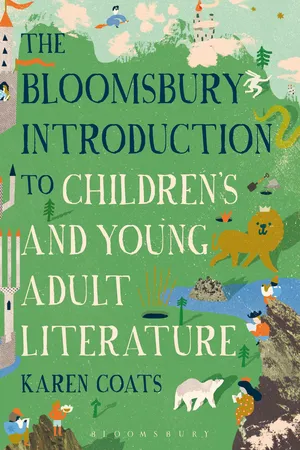
From Maria Edgeworth, Dr Seuss and Lewis Carroll to Sherman Alexie, Sharon Flake, and Gene Luen Yang, this is a comprehensive introduction to studying the infinitely varied worlds of literature for children and young adults.
Exploring a diverse range of writing, The Bloomsbury Introduction to Children's and Young Adult Literature includes:
- Chapters covering key genres and forms from fiction, nonfiction, and poetry to picture books, graphic novels and fairy tales
- A history of changing ideas of childhood and adolescence
- Coverage of psychological, educational and literary theoretical approaches
- Practical guidance on researching, reading and writing about children's and young adult literature
- Explorations of children's and young adult film, TV and new media
In addition, "Extending Your Study" sections at the end of each chapter provide advice on further reading, writing, discussion and online resources as well as case study responses from writers and teachers in the field. Accessibly written for both students new to the subject and experienced teachers, this is the most comprehensive single volume introduction to the study of writing for young people.
- 456 pages
- English
- ePUB (mobile friendly)
- Available on iOS & Android
eBook - ePub
The Bloomsbury Introduction to Children's and Young Adult Literature
About this book
Information
1
Ideologies of Childhood and the History of Children’s Literature
Suggested texts to read alongside this chapter
The Brownies’ Book (full text of select issues available here: http://childlit.unl.edu/topics/edi.brownies.html.
Comenius, John Amos, Orbis Sensualium Pictus (full text available online).
Fine, Anne, Madame Doubtfire; The Tulip Touch; Flour Babies.
New England Primer (full text available online).
Rousseau, Jean-Jacques, Emile, or On Education (full text available online).
Stevenson, Robert Louis, A Child’s Garden of Verses (full text available online).
Yang, Gene Luen, American Born Chinese.
How histories of childhood and children’s and young adult literature are constructed
In Lenore Look’s Alvin Ho: Allergic to Dead Bodies, Funerals, and Other Fatal Circumstances (2011), anxiety-ridden second-grader Alvin is worried about his first test on the colonial history of his hometown of Concord, Massachusetts. His older brother, Calvin, comes up with the ingenious plan of drawing symbolic pictures to help his brother remember significant historical events. He starts by drawing a dinosaur, and then Pangaea, then the Egyptian pyramids, the Trojan War, the Great Wall of China, the Vikings, Benjamin Franklin, Henry David Thoreau, and finally, Fenway Park. Of course, none of these selective tidbits will be of any help to Alvin on his test, but Calvin has hit on some of the key problems of writing a history: when to start your history, and what to include. Your own teachers over the years have likely warned you often enough not to begin any essay with some variant of “since the dawn of time,” and yet even the distinguished scholar Seth Lerer (2008: 1) begins his magisterial history of children’s reading with the sentence: “Ever since there were children, there has been children’s literature.” While this is very likely true, it requires a feat of informed imagination to reflect on the forms that literature took before print, as well as to extrapolate from the bits and scraps that have been preserved over time in order to make some generalizations about what young readers might have read and enjoyed prior to our present age; well-loved books, like well-loved toys, may not have survived the ravages of time and rough handling as well as those items that were not subjected to everyday use. Yet this kind of imaginative reconstruction is precisely what we must do to fully account for the stories, educative texts, and poetic forms shared with young people throughout the course of human history.
Conceiving a history of children’s and YA literature requires a writer to consider three overarching questions: First, what will count as literature? Second, what do we mean when we say children and YAs? And third, how does literature fit into broader cultural, ideological, and historical contexts? The answers the historian frames for these questions guide the selection of what to include in the history of a literary genre. The overly broad sweep proposed by Calvin in his march through planetary history toward the contemporary state of a small town in North America is certainly meant to be comic, but it reminds us that history is always colored by conscious and unconscious perspectives and biases, as well as by the degree of specificity the project needs or can afford. In this introduction to children’s and YA literature, for instance, I am dedicating a single chapter to the history of a genre (some would argue two genres, separating out children’s from YA literature) that has received far fuller treatment in multiple book-length studies from diverse perspectives and with various levels of specificity. My goal in this chapter is to bring together historical and ideological contexts from antiquity to the present in order to explore how and why Western children’s and YA literature has developed into the forms it takes today.
Why history matters to the study of children’s literature
But, some of you may be saying, I am not really all that interested in the history of youth literature; I plan to teach contemporary youth literature to contemporary children, tweens, and teens. Or: I want to write for young people, so my goal is to understand what’s happening in the literature today and where it’s headed. Fair enough—the historical study of children’s and YA literature as an end in itself may be more relevant to those seeking to become professors and literary critics. However, no reader, adult or child, approaches a children’s or YA text without a distinct attitude toward its intended audience, without, in other words, an ideology of childhood or what it means to be a teenager. Such an ideology is a set of conscious and unconscious ideas, beliefs, and values that influence how we read and understand the literature as well as how we think about ourselves and how we respond to actual children. Since our ideas seem natural to us, they don’t feel like beliefs or values at all, but rather common sense or, simply, truth.
Studying the history of youth literature, however, reveals that ideas about childhood have a particular point of emergence and that they have changed over time. Our present attitudes rest on the tip of a very large iceberg. Considering the rest of the iceberg—the foundations on which those attitudes rest—shows us that what people have believed about children and childhood in the past is different, in some cases markedly so, from what we believe now about children and childhood. Let’s take a pause and consider what ideology means and what its implications are for the study of youth literature.
Icebergs and Ideologies
If you are sitting in a room with a window, look at it and consider what you see. When I ask my students to do this, they usually tell me what is visible outside—the leaves of a tree, the next building over, people tossing a ball or studying under the trees on the campus lawn. In other words, they are looking through the window, and why not? This is one of the things windows are for, after all, so why else would I be asking? But then I point out that nobody mentioned the window itself—the shape of it that limits the range of what they can see (i.e., only part of the tree, building, and lawn rather than the whole thing), and the fact that there are smudges, fingerprints, and a mesh screen that they ignored, not recognizing the distorting effects these have on what they see. Once they scold (and forgive) me for my trick question, I also point out that, even with this limitations, they wouldn’t be able to see anything at all if the window weren’t there.
In a similar way, ideology acts as a framing device that enables and also limits or distorts what we can see. Ideology refers to the consciously and unconsciously held beliefs and values that structure and inform our attitudes and actions. We can usually give accounts or defenses for our actions and attitudes—what we see in front of us. The challenge is to be able to look at the ideologies that inform or underlie them—in other words, to redirect our attention to the window through which we see, rather than what we see on the other side.
Consciously held ideologies are usually not that hard to locate and explain, and we can discuss them as goals or values even when we don’t always act in ways that are consistent with them. They are those positions that we have thought through and adopted because we see in them some benefit toward creating a society that we want to live in; political ideologies and belief systems, including atheism, for instance, are usually consciously adopted positions. But even though we consciously espouse certain beliefs or values, we also hold unconscious ideological positions that we have absorbed to the point where they seem like common sense; these are values that we take for granted, so much so that we are surprised when we find that other people perceive things differently. These positions are often related to the ways in which we think about ourselves with relation to other people, so they include our racial and ethnic attitudes and prejudices, our attitudes toward gender and family structures, and our expectations toward what constitutes a good society and a happy life. Since these unconscious ideologies are, by definition of the word unconscious, absorbed from birth without thought or reflection through encounters with the world around us—our families, our cultural products such as books and other media, and our schooling—it becomes important for those who study child culture to examine how ideologies appear and are reinforced in youth literature. In other words, we need to look at the window rather than merely through it, to drill down to what motivates our thoughts, opinions, and, most importantly, our emotional, kneejerk reactions to the things we see and hear, and ask ourselves where these responses came from.
As you read through this chapter, be on the lookout for the ways that cultural attitudes toward childhood have shifted. A quick summary of the evolution of ideologies of childhood that have informed much of the literature produced for them looks like this:
- Children, though they require different levels of physical care than adults, only need practical training in tasks that fit their role in their social group, and don’t need special stories that would prepare them for life outside of their own communities.
- Children are immature adults that need to be shuffled along to adulthood as soon as possible.
- Children are special gifts from God but are infected with original sin and thus need to be cherished but also corrected and instructed according to the dictates of their faith. A secular version of this is that children are born with aggressive tendencies in the service of their own self-interest. In either case, they can and should be allowed to read stories that show natural and imposed consequences to aggressive and antisocial actions in order to develop their moral sense as well as self-control.
- Children are blank slates that can be positively or negatively influenced by their surroundings and education. Their education should be both robust and moral, emphasizing humans’ superiority over the natural world along with their obligation to protect and develop their understanding of it.
- Children are born naturally and innocently good, with an innate sense of justice and compassion, and should be protected from negative influences, including stories with sloppy or ambiguous morals, that emerge from adult society.
- Young people are our only hope to save the world and make it a better place.
- Children are diverse in intelligence, temperament, experience, and interest, but are all capable of learning given the right approach, and all need positive representation in literature and other media in order to understand their embeddedness in human communities and to realize their full potential as individuals. Moreover, there is a time between childhood and adulthood that is distinctly different from either, and thus deserves its own attention as a stage of life.
Despite the fact that I have indicated various ideologies of childhood as discrete positions, it is also important to understand that once certain ideas about what it means to be human come into the world, they don’t simply go away. Instead, newer ideas dialogue with older ones, refining, challenging, sometimes reinforcing and sometimes transforming those ideas beyond recognition. Thinking historically allows us to recognize and trace connections and disruptions, and to consider what conditions enable us to hold our present attitudes. Looking backward in time, we can ponder the question of whether it is the children and teenagers who have changed, as Anne Fine does in the Author Talkback to this chapter, or whether it is our interpretation of and attitudes toward their concerns that have changed. Related questions then emerge regarding how such a change happens; that is, does the literature change in response to the needs of its audience, or does the audience change in response to the literature?
Seth Lerer (2008: 1) frames an answer to some of those questions this way: “The history of children’s literature is inseparable from the history of childhood, for the child was made through texts and tales he or she studied, heard, and told back.” The first part of that sentence seems inarguable: in order to have a literature specially dedicated to young people, a culture has to have a sense of who and what that audience is and what they need to know as they grow into adulthood. The contemporary idea that we should also consider what will make them happy is a more recent notion, as is the rather curious claim expressed in the second half of the sentence, that children are somehow made through stories. This is an idea we will consider in more depth in future chapters. However, if you read around in the history of childhood or children’s literature, at some point you will come across the statement that the concept of childhood as a separate stage of life didn’t exist in traditional Western societies before the Middle Ages. This strange idea grows out of the work of French historian Philippe Ariès, who states provocatively in his 1960 book, Centuries of Childhood: A Social History of Family Life, “In medieval society, the idea of childhood did not exist” (128). Such a statement was bound to meet with challenge, and it has, repeatedly, in the works of scholars interested in childhood and family life during the classical and medieval periods. Hugh Cunningham (2014: 30), for instance, points to a translation problem in the sentence, arguing that what has been translated as “idea” was something more like “sentiment” in the original French. Understood this way, Cunningham argues that our tenderly nostalgic sense that child hood should be a time set apart and deserving of protection from adult troubles, even if it isn’t actually like that for many of the world’s children, is in fact an invention of the 1600s, which we have been refining ever since. Eva M. Simms (2008) elaborates the provocative idea that the issue wasn’t that we didn’t have a sense of what childhood was so much as we lacked a sense of what constituted adulthood. During much of human history prior to the eleventh century, she explains, adults and children participated in communal rituals on an even basis; they played the same games, sang the same songs, told the same stories. The advent of the Crusades and the practice of embarking on spiritual pilgrimages marked the first time that many people ever left the villages of their birth. Simms argues that it was only when YAs began to loosen their ties to their families and communal traditions to follow such private destinies that a new psychological awareness of individual personality and maturity developed. Consider this in light of the very common trope of the road trip in YA fiction: taking off in an unreliable vehicle with a few friends and a load of snacks constitutes a modern-day pilgrimage on the road to maturity. “Children become children,” Simms argues...
Table of contents
- Cover
- Title Page
- Dedication
- Contents
- Acknowledgments
- Introduction
- 1 Ideologies of Childhood and History of Children’s Literature
- 2 Contemporary Insights into Child and Adolescent Development
- 3 Thinking Theoretically about Children’s and Young Adult Literature
- 4 Poetry and Poetic Language
- 5 Reading (with) Pictures
- 6 Thinking about Story
- 7 Drama, Film, New Media, Oh My!: Children’s and Young Adult Literature on Stage and Screens
- 8 Tales We Live By
- 9 “The Web Itself is a Miracle”: Nonfiction and Informational Literature
- 9 ¾ The In-Betweens of Children’s and Young Adult Literature
- 10 Narrative Fiction: As Real as it Gets?
- 11 Are We Posthuman Yet?: Fantasy and Speculative Fiction
- 12 Entering the Professional Conversation
- Glossary
- Academic References
- Index
- eCopyright
Trusted by 375,005 students
Access to over 1.5 million titles for a fair monthly price.
Study more efficiently using our study tools.
Frequently asked questions
Yes, you can cancel anytime from the Subscription tab in your account settings on the Perlego website. Your subscription will stay active until the end of your current billing period. Learn how to cancel your subscription
No, books cannot be downloaded as external files, such as PDFs, for use outside of Perlego. However, you can download books within the Perlego app for offline reading on mobile or tablet. Learn how to download books offline
Perlego offers two plans: Essential and Complete
- Essential is ideal for learners and professionals who enjoy exploring a wide range of subjects. Access the Essential Library with 800,000+ trusted titles and best-sellers across business, personal growth, and the humanities. Includes unlimited reading time and Standard Read Aloud voice.
- Complete: Perfect for advanced learners and researchers needing full, unrestricted access. Unlock 1.5M+ books across hundreds of subjects, including academic and specialized titles. The Complete Plan also includes advanced features like Premium Read Aloud and Research Assistant.
We are an online textbook subscription service, where you can get access to an entire online library for less than the price of a single book per month. With over 1.5 million books across 990+ topics, we’ve got you covered! Learn about our mission
Look out for the read-aloud symbol on your next book to see if you can listen to it. The read-aloud tool reads text aloud for you, highlighting the text as it is being read. You can pause it, speed it up and slow it down. Learn more about Read Aloud
Yes! You can use the Perlego app on both iOS and Android devices to read anytime, anywhere — even offline. Perfect for commutes or when you’re on the go.
Please note we cannot support devices running on iOS 13 and Android 7 or earlier. Learn more about using the app
Please note we cannot support devices running on iOS 13 and Android 7 or earlier. Learn more about using the app
Yes, you can access The Bloomsbury Introduction to Children's and Young Adult Literature by Karen Coats in PDF and/or ePUB format, as well as other popular books in Letteratura & Critica letteraria. We have over 1.5 million books available in our catalogue for you to explore.