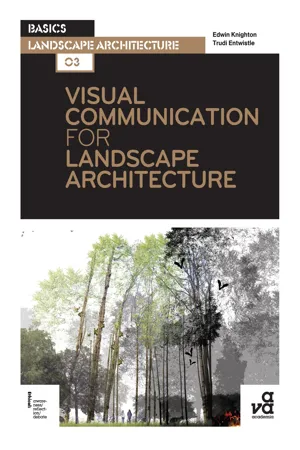
Visual Communication for Landscape Architecture demonstrates not only how and where a range of visual communication skills are needed to inform a design process, but also why they are essential in order to make presentations both informative and memorable. It illustrates how representational techniques can be sensitively applied in different contexts appropriate to a diverse range of design challenges, and encourages experimentation with contemporary techniques, both 2D and 3D. Developing a professional but creative design portfolio is explored in relation to creating e-portfolios and websites. A total of 12 contemporary case studies enable readers to contextualize the methods and techniques explored in each chapter through exploring real-life examples of winning projects by successful landscape architecture practices, making this title an inspirational resource for both budding – and practising – landscape architects.
- 208 pages
- English
- ePUB (mobile friendly)
- Available on iOS & Android
eBook - ePub
Visual Communication for Landscape Architecture
About this book
Trusted by 375,005 students
Access to over 1 million titles for a fair monthly price.
Study more efficiently using our study tools.
Information
1
Understanding landscape
The design process begins on site. Developing an awareness of and understanding of the meaning of a place is a fundamental skill for landscape architects because any intervention in the landscape will refer to its context in some way. When designing spaces, it is crucial to know how to read and record them. This chapter explores different ways of observing and recording visual data. The aim of ‘reading the landscape’ is to capture the nature of a range of environments, their three-dimensional characters and the processes that affect their development. Observation and analysis both take place when exploring the elements that make up a landscape: the recording and communication of this quantitative and qualitative data is known as ‘survey and analysis’ in the initial stages of a project. As there can be overlap when communicating these two types of data, this chapter will explore the techniques used for both observation and analysis together. The way in which this information is presented graphically and the techniques used are dictated by the site, the aspirations of the landscape architect and the client brief.

1.1
Location: Thames BarrierPark, UK
Designer: Alistair W. Baldwin Associates
The contrast of coloured pencil alongside white space highlights the play of light and shadow in this formal planting bed.
Observational drawing
As a student of landscape architecture, you no doubt already have some artistic and graphic ability, such as knowing how to use different media, and how to compose and proportion a drawing. In this section, we will explore various sketching techniques and approaches that can be used to identify and communicate the features, characteristics and qualities that make a place distinctive. The objective here is for you to experiment with expressive ways of sketching that respond to the landscape, rather than aiming to produce artistic masterpieces! Practise is key to distilling an intuitive response to a landscape, and to developing a personal style of drawing and recording your observations. Carrying a sketchbook around is essential!
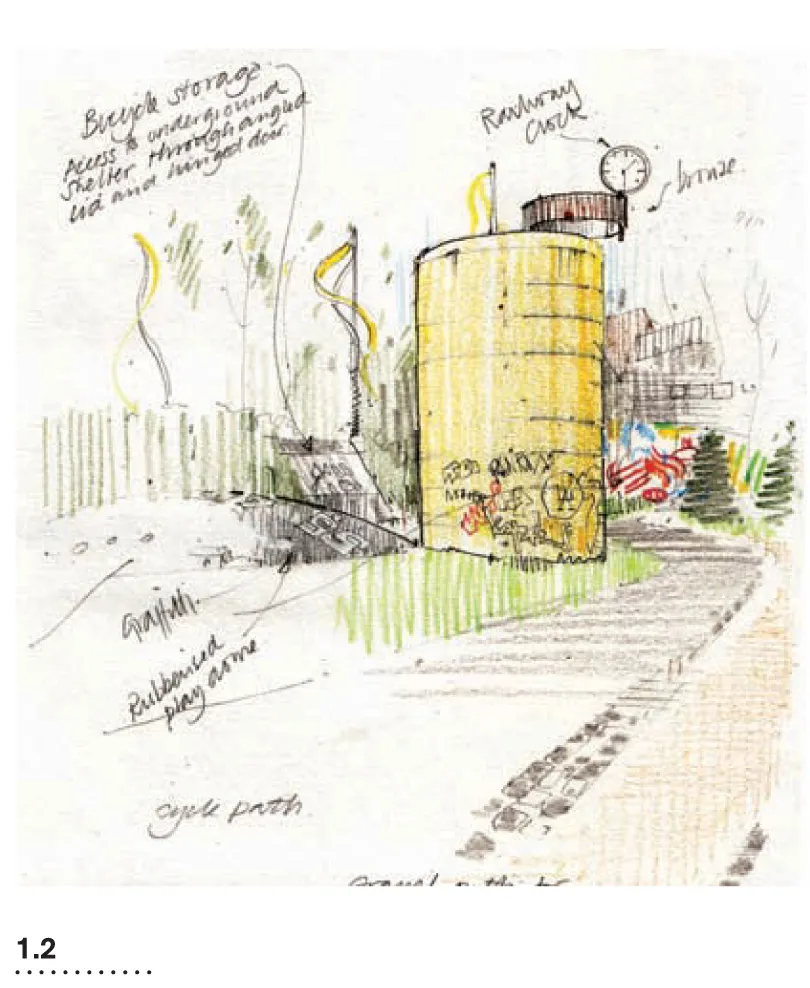
1.2
Location: Copenhagen, Denmark
Designer: David Smith
A rapid yet accurate sketch from a student sketchbook that highlights prominent features in the landscape.
A way of seeing
John Ruskin (the leading Victorian critic and artist, 1819–1900) saw drawing as the foundation of visual thought. He believed that his mission was not to teach people how to draw but rather how to see. Sketching is about exploring our relationship with landscapes; how we see them, how we record their qualities and what they mean to us. The more we understand landscape, the easier it is to simplify a sketch, editing out detail to emphasize and capture something that photography alone cannot. Sketching is usually one of the most personal parts of the design process and so may not necessarily be used as a communication tool for a client. The full value of sketching goes beyond the start of a design process, so it is essential to practise sketching as an observational tool, too: it will ultimately help you to develop sensitivity and spatial awareness as a designer, which will in turn inform your future design work.
‘We always see with memory, and seeing each person’s memory is different: we can’t be looking at the same things.’
David Hockney, Artist
David Hockney: The Art of Seeing
BBC1 TV documentary

1.3
Location: Ferry Bridge Power Station, UK
Designer: Richard Contini
Observations don’t have to be a realistic record of space. This simplified sketch captures a personal memory and first impression of place, creating more powerful and memorable image than a photograph might have done.

1.4
Location: China
Designer: Nick Bonner
‘To me it was as much as remembering I was there. The use of line and colour create an exaggerated feel of the place. Through allowing for quirks and mistakes, opportunity and discovery for design are revealed’.
Approach
To compose a view, you need to understand the relationship between objects in a space. The composition of a drawing requires you to translate that relationship into a series of expressive marks. As a designer, it is therefore important to develop an understanding of the fundamental elements of visual expression, including line, tone, texture, pattern, colour, form and space. It is through the construction of observational drawing that we can begin to understand how these elements make up a place, which will then have a major influence on inspiration and visualization within the rest of the design process. These elements can be applied to the composition of both hand and digital techniques.

1.5
Location: Robin Hood’s Bay, UK
Designer: Mark Coskie
A simple line drawing can usefully edit information. Here, the sketch highlights the character and scale of the buildings in context to the road and backdrop of trees.
‘The capacity to see comes from persistently analyzing our reactions to what we look at, and their significance as far as we are concerned. The more one looks, the more one will come to see.’
Louis L. Kahn
Architect
Line
The line is the fundamental element of drawing. It has its own expressive qualities. At its simplest, a line can outline an object to contour shape or give structure to define perspective and context. Each line has character, therefore it is important to master your hand–eye coordination skills and so develop confidence to express what it is that...
Table of contents
- Cover
- Title Page
- Contents
- Introduction
- 1 Understanding landscape
- 2 Design exploration
- 3 Visualizing in 2D
- 4 Visualizing in 3D
- 5 Implementation
- 6 Presentation
- Resources
- Picture credits
- Index
- Acknowledgements
- Working with ethics
- eCopyright
Frequently asked questions
Yes, you can cancel anytime from the Subscription tab in your account settings on the Perlego website. Your subscription will stay active until the end of your current billing period. Learn how to cancel your subscription
No, books cannot be downloaded as external files, such as PDFs, for use outside of Perlego. However, you can download books within the Perlego app for offline reading on mobile or tablet. Learn how to download books offline
Perlego offers two plans: Essential and Complete
- Essential is ideal for learners and professionals who enjoy exploring a wide range of subjects. Access the Essential Library with 800,000+ trusted titles and best-sellers across business, personal growth, and the humanities. Includes unlimited reading time and Standard Read Aloud voice.
- Complete: Perfect for advanced learners and researchers needing full, unrestricted access. Unlock 1.4M+ books across hundreds of subjects, including academic and specialized titles. The Complete Plan also includes advanced features like Premium Read Aloud and Research Assistant.
We are an online textbook subscription service, where you can get access to an entire online library for less than the price of a single book per month. With over 1 million books across 990+ topics, we’ve got you covered! Learn about our mission
Look out for the read-aloud symbol on your next book to see if you can listen to it. The read-aloud tool reads text aloud for you, highlighting the text as it is being read. You can pause it, speed it up and slow it down. Learn more about Read Aloud
Yes! You can use the Perlego app on both iOS and Android devices to read anytime, anywhere — even offline. Perfect for commutes or when you’re on the go.
Please note we cannot support devices running on iOS 13 and Android 7 or earlier. Learn more about using the app
Please note we cannot support devices running on iOS 13 and Android 7 or earlier. Learn more about using the app
Yes, you can access Visual Communication for Landscape Architecture by Trudi Entwistle, Edwin Knighton in PDF and/or ePUB format, as well as other popular books in Architecture & Urban Planning & Landscaping. We have over one million books available in our catalogue for you to explore.