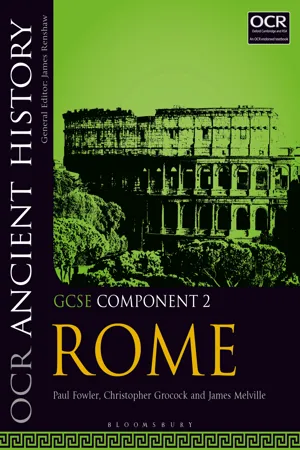
This textbook is endorsed by OCR and supports the specification for GCSE Ancient History (first teaching September 2017). It covers the whole of Component 2, both the compulsory longer Period Study and the three optional Depth Studies:
Longer Period Study: The Foundations of Rome: From Kingship to Republic, 753–440 BC by Paul Fowler
Depth Study: Hannibal and the Second Punic War, 218–201 BC by Paul Fowler
Depth Study: Cleopatra: Rome And Egypt, 69–30 BC by James Melville
Depth Study: Britannia: From Conquest to Province, AD 43–c. 84 by Christopher Grocock
How did reactions to the exploitation of women and the poor make Rome great? How did Rome survive a fourteen-year invasion? Was Cleopatra a great queen? What was the impact of Roman invasion on Britain's diverse and prosperous culture?
This book raises these and other key questions. GCSE students and their teachers will explore the foundation of Rome, the rise of its empire, and its interactions with neighbouring cultures, through the eyes of its historians and archaeology. This book invites us to look at Ancient Rome and the modern world in a new light.
The ideal preparation for the final examinations, all content is presented by experts and experienced teachers in a clear and accessible narrative. Ancient literary and visual sources are described and analysed, with supporting images. Helpful student features include study questions, further reading, and boxes focusing in on key people, events and terms. Practice questions and exam guidance prepare students for assessment.
A Companion Website is available at www.bloomsbury.com/anc-hist-gcse.
- 304 pages
- English
- ePUB (mobile friendly)
- Available on iOS & Android
eBook - ePub
About this book
Trusted by 375,005 students
Access to over 1.5 million titles for a fair monthly price.
Study more efficiently using our study tools.
Information
PART 1
LONGER PERIOD STUDY:
THE FOUNDATIONS OF ROME:
FROM KINGSHIP TO REPUBLIC,
753–440 BC
Introduction
Just over a quarter of your GCSE in Ancient History involves a Roman Period Study. You will learn about the earliest history of Rome as told by ancient historians, and you will think about how to distinguish myth from fact. OCR has not set any particular sources for you to read, so the ones you will encounter in this textbook are only a suggestion: you should use the skills you build to read other texts and sources about this period of history.
EXAM OVERVIEW J198/02 SECTION A
Your assessment for the Period Study will be:
| 27.5% of the GCSE | 60 mins | 60 marks | ||
| out of 1hr 45mins | out of 105 marks | |||
| for the whole paper | for the whole paper* |
* This includes 5 marks are available for spelling, punctuation, grammar and appropriate historical terminology (SPaG).
30 marks will test AO1: demonstrate knowledge and understanding of the key features and characteristics of the historical periods studied.
15 marks will test AO2: analyse and explain historical events and historical periods to arrive at substantiated judgements.
10 marks will test AO3: use, analyse and evaluate ancient sources within their historical context.
EXAM TIP: THE DIFFERENCE BETWEEN EVALUATION AND ANALYSIS
Analysis is the ability to explore the value or weight of a particular piece of evidence or event. Evaluation is the ability to weigh up a number of facts and sources in combination to make a decision about how far something is important.
USING ANCIENT HISTORIANS TO STUDY THE FOUNDATIONS OF ROME
republic a country without a king; the word derives from the Latin – res publica – the ‘public matter’ or the people’s government
foundation chronology a popular theory that the Roman writer Fabius Pictor created a foundation timeline to organise the history of Rome, by mixing together the different sources he had found with his own narrative
narrative used by all authors to help readers follow their story and ancient historians similarly used story-lines to help explain the changes and developments introduced in Rome
literary tradition accounts of Rome’s foundation by ancient historians such as Dionysius and Livy; very little of older sources such as Cato and Pictor survives
weight the historical value of a source
interpretations the different ways historians have viewed the past
patricians a difficult group to define accurately, Livy and Dionysius refer to them as men belonging to Rome’s oldest families, many being rich landowners
plebeians Roman citizens who did not belong to the patrician families
Historians are confident about only three things.
1.We do not know for certain how Rome was founded, we only have theories and possibilities.
2.The ancient accounts of this period are a mixture of legend, myth and fiction.
3.The archaeology we possess is limited and produces more questions than answers.
It may seem strange to be studying a topic we know very little about. This is a common obstacle when studying Ancient History. Most periods have an incomplete archaeological record which makes it very difficult to make sense of the past.
This component concentrates upon the work of Livy and Dionysius. In their opinion Rome developed from a small settlement of soldiers into a thriving city with a Republic. The archaeological record does not fully agree with their version of events. Unfortunately, archaeology does not provide us with a complete history.
Modern historians use Livy and Dionysius, cautiously, to provide an approximate chronology to the foundation of Rome. The foundation chronology they provide is not historical fact but a historical narrative. Modern historians call their story the literary tradition.
Historians debate the weight of the literary tradition. Some value the ancient historians because they had access to evidence which no longer exists. Others argue that the ancient sources they use have been manipulated or made up by earlier historians like Fabius Pictor. In their opinion Livy’s and Dionysius’ histories are interpretations. In other words, they alter the ancient sources to achieve personal aims.
What will I study?
In the first two sections, you will explore the role of the legendary kings. Romulus, the legendary founder of Rome, is supposed to have created Rome’s basic structure. This included dividing the city into two orders called patricians and plebeians. Over time, other kings would add to this structure until the removal of Tarquinius Superbus in 509 BC.
In the final two sections, you explore the early history of the Republic. In section three you will explore how Ro...
Table of contents
- Cover
- Half Title
- Series
- Title
- Contents
- Introduction |
- How to Use this Book |
- PART 1 LONGER PERIOD STUDY: THE FOUNDATIONS OF ROME: FROM KINGSHIP TO REPUBLIC, 753–440 BC |
- Introduction1 |
- 1.1 The Legendary Kings and the Origins of Rome, 753–616 BC |
- 1.2 The Etruscan Kings, 616–509 BC |
- 1.3 Origins of the Republic, 509–494 BC |
- 1.4 Securing the Republic, 494–440 BC |
- What to Expect in the Exam: Section A |
- PART 2 DEPTH STUDIES |
- Introduction to the Depth Study options |
- DEPTH STUDY 1: HANNIBAL AND THE SECOND PUNIC WAR, 218–201 BC |
- Introduction to Hannibal and the Second Punic War, 218–201 BC |
- 2.1 Reasons for the Outbreak of the Second Punic War |
- 2.2 The Nature and Dynamics of Hannibal’s Leadership |
- 2.3 The Changing Nature of Rome’s Response to Hannibal |
- 2.4 How Did Rome Defeat Carthage? |
- What to Expect in the Exam: Section B |
- DEPTH STUDY 2: CLEOPATRA: ROME AND EGYPT, 69–30 BC |
- Introduction to Cleopatra: Rome and Egypt, 69–30 BC |
- 3.1 Cleopatra as Queen of Egypt |
- 3.2 Cleopatra’s Relationship with Julius Caesar, 48–44 BC |
- 3.3 Cleopatra’s Relationship with Mark Antony, 41–30 BC |
- 3.4 The Battle of Actium and its Significance for Egypt and Rome |
- What to Expect in the Exam: Section C |
- DEPTH STUDY 3: BRITANNIA: FROM CONQUEST TO PROVINCE, AD 43–c. 84 |
- Introduction to Britannia: from Conquest to Province, AD 43–c. 84 |
- 4.1 Claudius’ Invasion of Britain, AD 43 |
- 4.2 The Romans in Britain |
- 4.3 Romanisation and Further Resistance |
- What to Expect in the Exam: Section D |
- Glossary |
- Sources of Quotations |
- Sources of Illustrations |
- Index |
- Copyright
Frequently asked questions
Yes, you can cancel anytime from the Subscription tab in your account settings on the Perlego website. Your subscription will stay active until the end of your current billing period. Learn how to cancel your subscription
No, books cannot be downloaded as external files, such as PDFs, for use outside of Perlego. However, you can download books within the Perlego app for offline reading on mobile or tablet. Learn how to download books offline
Perlego offers two plans: Essential and Complete
- Essential is ideal for learners and professionals who enjoy exploring a wide range of subjects. Access the Essential Library with 800,000+ trusted titles and best-sellers across business, personal growth, and the humanities. Includes unlimited reading time and Standard Read Aloud voice.
- Complete: Perfect for advanced learners and researchers needing full, unrestricted access. Unlock 1.5M+ books across hundreds of subjects, including academic and specialized titles. The Complete Plan also includes advanced features like Premium Read Aloud and Research Assistant.
We are an online textbook subscription service, where you can get access to an entire online library for less than the price of a single book per month. With over 1.5 million books across 990+ topics, we’ve got you covered! Learn about our mission
Look out for the read-aloud symbol on your next book to see if you can listen to it. The read-aloud tool reads text aloud for you, highlighting the text as it is being read. You can pause it, speed it up and slow it down. Learn more about Read Aloud
Yes! You can use the Perlego app on both iOS and Android devices to read anytime, anywhere — even offline. Perfect for commutes or when you’re on the go.
Please note we cannot support devices running on iOS 13 and Android 7 or earlier. Learn more about using the app
Please note we cannot support devices running on iOS 13 and Android 7 or earlier. Learn more about using the app
Yes, you can access OCR Ancient History GCSE Component 2 by Paul Fowler,Christopher Grocock,James Melville in PDF and/or ePUB format, as well as other popular books in History & Ancient History. We have over 1.5 million books available in our catalogue for you to explore.