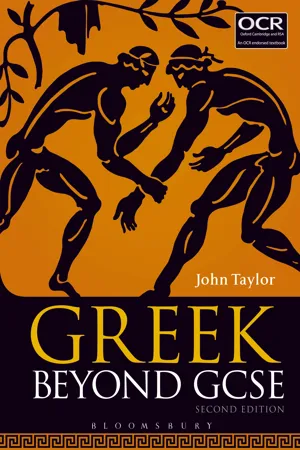
Greek Beyond GCSE covers all the linguistic requirements for the OCR AS and A Level in Classical Greek. It aims to bring students to a point where they can tackle original Greek texts with confidence. Although designed as a continuation of Greek to GCSE, it is self-contained and can be used independently.
This second edition is brought in line with the current OCR specifications. The first part of the book introduces new constructions accompanied by exercises including the translation of sentences from English to Greek and reading passages(which in the opening chapters are lightly adapted). The next sections provide translation and comprehension passages at both AS and A Level standard, including verse unseens, scansion, and a list of 300 common poetic words (new to this edition). Next come longer unadapted extracts from a range of authors. Finally there is a reference section including a summary of all constructions, a comprehensive grammar, various appendices and a vocabulary of about 1,200 Greek words.
- 416 pages
- English
- ePUB (mobile friendly)
- Available on iOS & Android
eBook - ePub
Greek Beyond GCSE
About this book
Information
Chapter One
DIRECT AND INDIRECT QUESTIONS
We saw in Greek to GCSE (1) that any sentence can be made into a question simply by adding a question mark (;), but that open questions (asking whether a statement is true, so that the answer will be yes or no) are commonly signalled by ἆρα at the beginning:
ἆρα ὁ παῖς μῶρός ἐστιν;
Is the boy stupid?
The word ἆρα cannot be translated in isolation (think of it as, but do not write, Is it the case that …? - like French Est-ce que …?): you need to look first at the tense and person of the verb.
•By adding οὐ after ἆρα (elided to ἆρ’ οὐ, and with οὐ changing to οὐκ or οὐχ according to the usual rule if a vowel follows) the question is loaded to expect or invite the answer yes:
| ἆρ’ οὐχ ὁ παῖς μῶρός ἐστιν; | ||
| Isn’t the boy stupid? | ||
| or | Surely the boy is stupid? |
•With the alternative negative μή, the question is loaded in the other direction, to expect or invite no:
| ἆρα μὴ ὁ παῖς μῶρός ἐστιν; | ||
| The boy isn’t stupid, is he? | ||
| or | Surely the boy isn’t stupid? | |
| This meaning can also be expressed by using μῶν (a contraction of μή and οὖν): | ||
| μῶν ὁ παῖς μῶρός ἐστιν; |
The easiest way to remember these is to think of ἆρ’ οὐ as surely and of ἆρα μή (or μῶν) as surely not. They correspond respectively to Latin nonne (expecting yes) and num (expecting no).
We also met direct questions asking for specific information, introduced by one of a number of interrogative or question words (mos...
Table of contents
- Cover
- Half Title
- Series Page
- Title Page
- Contents
- List of illustrations
- Preface
- Map
- List of Abbreviations
- Chapter One
- Chapter Two
- Chapter Three
- Chapter Four
- Chapter Five: AS-Level Practice Passages and Sentences
- Chapter Six: A-Level Practice Passages (1)
- Chapter Seven: A-Level Practice Passages (2)
- Chapter Eight: Readings
- Chapter Nine: Summaries of Syntax
- Reference Grammar
- 1: Words easily confused
- 2: Greek and Latin constructions compared
- 3: Pronunciation
- 4: Outline of Greek history
- 5: Major Greek authors
- Glossary of grammar terms
- Vocabulary
- Index
- Copyright
Trusted by 375,005 students
Access to over 1.5 million titles for a fair monthly price.
Study more efficiently using our study tools.
Frequently asked questions
Yes, you can cancel anytime from the Subscription tab in your account settings on the Perlego website. Your subscription will stay active until the end of your current billing period. Learn how to cancel your subscription
No, books cannot be downloaded as external files, such as PDFs, for use outside of Perlego. However, you can download books within the Perlego app for offline reading on mobile or tablet. Learn how to download books offline
Perlego offers two plans: Essential and Complete
- Essential is ideal for learners and professionals who enjoy exploring a wide range of subjects. Access the Essential Library with 800,000+ trusted titles and best-sellers across business, personal growth, and the humanities. Includes unlimited reading time and Standard Read Aloud voice.
- Complete: Perfect for advanced learners and researchers needing full, unrestricted access. Unlock 1.5M+ books across hundreds of subjects, including academic and specialized titles. The Complete Plan also includes advanced features like Premium Read Aloud and Research Assistant.
We are an online textbook subscription service, where you can get access to an entire online library for less than the price of a single book per month. With over 1.5 million books across 990+ topics, we’ve got you covered! Learn about our mission
Look out for the read-aloud symbol on your next book to see if you can listen to it. The read-aloud tool reads text aloud for you, highlighting the text as it is being read. You can pause it, speed it up and slow it down. Learn more about Read Aloud
Yes! You can use the Perlego app on both iOS and Android devices to read anytime, anywhere — even offline. Perfect for commutes or when you’re on the go.
Please note we cannot support devices running on iOS 13 and Android 7 or earlier. Learn more about using the app
Please note we cannot support devices running on iOS 13 and Android 7 or earlier. Learn more about using the app
Yes, you can access Greek Beyond GCSE by John Taylor in PDF and/or ePUB format, as well as other popular books in Languages & Linguistics & Ancient Languages. We have over 1.5 million books available in our catalogue for you to explore.