Basics Architecture 03: Architectural Design explains the process of designing architectural projects. It describes the design studio and the activities that take place there. The architectural design process is as diverse as the people who practise it; all architects follows their own individual design process. In this dynamic new text the realities of the design process and the relationship between education and practice are explored in detail. The book introduces a variety of processes through examples and case studies. This allows readers to identify with certain methods with which they could respond to in their own work, and enables them to develop their own unique approach.
- 184 pages
- English
- ePUB (mobile friendly)
- Available on iOS & Android
eBook - ePub
Basics Architecture 03: Architectural Design
About this book
Information
The design project
The design project is common to both architectural education and practice. It is not only the means by which buildings are built, it is also a vehicle for solving problems, experimentation, improving skills and communication of new ideas. It is important to remember that neither the process of design nor the course of a design project follow a neatly linear course. One project may start with client, another with site. Design might progress to a particular stage and then return to another, or even miss out a stage. Certain parts of a design might be at the beginning while others are already advanced.
This chapter of the book divides the design project into five, roughly chronological parts, starting with the client and ending with their occupation of the finished project. In accordance with the non-linear nature of design, this chapter can be read in at least two different ways. It can be read by architect: interviews and examples of work from five architects enables a comparison of their distinct approaches to design. It can also be read by stage: each section provides information and advice on typical activities undertaken in that stage of the design project.
Each of the five parts examines student design diaries, which help describe their parallel experience. There are exercises to try, which demonstrate methods that could be used to develop a design project at this stage. Where possible, connections have been made between design studio activity in practice and education. In addition to practising and teaching, the five architects interviewed have written and lectured on their work. Reference to their books can be found in Further Resources.
Clients, users and brief
Typical activities at this stage
Client meetings
Sketching
Recording ideas
Organisational diagrams
Gathering information
Opening up possibilities
Managing complexity
Research
Collaboration
Feedback
Setting priorities
Most student projects do not have a real client involved with the project, although real project briefs are often adapted and imaginary clients may be included. Tutors and visiting critics partly form the role of proxy-client and the project brief will be developed by research into the given client.
Most live projects emerge in order to fulfil the need of a client. This need forms the basis of the project brief. A client may decide that they need to build a new shop, contact an architect and commission them to design and manage the project. However there are many variations to this scenario. The client may be a developer who needs to make a profit on the development and therefore is not the intended user of the building. The architect may be designing for people whom they are not able to meet or consult. The client, the user and their various needs and constraints, must be identified and understood by the architect.
The brief normally has complexities that are not immediately apparent. The brief is not a static document handed to the architect at the beginning of the project; it must be developed in collaboration with the client and users an often has to evolve to cope with changes in circumstances as the project develops. The direction, ambition and nature of the project can be radically altered by the interpretation of the brief that is agreed by the architect and client. The architect is normally the driver for the detailed development of the brief and the process of discovery that this uncovers. They must seek to answer needs and aspirations that are both mundane and poetic.

Project: Tufnell Park School
Location: Islington, London, UK
Architect: East
Date: 2006
Internal perspective montage.
‘We always try to locate the need for architecture and that is very much about influencing the brief.’
Dan Jessen, East
East
East is an architecture, landscape and urban design practice based in London. Its three directors are Julian Lewis, Dann Jessen and Judith Lösing. They are interested in places, their uses and the way they come about; cities, spaces within them, buildings and landscapes. Their work is recognised for its innovative role in adjusting and improving urban fabric and its uses. Their experience in considering the broad range of people who will use their urban landscape interventions informs an engagement with all who will use their architecture. This engagement begins during the development of the brief and continues during fund-raising and construction of the project through to occupation of the building. Their work ranges from large-scale landscape and urban planning projects to community buildings and interventions to improve public space. They are particularly interested in the potential of previously disregarded edge places to become sites of generosity where public space can be formed to meet the needs of local people. The directors of East are design advisors at the London Development Agency and they teach at London Metropolitan University and the Accademia di Mendrisio in Switzerland, as well as lecturing internationally.
With great skill, East has used the opportunities afforded by its complex public realm projects to explore creative means of connecting with the many and varied users of its public spaces. The practice has translated this knowledge into methods for developing effective briefs with other complex client bodies, such as schools and community centres. Its involvement in large-scale landscape and urban projects also links to its work in formulating strategic plans and design guides, such as the Transport for London Streetscape Guidance, which is another form of brief writing.
Interview with Julian Lewis, Dann Jessen and Judith Lösing of East
When you formulated the Transport for London Streetscape Guidance, what ambitions did you set for yourselves and the brief?
Dann Jessen
It’s important to understand that the client is London and that therefore you don’t rely on the express aspirations of the paying client only, but look at the need for the work that you are doing and raise the aspirations for it yourself. That project was special because it stretched across London. Normally we would be really interested in the specifics of a local situation; with the Streetscape Guidance we needed to understand the spatial and cultural characteristics of large chunks of the city.
Judith Lösing
Transport for London’s ambition is not necessarily about making a decent background for ordinary life to happen. Their impetus is about making safe crossings, following guidelines. Our role was always to bring it back to what it is like spatially and how it can be simplified.
Does your application of the term ‘client’ beyond the person paying for the project change your approach to an architectural problem?
Dann Jessen
With public realm clients the paying client is not necessarily the one who’s going to use the project, who has most ambitions for it, who will live with it. Because we have the mindset that the client group can be big and multi-headed and ambitious, that means that we are not afraid of looking outside the red line site boundary. It’s in our mindset that people outside the red line are also part of the client group and that influences what we can do inside the red line. If you can actually push up against the boundary and think beyond that, then that influences the centre.
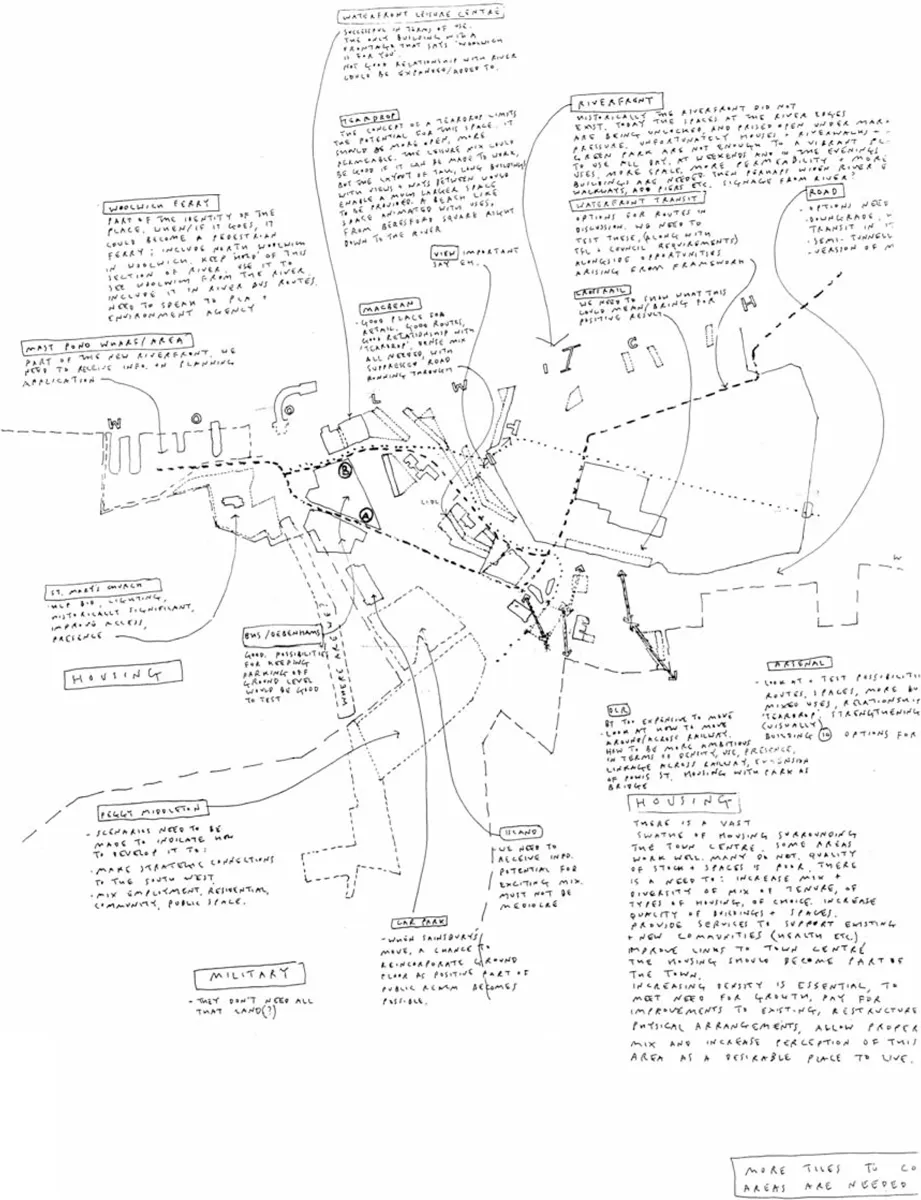

Project: Woolwich Development Framework
Location: London, UK
Architect: East
Date: 2003
Development framework study. East has developed a technique called ‘hairy drawing’. It involves several people sitting a...
Table of contents
- Cover
- Title Page
- Contents
- Introduction
- The design studio
- The design process
- The design project
- Conclusion
- Further resources
- Picture credits
- Acknowledgements
- Working with ethics
- eCopyright
Trusted by 375,005 students
Access to over 1.5 million titles for a fair monthly price.
Study more efficiently using our study tools.
Frequently asked questions
Yes, you can cancel anytime from the Subscription tab in your account settings on the Perlego website. Your subscription will stay active until the end of your current billing period. Learn how to cancel your subscription
No, books cannot be downloaded as external files, such as PDFs, for use outside of Perlego. However, you can download books within the Perlego app for offline reading on mobile or tablet. Learn how to download books offline
Perlego offers two plans: Essential and Complete
- Essential is ideal for learners and professionals who enjoy exploring a wide range of subjects. Access the Essential Library with 800,000+ trusted titles and best-sellers across business, personal growth, and the humanities. Includes unlimited reading time and Standard Read Aloud voice.
- Complete: Perfect for advanced learners and researchers needing full, unrestricted access. Unlock 1.5M+ books across hundreds of subjects, including academic and specialized titles. The Complete Plan also includes advanced features like Premium Read Aloud and Research Assistant.
We are an online textbook subscription service, where you can get access to an entire online library for less than the price of a single book per month. With over 1.5 million books across 990+ topics, we’ve got you covered! Learn about our mission
Look out for the read-aloud symbol on your next book to see if you can listen to it. The read-aloud tool reads text aloud for you, highlighting the text as it is being read. You can pause it, speed it up and slow it down. Learn more about Read Aloud
Yes! You can use the Perlego app on both iOS and Android devices to read anytime, anywhere — even offline. Perfect for commutes or when you’re on the go.
Please note we cannot support devices running on iOS 13 and Android 7 or earlier. Learn more about using the app
Please note we cannot support devices running on iOS 13 and Android 7 or earlier. Learn more about using the app
Yes, you can access Basics Architecture 03: Architectural Design by Jane Anderson in PDF and/or ePUB format, as well as other popular books in Architecture & Architecture Design. We have over 1.5 million books available in our catalogue for you to explore.