The Improv Handbook is the most comprehensive, smart, helpful and inspiring guide to improv available today. Applicable to comedians, actors, public speakers and anyone who needs to think on their toes, it features a range of games, interviews, descriptions and exercises that illuminate and illustrate the exciting world of improvised performance.
First published in 2008, this second edition features a new foreword by comedian Mike McShane, as well as new exercises on endings, managing blind offers and master-servant games, plus new and expanded interviews with Keith Johnstone, Neil Mullarkey, Jeffrey Sweet and Paul Rogan.
The Improv Handbook is a one-stop guide to the exciting world of improvisation. Whether you're a beginner, an expert, or would just love to try it if you weren't too scared, The Improv Handbook will guide you every step of the way.
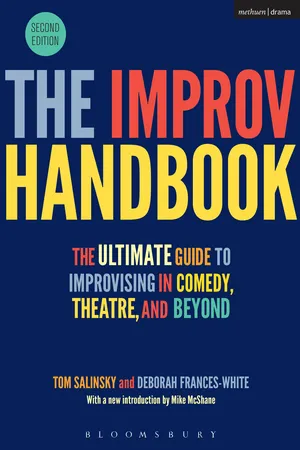
eBook - ePub
The Improv Handbook
The Ultimate Guide to Improvising in Comedy, Theatre, and Beyond
- 520 pages
- English
- ePUB (mobile friendly)
- Available on iOS & Android
eBook - ePub
The Improv Handbook
The Ultimate Guide to Improvising in Comedy, Theatre, and Beyond
About this book
Information
SECTION TWO
How to Improvise
2.1
How to Use This Section
If you want to learn to improvise, you should go and take some improv classes. There, we’ve said it. Put down this book, go on Facebook, or do a Google search, and find some. It almost doesn’t matter how good they are. Even if you’re saddled with a moon-faced fool who blathers endlessly on about “truth” and lets turgid scenes waffle pointlessly on forever, or a ruthlessly cynical comedian who tells you with no trace of enjoyment which tricks “always make ’em laugh,” you will gain far more from the experience of actually working with other people, without a script, in front of even an informal audience than you can ever learn from passively reading a book.
But that doesn’t make this section of the book useless or pointless. Over the pages which follow, we have described what would happen if you were in one of our workshops, often with a little more detail about what is going on “under the hood” than might be apparent if you were simply attending the class. Our hope is that this will be a useful manual for teachers and students, experienced improvisers and novices.
If you are reading this book as someone who is new to teaching improv, we also highly recommend reading Impro by Keith Johnstone (a life-changing book for anyone). Having an open mind and a genuine desire to see the students improve would also be excellent. You could then adapt the exercises given here into a syllabus for your students, tailoring them as necessary to suit their particular requirements, but we hope not confining them entirely to a classroom or rehearsal room. This stuff was meant to be staged.
If you are a more experienced improvisation teacher, you may be reading this for fresh inspiration, some contentious viewpoints to get you charged up and questioning again or just for some new exercises to cherry-pick from to freshen up your classes.
Alternatively, you might be a school teacher looking to liven up a dreary syllabus or trying to avoid staging yet another production of West Side Story with under-fifteens. You may work at a drama school and see how scared the students seem—especially of improvisation—and wonder if that fear can really be helping them. You could use some of the exercises in this book to alleviate their anxiety and remind them why they wanted to become actors in the first place.
You could also be an experienced improviser looking for a fresh take on the nuts and bolts of improvisation. You may find new games and new exercises here, which you can bring back to your group, but if you’re craving novelty and new games, you are likely to be frustrated by the emphasis here on craft and process. We’re more interested in what games teach improvisers about the business of improvising for performance than in learning a wide variety of “hoop” games.
You could be one of a group of people starting an improvisation company from scratch. The exercises described here begin at the beginning, with no prior knowledge or experience assumed, so the designated director could work through this section of the book, chapter by chapter, coaching the group as they go. Or you could take a chapter each. At some point, however, you’ll probably benefit from having a more experienced coach take a dispassionate look at what you’re doing. The act of teaching can itself be fraught with anxiety, especially when working from someone else’s syllabus, and that will cloud your vision.
Finally, we imagine that there will be members of the improv and theatre community who want to read this book, and this section in particular, not necessarily to go out and put it into action, but just to be stimulated about the challenge of improvisation and listen to our take on various topics.
We welcome all readers (including those not mentioned here) and hope you enjoy the book and find it of practical use.
2.2
Teaching and Learning
Whether you are attending improvisation classes or teaching them, it is important to know that the words “Can I have a volunteer?” often ignite feelings of fear and anxiety. People who have paid to be at the class, or have sometimes paid for three years of drama school, will often avoid eye contact with the teacher when this request is made.
It is not always like this, however. On some occasions, if a volunteer is asked for, every single person puts their hands up and some actually rush forward. That’s when those people are children.
Children approach playing games, or doing exercises, or being given the chance to try something new, very differently from adults. Children approach these situations with one mission, and that mission is to have lots of goes. They sometimes actually rate their success that way: “I had four goes and you only had three—I win!”
Adults are very different. We want to sit back, assess—from our seats!—whether we’d be any good at the task in question. If we think we’d be successful at it, then and only then will we want a go. If we think it is something we would not be good at, we would usually prefer to have no go at all.
Children want lots of goes, but adults want one perfect go.
As adults, we’ve already decided what we’re good at and what we’re bad at, and we only want to have goes at things we’re already good at. We’ve met lots of people who’ve told us they can’t draw, but none of them was seven years old. All children think they’re brilliant artists and want their drawings displayed on the refrigerator. As adults, even if we secretly think we can draw, we hide our sketches away under the bed: “Don’t look at those—they’re just some silly things I was doodling.” The thing is, we all were those children. We believed we were great artists, we sang and danced when we were happy and acted out cops and robbers for hours. No one ever stopped and said, “I’m not a very good robber. I’ve run out of ideas. I think I need to research my character.” We always had endless ideas. Endless positivity. Endless faith in our own talent. What happened to us?
One answer is: our education. We hope at least that your education was free because, wherever you got it, it has screwed you over and transformed you from someone who volunteered fearlessly and believed in your own creative abilities into someone who is unwilling to get up at all in case “you make a fool of yourself,” and who claims they “can’t” sing, dance, draw, act or speak in public and who has no imagination.
When you’re at school, if the teacher tells the class to write an essay and everyone else is writing, and you’re just sitting there, all Zen and relaxed, thinking about your essay, what will happen? The teacher will shout at you. She’ll say, “You! You’re not even trying.” She would know if you were trying because trying looks like something. If your shoulders are hunched and you look worried and a little ill, then the teacher will probably come and do it for you. We learn to look anxious before we do things—like we’re not up to it.
We also tend to punish ourselves after we do things. Two adults will volunteer for something, and after they finish they’ll make a physical gesture of apology which says to the room: “No need to mention it—we know it wasn’t very good.” Maybe this is because we teach our children to punish themselves if they suspect they’ve failed. When you’re a kid, if you’re washing dishes and you break a plate and you say, “Well, never mind, everyone drops things from time to time,” and you clean it up in a relaxed and happy fashion, your mother will shout at you. That in our society is a “bad attitude.” A “good attitude” is to cry and feel worthless. Then your mother will say, “Never mind, darling, it was only an accident,” and clean it up for you. Therefore, as adults, we anticipate this; we’ve learned to. We look anxious before and after everything we do to avoid punishment from others.
This means we come to any learning opportunity, like an improv workshop, feeling tense and anxious. If that was a good state for learning or creativity that would be great, but unfortunately you’re less likely to be good at learning—or any creative pursuit—with a gun pointed to your head. The fact is you’re the most able to learn, create and improvise when you’re most yourself. Think about it: are you more witty, sparky and full of ideas when you’re with your oldest friends and a bottle of wine or when you’re on a job interview? Your inner improviser is far more likely to be with you when you’re relaxed.
It follows that the people who are most successful at learning to improvise are those who are most relaxed. We tell our students that their only mission is to have lots of goes and see if we’re worth our money. We say, “I’m the only one who’s shown up claiming to be an expert and therefore I’m the only one who should be nervous.” If they can already do everything we show them very well, that makes our job very difficult. As teachers it’s our job to find things the students can’t do and show them how to do them. Education is not coming to the workshop pre-educated. We tell them “I’m hoping for a very high level of failure in this workshop, otherwise how can I take your money in good conscience?” We say if they can do everything we show them perfectly, they should ask for their money back because it means we’re not teaching them anything new.
On the other hand, we say that if they’re no better at the end of the workshop, they should ask for their money back as well, because that can’t possibly be their fault. It must by ours. We really believe that if we’re taking the money we absolutely need to take responsibility for what happens in the workshop. If there’s someone who’s not getting any better, it’s our job to find a way to get through to them, and if we can’t, we should be prepared to offer them their money back. Too many teachers blame their students and get frustrated with people they see as talentless. We really don’t think anyone is talentless, especially at improvising. We all have our experiences to bring which will inspire stories worth telling. Some of us may be more natural performers than others, but others will be better storytellers or more happily collaborative. As a teacher, try and see what your students are bringing with them. As a learner, the best advice we can offer is to listen to what your teacher says, have lots of goes and see if they’re worth their money.
This is not to say that you should go into the room with a “prove yourself” attitude toward the teacher. Be positive and open and contribute to the kind of supportive environment you want to learn in. Be supportive and interested in other improvisers’ work. Just don’t take the burden of responsibility for learning onto your shoulders. Let your teacher do that.
Teaching at RADA, we’ve talked to the students about their hopes for the course. It’s a big honor to go to RADA and so most people go there with the hope that their whole three years will be filled with classes where they will be the star. Their hope is that all their goes will be wonderful ones and the teacher in each class will say, “That was a wonderful go. I wish all the rest of the students could have a go as wonderful as that one.” No one comes to RADA hoping to fail. We think that this is a strange attitude to bring to a learning experience (despite the fact that it is overwhelmingly common), because it means the student is hoping not to be educated but validated.
Compare this to taking your car to a mechanic because it’s making a strange noise. It’s frustrating if the car won’t make the noise when the mechanic’s there, because then they can’t diagnose it. So you drive away and there’s that damned noise again. If you go to drama school or improv classes and the teacher only sees your very best work, they will never have an opportunity to diagnose you and help fix your weaknesses. You will then go on stage and your weaknesses will come out. Sadly, all your goes in class were so good that your weaknesses went unnoticed. We say to the students we teach at RADA, “Some days you’ll be great all day and the teachers will only be able to praise you. If that happens, it happens. Never mind. Maybe you’ll have a worse day tomorrow.” We usually get groups to say, “We suck and we love to fail!” in order to get them into the right counterintuitive headspace. This was something that Patti Stiles invented for her time in Lond...
Table of contents
- Cover
- Half Title
- Title
- Dedication
- Contents
- Foreword
- Introduction to the Second Edition
- Introduction
- Section One: What Is Improvisation?
- Section Two: How to Improvise
- Section Three: How to Improvise in Public
- Section Four: Making Improvisation Pay
- Section Five: Talking to Improvisers
- Afterword
- Appendix One: Games
- Appendix Two: Syllabus
- Glossary of Terms
- Thanks
- Bibliography
- Index
- eCopyright
Trusted by 375,005 students
Access to over 1.5 million titles for a fair monthly price.
Study more efficiently using our study tools.
Frequently asked questions
Yes, you can cancel anytime from the Subscription tab in your account settings on the Perlego website. Your subscription will stay active until the end of your current billing period. Learn how to cancel your subscription
No, books cannot be downloaded as external files, such as PDFs, for use outside of Perlego. However, you can download books within the Perlego app for offline reading on mobile or tablet. Learn how to download books offline
Perlego offers two plans: Essential and Complete
- Essential is ideal for learners and professionals who enjoy exploring a wide range of subjects. Access the Essential Library with 800,000+ trusted titles and best-sellers across business, personal growth, and the humanities. Includes unlimited reading time and Standard Read Aloud voice.
- Complete: Perfect for advanced learners and researchers needing full, unrestricted access. Unlock 1.5M+ books across hundreds of subjects, including academic and specialized titles. The Complete Plan also includes advanced features like Premium Read Aloud and Research Assistant.
We are an online textbook subscription service, where you can get access to an entire online library for less than the price of a single book per month. With over 1.5 million books across 990+ topics, we’ve got you covered! Learn about our mission
Look out for the read-aloud symbol on your next book to see if you can listen to it. The read-aloud tool reads text aloud for you, highlighting the text as it is being read. You can pause it, speed it up and slow it down. Learn more about Read Aloud
Yes! You can use the Perlego app on both iOS and Android devices to read anytime, anywhere — even offline. Perfect for commutes or when you’re on the go.
Please note we cannot support devices running on iOS 13 and Android 7 or earlier. Learn more about using the app
Please note we cannot support devices running on iOS 13 and Android 7 or earlier. Learn more about using the app
Yes, you can access The Improv Handbook by Tom Salinsky,Deborah Frances-White in PDF and/or ePUB format, as well as other popular books in Medios de comunicación y artes escénicas & Actuación y audiciones. We have over 1.5 million books available in our catalogue for you to explore.