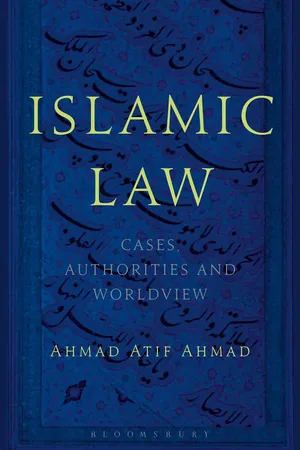
Introducing undergraduate students to Islamic law, this accessible textbook does not presume legal or technical knowledge. Drawing on a comparative approach, it encourages students to think through the issues of the application of Islamic law where Muslims live as a majority and where they live as a minority, including the USA, Saudia Arabia, Egypt, Pakistan.
The book surveys the historical development as well as the contemporary contexts of Islamic law. In distilling the history of Islamic law for non-specialists, the author covers important topics such as the development and transformation of Islamic institutions before and after colonialism. Coverage of Islamic law across contemporary contexts draws on real case material, and allows for discussion of Islam as a legal and a moral code that is activated both inside and outside the court.
Readers will learn about rituals, dietary restrictions, family, contracts and property, lawful and unlawful gain, criminal law and punishments, and what makes a government legitimate in the eyes of Muslim individuals and authorities.
- 225 pages
- English
- PDF
- Available on iOS & Android
eBook - PDF
About this book
Information
Table of contents
- Cover page
- Halftitle page
- Series page
- Title page
- Copyright page
- Contents
- Illustrations
- Acknowledgments
- Preliminaries
- Calendars, terms, and conventions
- Introduction
- 1 Three Cases
- 2 Madhhabs
- 3 Theorizing the Shari‘a
- 4 The Social Shari‘a
- 5 The Personal Shari‘a
- 6 The National Shari‘as
- 7 The Transnational Shari‘a
- 8 The Triangle of Society, Law, and Government
- Final Review
- Appendix I A debate between Shafi‘i (d. 204/820) and Ahmad Ibn Hanbal (d. 241/856) (On a Muslim who does not deny the prayers are obligatory but does not perform them.)
- Appendix II Map of Muslim populations around the world
- Appendix III Preamble to Pakistan’s Constitution (4/12/73)
- Appendix IV Inheritance tables
- Appendix V Islamic mortgage resources
- Further reading
- Index
Trusted by 375,005 students
Access to over 1.5 million titles for a fair monthly price.
Study more efficiently using our study tools.
Frequently asked questions
Yes, you can cancel anytime from the Subscription tab in your account settings on the Perlego website. Your subscription will stay active until the end of your current billing period. Learn how to cancel your subscription
No, books cannot be downloaded as external files, such as PDFs, for use outside of Perlego. However, you can download books within the Perlego app for offline reading on mobile or tablet. Learn how to download books offline
Perlego offers two plans: Essential and Complete
- Essential is ideal for learners and professionals who enjoy exploring a wide range of subjects. Access the Essential Library with 800,000+ trusted titles and best-sellers across business, personal growth, and the humanities. Includes unlimited reading time and Standard Read Aloud voice.
- Complete: Perfect for advanced learners and researchers needing full, unrestricted access. Unlock 1.5M+ books across hundreds of subjects, including academic and specialized titles. The Complete Plan also includes advanced features like Premium Read Aloud and Research Assistant.
We are an online textbook subscription service, where you can get access to an entire online library for less than the price of a single book per month. With over 1.5 million books across 990+ topics, we’ve got you covered! Learn about our mission
Look out for the read-aloud symbol on your next book to see if you can listen to it. The read-aloud tool reads text aloud for you, highlighting the text as it is being read. You can pause it, speed it up and slow it down. Learn more about Read Aloud
Yes! You can use the Perlego app on both iOS and Android devices to read anytime, anywhere — even offline. Perfect for commutes or when you’re on the go.
Please note we cannot support devices running on iOS 13 and Android 7 or earlier. Learn more about using the app
Please note we cannot support devices running on iOS 13 and Android 7 or earlier. Learn more about using the app
Yes, you can access Islamic Law by Ahmad Atif Ahmad in PDF and/or ePUB format, as well as other popular books in Teologia e religione & Teologia islamica. We have over 1.5 million books available in our catalogue for you to explore.