1
What Is Quality Inclusion?
Erin E. Barton and Jaclyn D. Joseph
TOOLS FROM THE TOOLBOX
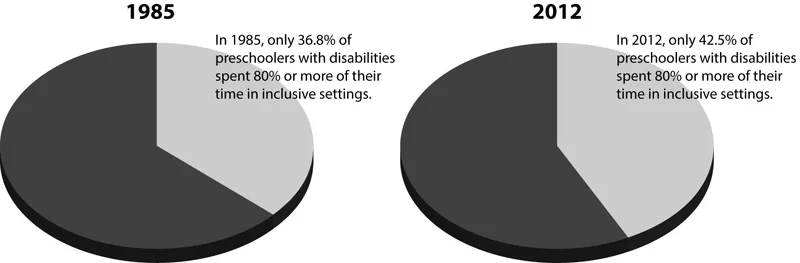
• Figure 1.1 National Data on the Slow Progress of Preschool Inclusion
• Figure 1.2 Preschool Inclusion Framework
• Figure 1.3 Inclusion For Preschool Children With Disabilities: What We Know And What We Should Be Doing
• Form 1.1 Preschool Inclusion Self-Checklist
The purpose of this chapter is to provide several important introductory tools for your preschool inclusion toolbox. First, we briefly discuss the state of inclusion in the United States. Then, we discuss our preschool inclusion framework. Finally, as part of our inclusion framework, the empirically supported, effective components of inclusion are presented. As noted in the Introduction, the first step to establishing high-quality preschool inclusion services and systems is to create a preschool inclusion team. Chapter 3 describes specific strategies and logistics for ensuring the preschool inclusion team is focused and effective. One of the first things the team will do is review the data and research on preschool inclusion. This chapter will be helpful in that initial phase of work.
STATE OF PRESCHOOL INCLUSION IN THE UNITED STATES
As shown in Figure 1.1, a comparison of the 2012 IDEA data (which was the most recent information available at the time of printing) to the 1985 IDEA data indicates that the practice of providing special education and related services to children ages 3–5 years old in regular EC settings increased by only 5.7% in 27 years.
The limited improvement from 1985 to 2012 suggests administrators might need support for designing services, implementing systems, and crafting policies that support the inclusion of young children with disabilities in high-quality EC settings.
APPLICATION QUESTION
You can find state-specific information about preschool inclusion and IDEA at http://www.ideadata.org. What is the percentage of children with disabilities spending 80% or more of their time in inclusive settings in your state? Are you surprised with what you found? Discuss these questions with your preschool inclusion team.
EMPIRICAL AND LEGAL SUPPORT FOR PRESCHOOL INCLUSION
Research consistently demonstrates that high-quality and responsive environments are associated with positive outcomes for young children, including for children with disabilities (Camilli et al., 2010; Espinosa, 2002; Pianta, Barnett, Burchinal, & Thornburg, 2009). High-quality inclusive classrooms with adequate ratios of more competent peers, in particular, are related to positive outcomes for children with disabilities (Justice, Logan, Lin, & Kaderavek, 2014). Preschool inclusion has been at the heart of policy, professional standards, and research for decades. For more than 30 years, IDEA and other federal and state policies in EC (e.g., Head Start) have promoted delivering educational services for children with disabilities in which education is delivered for typically developing children. The fact sheet on research support and the fact sheet on IDEA provisions, provided in Appendixes IA and IB, describe the academic and legal foundations for preschool inclusion.
DIVISION FOR EARLY CHILDHOOD/NATIONAL ASSOCIATION FOR THE EDUCATION OF YOUNG CHILDREN JOINT POSITION STATEMENT ON INCLUSION
As noted in the Introduction, the two prominent EC professional associations, DEC and NAEYC, jointly developed and published a statement advocating for and supporting interdisciplinary, inclusive early care and education for all young children. The focus on cross-sector collaboration provides new opportunities at the state and local levels to engage in meaningful dialogue around critical issues for children with disabilities within the broader EC systems (Woods & Snyder, 2009). This is especially important given the fragmented nature of the EC intervention and education system and the need to ensure quality inclusion for young children with disabilities (Buysse & Hollingsworth, 2009; Odom, Buysse, & Soukakou, 2011). The diverse EC systems (e.g., Head Start, child care, public school) need to work together to ensure sufficient support for children with disabilities, their families, and the practitioners who work with them (Hayden, Frederick, & Smith, 2003).
The position statement, provided in Appendix IC, defines EC inclusion and identifies the relevant features and recommendations for developing quality inclusive preschool programs. Their definition of inclusion is as follows (DEC/NAEYC, 2009, p. 2):
Early childhood inclusion embodies the values, policies, and practices that support the right of every infant and young child and his or her family, regardless of ability, to participate in a broad range of activities and contexts as full members of families, communities, and society. The desired results of inclusive experiences for children with and without disabilities and their families include a sense of belonging and membership, positive social relationships and friendships, and development and learning to reach their full potential. The defining features of inclusion that can be used to identify high quality early childhood programs and services are access, participation, and supports.
Access refers to providing an adequate range of contextually relevant learning opportunities, activities, and settings for every child by enhancing physical accessibility, identifying and eradicating physical or structural barriers, and offering multiple and varied learning opportunities. The goal is to ensure that all children have access to effective learning environments; typical routines, activities, and settings; and general education curricula.
Participation means there is a focus on ensuring all children are active, independent participants in their families, classrooms, and communities. This means adults promote learning and engagement by using a range of instructional practices, from embedded to more explicit, to ensure all children have opportunities to engage, participate, and learn across all domains. Adults use individualized accommodations, modifications, and adaptations to promote active participation and a sense of belonging for all children in typical settings and learning environments. Participation should be driven by the needs of each individual child and his or her family.
Supports refers to broader, infrastructure-level support to the administrators, teachers, staff, and so forth, in providing high-quality programs. This means programs should ensure all adults involved have access to quality PD, effective ongoing follow-up assistance, and support for collaborative teaming. This also requires having effective policies in place that promote and incentivize high-quality preschool inclusion. See Figure 1.2 for...