- 176 pages
- English
- ePUB (mobile friendly)
- Available on iOS & Android
eBook - ePub
Abstract Expressionism For Beginners
About this book
Abstract Expressionism was the defining movement in American art during the years following World War II making New York City the center of the international art scene. But what the heck did it mean! The drips the spills the splashes the blotches of color the wild spontaneous energy—signifying what?Abstract Expressionism For Beginners will not only help you understand but also appreciate the art of some of the most iconic figures in modern art—Jackson Pollock Willem de Kooning Mark Rothko Helen Frankenthaler and others. Explore their lives and artistic roots the heady world of Greenwich Village in the 1940s and 1950s the influence of jazz the voices of critics and the enduring legacy of a uniquely inspired group of artists.
Information
Topic
ArtSubtopic
Art TechniquesCHAPTER 1
What Abstract Expressionism Isn't
Anyone searching for a precise, codified definition of Abstract Expressionism is, sadly, bound to come up short. The Abstract Expressionists were the most famous contingent of painters in the history of American art. They were emphatic about what art should and shouldn't be, but they were equally emphatic about not creating a concise, manifesto-driven movement with all the defined strictures that implied. They were going against the grain of the established art world. The established art world had definitions and rules. The Abstract Expressionists, to say the least, weren't enthralled with rules.
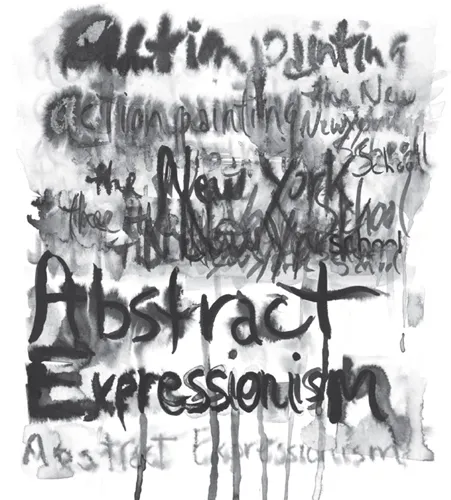
The very term abstract expressionism, as a matter of fact, was a label not of these painters' own choosing, but a name imposed by others. The wider art world of critics, curators, and gallery owners needed a good, shorthand tag line to describe this new, emerging school of painting. Action painting or simply the New York School came into parlance. But Abstract Expressionism—a phrase that had been floating around for a while and predated these particular painters—was the name that stuck.

Even the precise definition of who is and isn't an Abstract Expressionist is sometimes up for debate. And to muddy the waters even further, there is another group of artists called the second-generation Abstract Expressionists, who came up slightly later in the chronology.
On many levels, this vagueness of definition is the norm when it comes to new creative movements. That legendary coterie of American writers during the 1920s, for example, did not proclaim their intent to go off and create the “Lost Generation” school of literature; it was something that evolved. Likewise, the revolutionary jazz musicians who emerged after the end of World War II—musicians who, not incidentally, had a huge impact on the Abstract Expressionists—did not convene a meeting to announce to the world that a new form of jazz, called bebop, was about to be launched. The nature of artistic movements stems from creative alchemy, those unique historical and cultural circumstances when the right people come together at the right time to forge something that had never been seen or heard before. The same very much applies to the Abstract Expressionist painters. Their emergence cannot be fully explained.
Another complicating factor when it comes to truly defining Abstract Expressionism is the curve balls thrown by the painters themselves. These brash new artists consciously positioned themselves in direct opposition to the art establishment. For that matter, they consciously positioned themselves in opposition to stuffy societal mores in general. Metaphorically, they were throwing a brick into the window of the American art world. And if that brick also landed in other windows, that was okay too. Definitions, to the Abstract Expressionists, were confining, limiting. “To classify,” Mark Rothko, one of Abstract Expressionism's principal talents, asserted, “is to embalm.”
The painters also had disparate styles. While they shared many of the same influences and creative impulses and certainly learned from each other, the Abstract Expressionist painters had widely varying techniques and worldviews. This, too, is not uncommon when innovations in art and music come on the scene. The new wave of rock 'n roll in the 1970s, for example, is often treated as a discrete, specific movement even as that view blurs the huge distinctions between the street-smart Ramones and the art school–cerebral Talking Heads. Both bands came out at the same cultural moment, yet they were worlds apart. Likewise, the AbEx (short for Abstract Expressionism/Abstract Expressionist) painters had different backgrounds, personalities, and behavior patterns. What came out on their canvases reflected these differences. It was very much an individualist's way of approaching painting, which makes it harder to ascribe stylistic specifics to AbEx as a whole. The artists were militantly individualistic. An encapsulated definition of what they were all undertaking was intrinsically difficult: the aims and processes varied from one painter to the other.
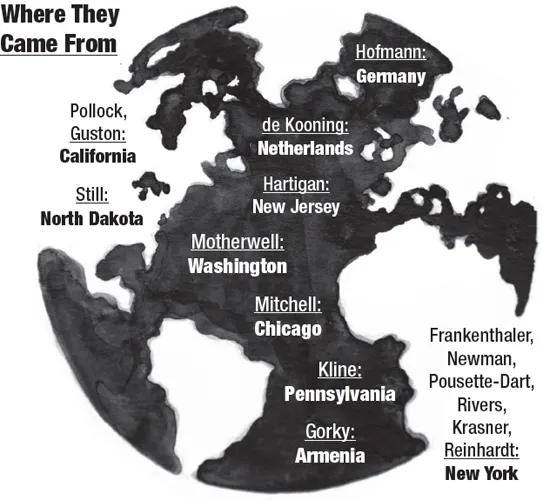
The rough-hewn Jackson Pollock was very much a product of the American West. Willem de Kooning, raised in the Netherlands, came to the United States as a ship's stowaway. Joan Mitchell was the product of a well-heeled, artistic Chicago family. In many respects, these painters didn't have much in common. What they did have in common, of course, was crucial: The thrown brick heard 'round the art world.
CHAPTER 2
So ... What Exactly (More or Less) Is Abstract Expressionism?
Abstract Expressionism may have lacked a concise definition, but the specifics far outweighed the differences: It was, after all, a discrete movement. The name itself is instructive. These were abstract painters, disregarding representational strictures. There was not much regard given to recognizable objects or even painting basics like the horizon line.
But the expressionist component was equally vital. The AbEx painters would have been horrified to have their work regarded as simply academic exercises in space and shapes, or unconventional painting simply for the sake of being unconventional. They were undertaking expressive studies in human emotion—sadness, fear, happiness—and to do these expressive studies they reached out into the greater world and into their own subconscious.
What else? The AbEx painters painted large. Many had gotten their start during the Depression, painting—under the auspices of the New Deal—large, bold murals, and this carried over into their artwork a decade later. Abstract Expressionism also took jazz's improvisatory ethos and transferred it to the canvas. They often used unconventional material, such as sign paint and collage. They were based in New York City.
The fact that they were centered in New York was vitally important for a number of reasons. The fabled city itself—massive and colorful—had a huge impact on Abstract Expressionism's collective psyche.
New York City after World War II was a teeming, frenetic place, providing enough grist for any art in any medium. With Europe in ruins, the city had emerged as the true international colossus. New York was the new Rome, with all that implied: a cacophony of highs and lows. Musicians, painters, writers, actors, and poets made their way to New York, which became a creative incubus with ample opportunity for artistic cross-pollination. It was a feast for creative types and bohemians. And it was also, of course, noisy, dirty, and poor. New York City—in all its grand contradictions—pulsated throughout much of the Abstract Expressionist oeuvre.
There was an equally significant practical aspect: The painters lived and worked in close proximity to each other. It was a concentrated space. Those sharing a like-minded worldview could interact on a constant basis (a condition that applied to all creative types, not just painters)—for better and for worse.
These upstart painters coalesced in Lower Manhattan. In a variety of ways they began to find each other. It was like sending out a beacon—sooner or later, you hope, someone flashes a light back at you. In crowded, downtown New York, the beacons flashed back and forth. In cheap cafeterias, bars, and galleries, like-minded painters bonded.
In 1949 that contingent of painters who soon emerged as the Abstract Expressionists rented a loft that became known as the Club, a place to meet and exchange ideas on a regular basis. A few years later, a seedy downtown bar called the Cedar Tavern became the legendary nexus of Abstract Expressionism, where the painters could be found night after night. The rough-and-tumble of Greenwich Village functioned as the AbEx training ground and salon.
Another key component to this movement was so overt that it risks restating the obvious: Abstract Expressionism was, well, abstract. By its very intent, it eschewed the representational and emphatically rejected the notion of painting cheery, inspirational studies of fields and mountains. Pastoral views were, of course, in short supply in New York City. (Just for the record, though, a good deal of the AbEx body of work does reference beauty and nature.) For the AbEx painters, there was a larger issue at hand. Their intent was to look elsewhere—far elsewhere, in many cases—for artistic inspiration. These painters set out in all manner of ways to dispense with conventional notions about what painting should be. Abstract Expressionist painters mined the subconscious, which was hardly a common motif in American painting. They used unconventional materials to make their artwork; some even utilized commercial paint, which was designed for use on signs and billboards. What sort of painter did that? Abstract Expressionism also incorporated music and literature into their paintings—and this was not just a passive interest. Jazz was pulsating all over New York City, just a stroll away from the artists' studios or the Cedar Tavern. It was just a stroll away from anywhere, really, which was the beauty of living in New York City.
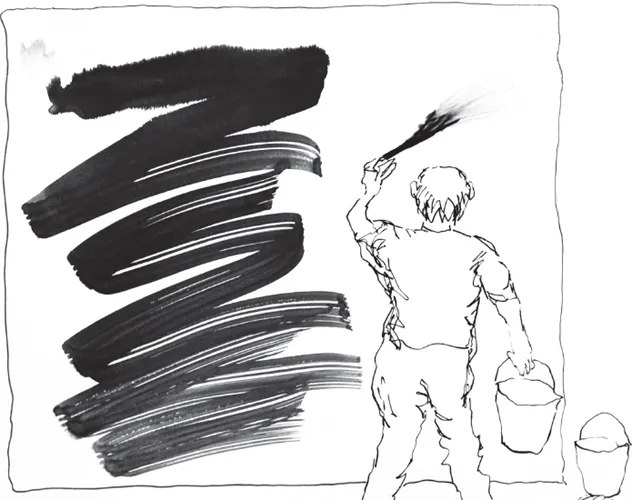
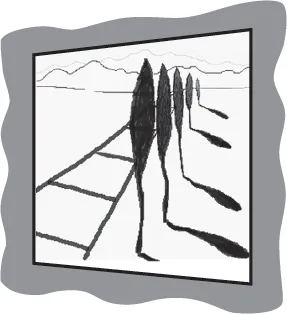
Another common element of their aesthetic was a theoretical emphasis on the flatness of the canvas. For centuries, painters had executed their own special trickster magic: fooling the viewer into forgetting that what they were gazing at was, after all, a simple rectangular slab with paint all over it. Accordingly, painters had used the tools of their trade to convey that there was much more to be seen than a mere chunk of canvas. There was the illusion of depth, of perspective, of space, out of which new worlds could be created. The creative magic was loosely related to that of writing. In much the same way, writers historically didn't want to draw attention to the fact that a book was simply a bound stack of paper with print all over it. They didn't want to draw attention to the fact that Madame Bovary wasn't ...
Table of contents
- Cover Page
- Title Page
- Copyright
- CONTENTS
- Dedication
- FOREWORD
- INTRODUCTION
- CHAPTER 1: What Abstract Expressionism Isn't
- CHAPTER 2: So ... What Exactly (More or Less) Is Abstract Expressionism?
- CHAPTER 3: Artistic License
- CHAPTER 4: Worldwide Web
- CHAPTER 5: Let's Make a (New) Deal
- CHAPTER 6: Tales of Hofmann
- CHAPTER 7: Birth of the Cool
- CHAPTER 8: Jackson Pollock: The Icebreaker
- CHAPTER 9: Made in New York
- CHAPTER 10: Infinite Jest
- CHAPTER 11: All That Jazz
- CHAPTER 12: Aiding and Abetting
- CHAPTER 13: Artful Dodging
- GLOSSARY
- FURTHER READING
- OTHER RESOURCES
- ABOUT THE AUTHOR AND ILLUSTRATOR
Trusted by 375,005 students
Access to over 1.5 million titles for a fair monthly price.
Study more efficiently using our study tools.
Frequently asked questions
Yes, you can cancel anytime from the Subscription tab in your account settings on the Perlego website. Your subscription will stay active until the end of your current billing period. Learn how to cancel your subscription
No, books cannot be downloaded as external files, such as PDFs, for use outside of Perlego. However, you can download books within the Perlego app for offline reading on mobile or tablet. Learn how to download books offline
Perlego offers two plans: Essential and Complete
- Essential is ideal for learners and professionals who enjoy exploring a wide range of subjects. Access the Essential Library with 800,000+ trusted titles and best-sellers across business, personal growth, and the humanities. Includes unlimited reading time and Standard Read Aloud voice.
- Complete: Perfect for advanced learners and researchers needing full, unrestricted access. Unlock 1.5M+ books across hundreds of subjects, including academic and specialized titles. The Complete Plan also includes advanced features like Premium Read Aloud and Research Assistant.
We are an online textbook subscription service, where you can get access to an entire online library for less than the price of a single book per month. With over 1.5 million books across 990+ topics, we’ve got you covered! Learn about our mission
Look out for the read-aloud symbol on your next book to see if you can listen to it. The read-aloud tool reads text aloud for you, highlighting the text as it is being read. You can pause it, speed it up and slow it down. Learn more about Read Aloud
Yes! You can use the Perlego app on both iOS and Android devices to read anytime, anywhere — even offline. Perfect for commutes or when you’re on the go.
Please note we cannot support devices running on iOS 13 and Android 7 or earlier. Learn more about using the app
Please note we cannot support devices running on iOS 13 and Android 7 or earlier. Learn more about using the app
Yes, you can access Abstract Expressionism For Beginners by Richard Klin,Lily Prince in PDF and/or ePUB format, as well as other popular books in Art & Art Techniques. We have over 1.5 million books available in our catalogue for you to explore.