Commentary on Patanjali's sutras. Updated edition.
- 465 pages
- English
- ePUB (mobile friendly)
- Available on iOS & Android
eBook - ePub
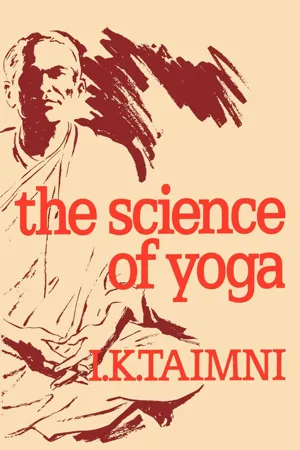
The Science of Yoga
About this book
Information
SECTION II
SĀDHANA PĀDA
SĀDHANA PĀDA

Tapaḥ-svādhyāyeśvara-praṇidhānāni kriyā-yogaḥ.


1. Austerity, self-study and resignation to Iśvara constitute preliminary Yoga.
The last three of the five elements of Niyama enumerated in II-32 have been placed in the above Sūtra under the title of Kriyā-Yoga. This is rather an unusual procedure and we should try to grasp the significance of this repetition in a book which attempts to condense knowledge to the utmost limit. Obviously, the reason why Tapas, Svādhyāya and Iśvara-praṇidhāna are mentioned in two different contexts lies in the fact that they serve two different purposes. And since the development of the subject of self-culture in Section II of the Yoga-Sūtras is progressive in character it follows that the purpose of these three elements in II-1 is of a more preliminary nature than that in II-32. Their purpose in 11-32 is the same as that of the other elements of Niyama and has been discussed at the proper place. What is the purpose in the context of II-1? Let us see.
Anyone who is familiar with the goal of Yogic life and the kind of effort it involves for its attainment will realize that it is neither possible nor advisable for anybody who is absorbed in the life of the world and completely under the influence of Kleśas to plunge all at once into the regular practice of Yoga. If he is sufficiently interested in the Yogic philosophy and wants to enter the path which leads to its goal he should first accustom himself to discipline, should acquire the necessary knowledge of the Dharma-Śāstras and especially of the Yoga-Śāstras and should reduce the intensity of his egoism and all the other Kleśas which are derived from it. The difference between the outlook and the life of the ordinary worldly man and the life which the Yogi is required to live is so great that a sudden change from the one to the other is hot possible and if attempted may produce a violent reaction in the mind of the aspirant, throwing him back with still greater force into the life of the world. A preparatory period of self-training in which he gradually assimilates the Yogic philosophy and its technique and accustoms himself to self-discipline makes the transition from the one life to the other easier and safer. It also incidentally enables the mere student to find out whether he is sufficiently keen to adopt the Yogic life and make a serious attempt to realize the Yogic ideal. There are too many cases of enthusiastic aspirants who for no apparent reason cool off, or finding the Yogic discipline too irksome, give it up. They are not yet ready for the Yogic life.
Even where there is present the required earnestness and the determination to tread the path of Yoga it is necessary to establish a permanent mood and habit of pursuing its ideal. Mere wishing or willing is not enough. All the mental powers and desires of the Sādhaka should be polarized and aligned with the Yogic ideal. Many aspirants have very confused and sometimes totally wrong ideas with regard to the object and technique of Yoga. Many of them have very exaggerated notions with regard to their earnestness and capacity to tread the path of Yoga. Their ideas become clarified and their capacity and earnestness are tested severely in trying to practise Kriyā-Yoga. They either emerge from the preliminary self-discipline with a clearly defined aim and a determination and capacity to pursue it to the end with vigour and single-minded devotion, or they gradually realize that they are not yet ready for the practice of Yoga and decide to tune their aspiration to the lower key of mere intellectual study.
This preparatory self-discipline is triple in its nature corresponding to the triple nature of a human being. Tapas is related to his will, Svādhyāya to the intellect and Iśvara-praṇidhāna to the emotions. This discipline, therefore, tests and develops all the three aspects of his nature and produces an all-round and balanced growth of the individuality which is so essential for the attainment of any high ideal. This point will become clear when we consider the significance of these three elements of Kriyā-Yoga in dealing with II-32.
There exists some confusion with regard to the meaning of the Saṃskṛta word Kriyā, some commentators preferring to translate it as ‘preliminary’ others as ‘practical’. As a matter of fact Kriyā-Yoga is both practical and preliminary. It is preliminary because it has to be taken up in the initial stages of the practice of Yoga and it is practical because it puts to a practical test the aspirations and earnestness of the Sādhaka and develops in him the capacity to begin the practice of Yoga as distinguished from its mere theoretical study however deep this might be.

Samādhi-bhāvanārthaḥ kleśa-tanūkara-ṇārthaś ca.


2. (Kriyā-Yoga) is practised for attenuating Kleśas and bringing about Samādhi.
Although the practice of the three elements of Kriyā-Yoga is supposed to subserve the preparatory training of the aspirant it should not therefore be assumed that they are of secondary importance and have only a limited use in the life of the Sādhaka. How effective this training is and to what exalted stage of development it is capable of leading the aspirant will be seen from the second Sūtra which we are considering and which gives the results of practising Kriyā-Yoga. Kriyā-Yoga not only attenuates the Kleśas and thus lays the foundation of the Yogic life but it also leads the aspirant to Samādhi, the essential and final technique of Yoga. It is, therefore, also capable of building to a great extent the superstructure of the Yogic life. The importance of Kriyā-Yoga and the high stage of development to which it can lead the Sādhaka will be clear when we have considered the ultimate results of practising Tapas, Svādhyāya and Iśvara-praṇidhāna in II-43-45.
The ultimate stage of Samādhi is, of course, reached through the practice of Iśvara-praṇidhāna as indicated in I-23 and II-45. Although the two results of practising Kriyā-Yoga enumerated in II-2 are related to the initial and ultimate stages of Yogic practice they are really very closely connected and in a sense complementary. The more the Kleśas are attenuated the greater becomes the capacity of the Sādhaka to practise Samādhi and the nearer he draws to his goal of Kaivalya. When the Kleśas have been reduced to the vanishing point he is in habitual Samādhi (Sahaja-Samādhi), at the threshold of Kaivalya.
We shall take up the discussion of these three elements of Kriyā-Yoga as part of Niyama in II-32.

Avidyāsmitā-rāga-dveṣābhiniveśāḥ kleśāḥ.


3. The lack of awareness of Reality, the sense of egoism or ‘I-am-ness’ attractions and repulsions towards objects and the strong desire for life are the great afflictions or causes of all miseries in life.
The philosophy of Kleśas is really the foundation of the system of Yoga outlined by Patañjali. It is necessary to understand thi...
Table of contents
- Cover
- Half Title
- Title
- Copyright
- Preface
- Contents
- SECTION I
- SECTION II
- SECTION III
- SECTION IV
Trusted by 375,005 students
Access to over 1.5 million titles for a fair monthly price.
Study more efficiently using our study tools.
Frequently asked questions
Yes, you can cancel anytime from the Subscription tab in your account settings on the Perlego website. Your subscription will stay active until the end of your current billing period. Learn how to cancel your subscription
No, books cannot be downloaded as external files, such as PDFs, for use outside of Perlego. However, you can download books within the Perlego app for offline reading on mobile or tablet. Learn how to download books offline
Perlego offers two plans: Essential and Complete
- Essential is ideal for learners and professionals who enjoy exploring a wide range of subjects. Access the Essential Library with 800,000+ trusted titles and best-sellers across business, personal growth, and the humanities. Includes unlimited reading time and Standard Read Aloud voice.
- Complete: Perfect for advanced learners and researchers needing full, unrestricted access. Unlock 1.5M+ books across hundreds of subjects, including academic and specialized titles. The Complete Plan also includes advanced features like Premium Read Aloud and Research Assistant.
We are an online textbook subscription service, where you can get access to an entire online library for less than the price of a single book per month. With over 1.5 million books across 990+ topics, we’ve got you covered! Learn about our mission
Look out for the read-aloud symbol on your next book to see if you can listen to it. The read-aloud tool reads text aloud for you, highlighting the text as it is being read. You can pause it, speed it up and slow it down. Learn more about Read Aloud
Yes! You can use the Perlego app on both iOS and Android devices to read anytime, anywhere — even offline. Perfect for commutes or when you’re on the go.
Please note we cannot support devices running on iOS 13 and Android 7 or earlier. Learn more about using the app
Please note we cannot support devices running on iOS 13 and Android 7 or earlier. Learn more about using the app
Yes, you can access The Science of Yoga by I. K. Taimni in PDF and/or ePUB format, as well as other popular books in Biological Sciences & Philosophical Metaphysics. We have over 1.5 million books available in our catalogue for you to explore.