- 128 pages
- English
- ePUB (mobile friendly)
- Available on iOS & Android
eBook - ePub
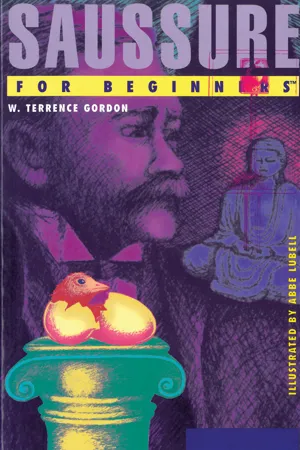
Saussure For Beginners
About this book
A concise accessible introduction to the great linguist who shaped the study of language for the 20th century Saussure for Beginners puts the challenging ideas of Ferdinand de Saussure (1857-1913) into clear and illuminating terms focusing on the unifying principles of his teachings and showing how his thoughts on linguistics migrated to anthropology.Ferdinand de Saussure's work is so powerful that it not only redefined modern linguistics it also opened our minds to new ways of approaching anthropology literary criticism and psychoanalysis. Saussure felt that 19th century linguistics avoided hard questions about what language is and how it works. By 1911 he had taught a general linguistics course only three times. Upon his death however his students were so inspired by his teachings that they published them as the "Course in General Linguistics."Saussure For Beginners takes you through this course points out the unifying principles and shows how these ideas migrated from linguistics to other subjects.
Information
INDEX
abstraction, 58
acoustic image, 18, 21–22
agglutination, 78–79
anagrams, 105–8
analogy, 70–79
false, 71
anthropology, 96–98
Aristotle, 12
association, 54–58, 72, 76
Barthes, Roland, 6, 98–100
Bloomfield, Leonard, 91–93
child language, 62–63, 74
Chomsky, Noam, 37, 93–95
code, 85
complex sign, 56–58, 68, 74
concept, 18, 21–22, 40
concrete object, 58
consonants, 61
Constantin, Emile, 8
context, 42–43
contrast, 48–49, 51–52
Cours de linguistique générale (Course in General Linguistics)(Saussure), 1–2, 8, 18
deconstruction, 103–4
Derrida, Jacques, 6, 7–9, 103–4
diachronic fact, 69
diachronic linguistics, 30–36, 59–82
doublet, 68
dualities (paired terms)
(Saussure's), 16–17, 103–4, 116
etymology, 66–68
folk or popular, 76–79
Firth, J. R., 37, 38
form, 39, 42–43, 69, 74–75
Gadet, Françoise, 102
grammatical system, 57–58
Guillaume, Gustave, 6, 86–88
Guiraud, Pierre, 89–91
idea, 38, 44, 48
identity, 41–43, 80–81
ideograph, 115–16
Indo-European, 3–4
irregular forms, 70–72
Jakobson, Roman, 6, 83–...
Table of contents
- Cover Page
- Title Page
- Copyright
- Contents
- Dedication
- Introduction
- Was there linguistics before Saussure?
- Definition of the linguistic sign
- How did Saussure break with earlier ways of analyzing language and why?
- The most important lessons in the Course in General Linguistics
- The linguistic sign
- Synchronic and diachronic analysis
- The elements of language
- Context and contrast create synchronic identity
- Synchronic identity is separable from synchronic value
- Language is a system of values
- The link between sound and thought in the lingistic sign
- Linguistic forms
- Oppostions among signs
- Linear and nonlinear relations
- Diachronic linguistics
- Analogy
- Agglutination
- European structuralism
- Gustave Guillaume (1883-1960)
- Pierre Guiraud (1912-1982)
- Leonard Bloomfield (1887-1949)
- Noam Chomsky (1928- )
- Claude Lévi Strauss (1906- )
- Roland Barthes (1915-1980)
- Jacques Lacan (1901-1981)
- Jacques Derrida (1930- )
- Anagrams
- Saussure at a glance
- Appendix
- Index
Trusted by 375,005 students
Access to over 1.5 million titles for a fair monthly price.
Study more efficiently using our study tools.
Frequently asked questions
Yes, you can cancel anytime from the Subscription tab in your account settings on the Perlego website. Your subscription will stay active until the end of your current billing period. Learn how to cancel your subscription
No, books cannot be downloaded as external files, such as PDFs, for use outside of Perlego. However, you can download books within the Perlego app for offline reading on mobile or tablet. Learn how to download books offline
Perlego offers two plans: Essential and Complete
- Essential is ideal for learners and professionals who enjoy exploring a wide range of subjects. Access the Essential Library with 800,000+ trusted titles and best-sellers across business, personal growth, and the humanities. Includes unlimited reading time and Standard Read Aloud voice.
- Complete: Perfect for advanced learners and researchers needing full, unrestricted access. Unlock 1.5M+ books across hundreds of subjects, including academic and specialized titles. The Complete Plan also includes advanced features like Premium Read Aloud and Research Assistant.
We are an online textbook subscription service, where you can get access to an entire online library for less than the price of a single book per month. With over 1.5 million books across 990+ topics, we’ve got you covered! Learn about our mission
Look out for the read-aloud symbol on your next book to see if you can listen to it. The read-aloud tool reads text aloud for you, highlighting the text as it is being read. You can pause it, speed it up and slow it down. Learn more about Read Aloud
Yes! You can use the Perlego app on both iOS and Android devices to read anytime, anywhere — even offline. Perfect for commutes or when you’re on the go.
Please note we cannot support devices running on iOS 13 and Android 7 or earlier. Learn more about using the app
Please note we cannot support devices running on iOS 13 and Android 7 or earlier. Learn more about using the app
Yes, you can access Saussure For Beginners by W. Terrence Gordon,Abbe Lubell in PDF and/or ePUB format, as well as other popular books in Languages & Linguistics & Linguistics. We have over 1.5 million books available in our catalogue for you to explore.