- 200 pages
- English
- ePUB (mobile friendly)
- Available on iOS & Android
eBook - ePub
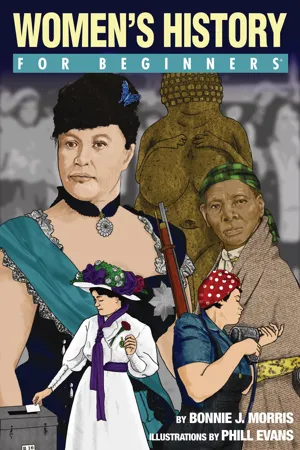
Women's History For Beginners
About this book
Women's History For Beginners offers a lively revealing and provocative overview of this important (and controversial) academic field. Who are the great women of history and why don't we know more about them? You don't need to be a scholar to notice that men's history dominates everything we learn in school; yet a quick tour of the past reveals dynamic female role models at every turn.This is more than an introduction to women's roles and contributions across time. It also examines the ways that women in all societies have been ruled by men according to law and custom. Women's History For Beginners opens with a critical investigation of why so few of us are exposed to women's history in our years of schooling—and why educators and political groups remain leery of bringing fair accurate women's history content into the classroom even now. It concludes with the reminder that women too are divided by race and class and nationality; that there is no one-size-fits-all women's history but many different versions each worthy of investigation and understanding.
Information
Chapter One
Why We Don’t Learn
Women’s History in School

Updating the way that world history is taught presents a real challenge for educational institutions. Despite what you may have heard about colleges being havens for radical faculty, sexism still pervades the halls of academia. A strong ratio of female to male students is one kind of statistic; it is not reflected in faculty appointments, where most tenured, full professors are male. This is especially true in history departments, which grant more degrees to men than to women. At the high school/prep school level, it’s more common to find men teaching history, and male teachers outnumber females at the annual College Board AP Reading in U.S. History. The AP exam itself primarily asks students to write responsively about men’s history and leadership, though this is changing.
Until quite recently, women weren’t welcome in higher education, even as students. Their very bodies were restricted to certain schools (women’s colleges, religious seminaries, “finishing” schools, teacher-training institutions), certain spaces (women had separate campuses, had to live in specific dormitories with curfews and chaperones), certain majors (nursing, education, English). This meant that women were not present in the classroom to advocate for their own inclusion and representation. We can see that this was also true in terms of women’s visibility in government and politics, the media, sports, and so forth.
From the late eighteenth century all the way to the late 1970s, the issue of allowing women in higher education created an uproar.3 Women (and their male allies) fought to allow female students into medical school, law school, and graduate programs. The story of women in American history—and elsewhere—is largely about female exclusion from basic institutions like schools. To examine this past is more than just a subject of academic inquiry, or an approach to understanding social change. Women’s history is also a cause: an ongoing effort to assure half the world of fair representation in the human record, and to preserve women’s memories as truthfully/authentically as possible. For example, girls aspiring to Ivy League colleges today should learn that up until 1969, the smartest women in the world could not apply to Princeton, Harvard, or Yale. And for several years after that, women were only allowed in through a fixed quota system requiring three or four males to be accepted for every female student grudgingly enrolled. (Harvard did not adopt sex-blind admissions until 1976.)
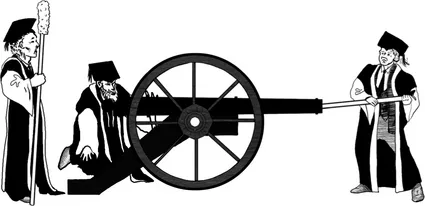
Some critics oppose altering the academic canon (traditionally assigned class readings, essential documents penned by men) to include additional coursework, arguing that women’s history—like black history, Native American studies, etc.—is mere political correctness masquerading as a humanities discipline. Conservative women, too, have contended that more inclusive historical perspectives will just replace the “timeless truths” of Western heritage with a radical agenda. (More on this later.)
Historians, students, archivists, and others in the women’s history field believe that a rational and balanced inquiry into the past must include what women were doing at the time, not just men. However, at most institutions of higher learning, women’s history is a separate specialty. These courses are not always available to interested students—even at top private schools and colleges. Regrettably, where women’s history courses and majors do exist, some faculty advisors discourage bright students from enrolling, scoffing at the value of such coursework.
One may get the sense that the study of women is not just neglected, but downright forbidden. Here are some reasons why women’s history is left out of what we learn:
Women’s roles stem from religious teachings. To examine women’s history is to deconstruct, or take apart, the scriptural teachings on women’s status that led to long-lasting attitudes and state laws. Critical reviews of holy religious texts are offensive to many people of faith: Isn’t it blasphemy to second-guess what God/Allah/Saint Paul/Confucius intended? Should public schools risk alienating the parents of many different faiths?
Threats to male status. Women’s history makes men look bad, and undermines male authority. Powerful male leaders in history, the very men who symbolize human rights and democratic progress, turn out to be wife-beaters, adulterers, or hypocrites who consistently voted down women’s rights. (As I write, former California Governor Arnold Schwarzenegger has just revealed that he fathered a child with one of his domestic employees—a woman hired to assist his own wife.) What happens when the female experience of history reveals too much about men? It’s a nightmare for history teachers, charged with instilling patriotism.
Sexuality and the body. Today’s teachers are still urged to avoid discussions of sex and sexuality in the K–12 classroom; such curricula, if allowed at all, are tightly controlled. Alas, much of women’s history is about the nitty-gritty of virginity, chastity, reproduction, and sexual reputation. Would students have to have parental permission to learn women’s history? (It may seem funny that parents nonetheless accept their kids being exposed to violence in the movies, videogames, or cartoons, as well as standard history lessons about heroic battles. But plenty of people prefer fictional or glorified violence to material about girls’ rights.)
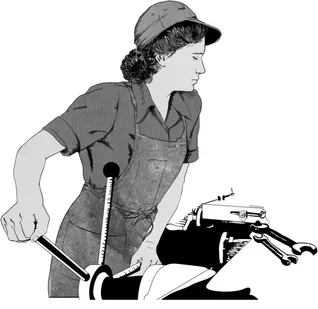
Preserving traditional family roles. The annoyance factor of adding women’s history material to a school year already jammed with standardized tests is one thing. But for many conservative parents and educators, it’s also an ideological imposition. Beginning in the early 1980s, America’s powerful right-wing evangelical lobby began mounting campaigns to preserve traditional family values in government, law, and education. Many parents upset with values discussions in the classroom (including open debate on the intended role of women) began home schooling their children. To this day, in Texas, conservative school boards make sure that the textbooks ordered for public schools uphold roles consistent with conservative teachings on the American family. School-board approval wields enormous economic clout in a place like Texas, which places more schoolbook orders than any other state system.
All four of these rationalizations for excluding women’s history are interconnected, as we’ll see. Basically, looking at and admiring women [the female body] has been forbidden by most religions, so that looking at and admiring women’s history, too, takes men into problematic terrain. Much of Scripture suggests that women are temptresses, unclean, and dangerous to men. Just consider the problem of Eve. The very first woman—according to the Bible, which informs so much of Western heritage—ruined everything.4
Religious Teachings on Women
For Jews and Christians, women’s history begins with the appearance of Eve, the first woman, in Genesis. However, sharp-eyed Bible scholars know there are two different creation stories. The earliest passage, Genesis 1:27, suggests that God made male and female at the same time: “male and female he created them.” This seems to put both sexes on an equal and even holy basis; both made at the same time, and in the image of God.
Later, Genesis 2:21–23 offers a very different story, telling us that man—or Adam—was created first, formed out of dust. While Adam slept, God took one of Adam’s ribs to create a female companion for him, Eve. This version establishes woman as the “second sex,” and, importantly, as being created both from and for man. “She shall be called Woman, because she was taken out of Man.”5
Many of the negative qualities ascribed to women throughout Western history stem from Adam and Eve’s disobedience in the Garden of Eden. Eve, lured by the snake (women are easily led astray by the devil: guard them!), decides to taste the forbidden fruit on the Tree of Knowledge. (Women are willful and disobedient: punish them! Knowledge will corrupt good women: keep them ignorant!) By disobeying God’s command to resist the apple, Eve tempts Adam to sin as well. (Women are the cause of man’s downfall; men must not trust women; women should not lead men.)
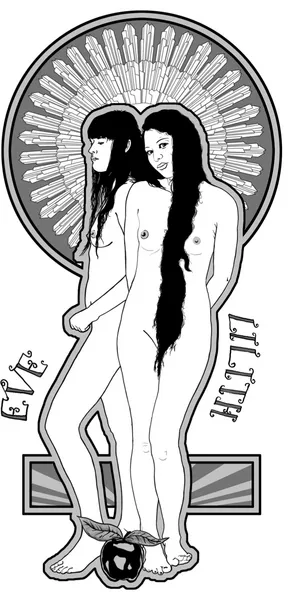
My student Taylor, raised as a churchgoing Christian, clearly remembers being introduced to this material. “I learned that God was so angry at Eve because she had brought sin into the world. Hearing this for the first time, I remember being excited that there was a girl in the story because Bible stories were mostly about men … But one thing I walked away with was that women were more naïve back then. I knew that I would have been able to stick to the rules.” Taylor’s mixed response, as a child, is understandable: She longed to identify with the female in the story, but refused to accept the premise that all women are naturally naïve or inclined toward disobedience.
In relating God’s punishments for Adam and Eve, the Bible establishes clearly different sex roles for men and women. In Genesis 3:17, God tells Adam “Because you have listened to the voice of your wife … cursed is the ground.” Adam will “earn his bread by the sweat of his face” (male = breadwinner); Genesis 3:16 commands Eve to suffer what we still call “the curse” of menstruation and labor pains. “I will greatly multiply your pain in childbirth: In pain you shall bring forth children, yet your desire shall be for your husband, and he shall rule over you.” Having demonstrated her need for a tight leash, Eve will forever be controlled by her uterus and her husband. These basic story lines effectively limited women for centuries thereafter; even a desire for education could be seen as a willful girl’s quest for that forbidden Tree of Knowledge. As soon as girls were able to menstruate, they were married to husbands who gained complete legal control over their lives.
Both Judaism and Christianity reinforce additional restrictions on women’s bodies and minds. Many of these are found in Leviticus, in the Hebrew Bible; for instance, Leviticus chapters 12 and 15 tell us that women are unclean during their menstrual periods, and that this uncleanliness is “catching”; so men, beware! Leviticus 15:19: “When a woman has a discharge of blood which is her regular discharge from her body, she shall be in her impurity for seven days, and whoever touches her shall be unclean … and everything upon which she lies during her impurity shall be unclean; everything also upon which she sits shall be unclean.” These blood impurities also applied after childbirth. Significantly, we learn in Leviticus that Moses is to instruct the people of Israel “If a woman conceives, and bears a male child, then she shall be unclean seven days, as at the time of her menstruation, she shall be unclean.” On the eighth day, when she is clean and may reemerge in mixed company, her newborn son is circumcised, a ceremony welcoming him into tribal membership. “Then she shall continue for thirty-three days in the blood of her purifying; she shall not touch any hallowed thing, nor come into the sanctuary, until the days of her purifying are completed. But if she bears a female child, then she shall be unclean two weeks, as in her menstruation, and she shall continue in the blood of her purifying for sixty-six days.” In other words, the birth of a girl results in double uncleanliness, and is not celebrated with a tribal ritual after the mother completes her seclusion. Eventually, some variations of these customs were incorporated into Christian and Catholic practices; in some eras Catholic women could not receive communion during their periods, and mothers recovering from childbirth were not allowed to be present at a child’s baptism.
But consider the math: A woman is kept apart from men and from the sanctuary for two weeks of menstrual impurity. Since Judaism’s tacharos mishpocha (laws of family purity) allow a wife to have marital relations with her husband only du...
Table of contents
- Cover
- Title Page
- Copyright
- Contents
- Dedication
- Introduction: A Women’s History Final Exam
- Chapter One: Why We Don’t Learn Women’s History in School
- Chapter Two: A Basic Walking Tour Through the Past
- Chapter Three: Not All Women’s History Looks the Same
- Chapter Four: Who Turned Women’s History Into an Important Field?
- Chapter Five: What’s the Impact of the Field? Responses From Students and Scholars
- The For Beginners Series
Trusted by 375,005 students
Access to over 1.5 million titles for a fair monthly price.
Study more efficiently using our study tools.
Frequently asked questions
Yes, you can cancel anytime from the Subscription tab in your account settings on the Perlego website. Your subscription will stay active until the end of your current billing period. Learn how to cancel your subscription
No, books cannot be downloaded as external files, such as PDFs, for use outside of Perlego. However, you can download books within the Perlego app for offline reading on mobile or tablet. Learn how to download books offline
Perlego offers two plans: Essential and Complete
- Essential is ideal for learners and professionals who enjoy exploring a wide range of subjects. Access the Essential Library with 800,000+ trusted titles and best-sellers across business, personal growth, and the humanities. Includes unlimited reading time and Standard Read Aloud voice.
- Complete: Perfect for advanced learners and researchers needing full, unrestricted access. Unlock 1.5M+ books across hundreds of subjects, including academic and specialized titles. The Complete Plan also includes advanced features like Premium Read Aloud and Research Assistant.
We are an online textbook subscription service, where you can get access to an entire online library for less than the price of a single book per month. With over 1.5 million books across 990+ topics, we’ve got you covered! Learn about our mission
Look out for the read-aloud symbol on your next book to see if you can listen to it. The read-aloud tool reads text aloud for you, highlighting the text as it is being read. You can pause it, speed it up and slow it down. Learn more about Read Aloud
Yes! You can use the Perlego app on both iOS and Android devices to read anytime, anywhere — even offline. Perfect for commutes or when you’re on the go.
Please note we cannot support devices running on iOS 13 and Android 7 or earlier. Learn more about using the app
Please note we cannot support devices running on iOS 13 and Android 7 or earlier. Learn more about using the app
Yes, you can access Women's History For Beginners by Bonnie J. Morris,Phill Evens,Bonnie Morris in PDF and/or ePUB format, as well as other popular books in Social Sciences & Gender Studies. We have over 1.5 million books available in our catalogue for you to explore.