- 192 pages
- English
- ePUB (mobile friendly)
- Available on iOS & Android
eBook - ePub
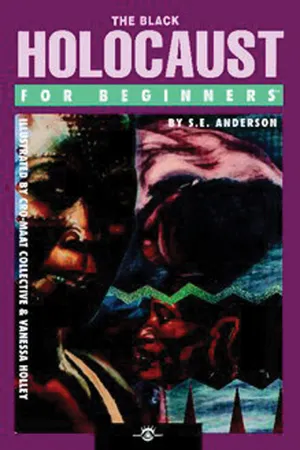
Black Holocaust For Beginners
About this book
Virtually anyone anywhere knows that six million Jewish human beings were killed in the Jewish Holocaust. But how many African human beings were killed in the Black Holocaust – from the start of the European slave trade (c. 1500) to the Civil War (1865)? And how many were enslaved? The Black Holocaust a travesty that killed millions of African human beings is the most underreported major event in world history. A major economic event for Europe and Asia a near fatal event for Africa the seminal event in the history of every African American – if not every American! – and most of us cannot answer the simplest question about it. Here is a sample of what you will get from the painstakingly researched painfully honest The Black Holocaust For Beginners:"The total number of slaves imported is not known. It is estimated that nearly 900000 came to America in the 16th Century 2.75 million in the 17th Century 7 million in the 18th and over 4 million in the 19th – perhaps 15 million in total. Probably every slave imported represented on average five corpses in Africa or on the high seas. The American slave trade therefore meant the elimination of at least 60 million Africans from their fatherland."The Black Holocaust For Beginners – part indisputably documented chronicle part passionately engaging narrative puts the tragic event in plain sight where it belongs! The long overdue book answers all of your questions sensitively and in great depth.
Information
LET US BEGIN WITH A FEW REAL ANSWERS TO OLD QUESTIONS

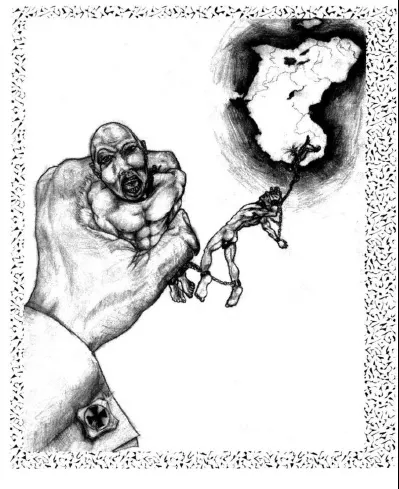
–Lerone Bennett: Before the Mayflower
WHEN DID THE BLACK HOLOCAUST BEGIN?
It began with the Arab slave trade of around 700 AD, with Europeans (Portuguese) entering the picture around 1442.
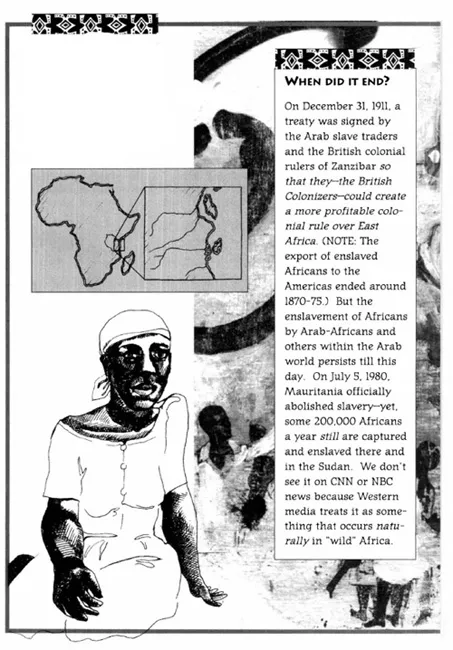
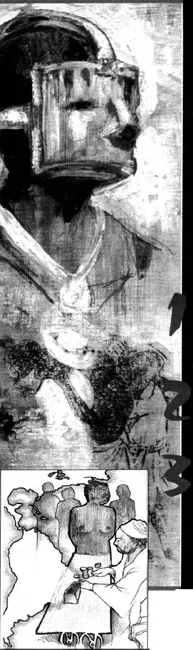
“THE AFRICAN SLAVE TRADE: 1995”
African Americans…are comforted only by the assurance that the buying and selling of Black Africans ended in the distant past. But such a belief is myth.
It has become clear that the enslavement of Black Africans did not stop with the demise of the Atlantic Slave Trade. That on this very day and hour, as you read this, there are Black people being bought and sold in two North African countries [Mauritania & Sudan].
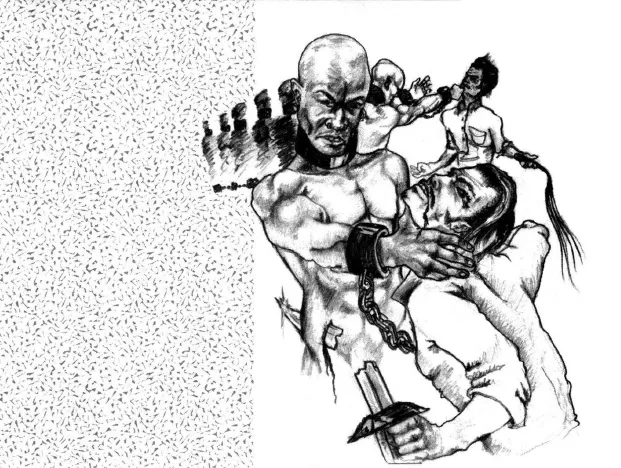
“Routine punishments for the slightest fault Include beatings, denial of food and prolonged exposure to the sun, with hands and feet tied together. Serious infringement of the master’s rule can mean prolonged tortures, as documented in a report by Africa Watch. These include:
The ‘camel treatment,’ where a human being is wrapped around the belly of a dehydrated camel and tied there. The camel in then given water to drink until its belly expands enough to tear the slave apart.
The ‘insect treatment,’ where insects are put into a person’s ears. The ears are waxed shut. The arms and legs are bound. The person goes insane from the bugs running around in his head.
The ‘burning coals,’ where the victim is sealed flat, with his legs spread out. He is then buried in sand up to his waist until he cannot move. Coals are placed between his legs and are burnt slowly. After a while, the legs, thighs, and sex of the victim are burnt. There are other gruesome tortures– none of which is fit to describe in a family newspaper “states Africa Watch.” –Samuel Cotton, The City SUN [Feb.7,1995]
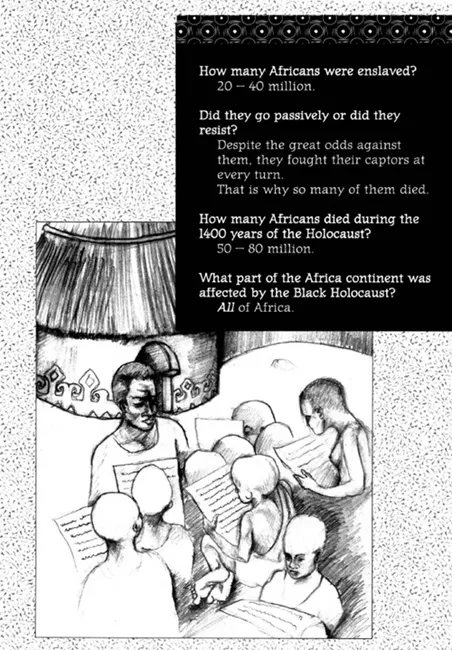
Were Africans always enslaved by whites and Arabs?
NO!
Were and are people of African descent less intelligent than white folks?
Of course not!
Did white Europeans “discover” Africans swinging from trees in the “jungles” of Africa and bring them “civilization?”
Of course not! (Unless virtual genocide is your idea of “civilization.”)
Were Africans steeped in superstition and ignorant of Science & Technology?
Of course not!
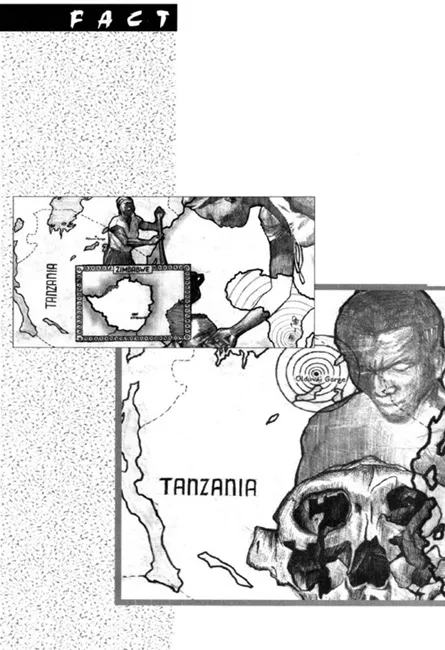
Humanity had its beginnings in Africa more than 3 million years ago with the first beings to walk upright and have opposable thumbs to grab and control sticks and stones as extensions of the hand. In other words, Africans invented tools and weapons to help themselves not only survive but thrive as well. To this date, the earliest bones of human beings were and are still being found in the Olduvai Gorge in east Africa, a region covering an area almost as big as the United States.
Over a million years ago, humans began migrating out of the Olduvai Gorge region in search of food and shelter. Others stayed in the rich, fertile regions around the Nile Valley, which runs through Africa for thousands of miles (longer than the distance between New York and Los Angeles!). About 250,000 years ago, early Africans began a major diet shift that helped increase brain size. They began to live longer (to about 40 years), walk more upright, create larger and more complex social relations which, in turn, helped them have more babies that survived to adulthood.
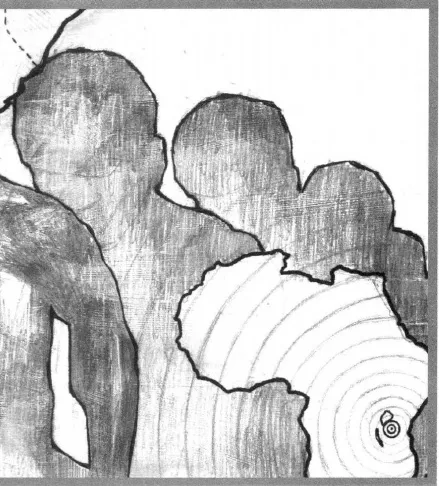
Around 50,000 years ago, some of these extended families and clans began to settle around the southern region of the Olduvai Gorge and began to establish control over their food–farming! They discovered the relationships between soil, rain, rivers, sun and phases of the moon and living things. This settling down gave them more time to think about their world and the universe around them. Men and women were engaged in this effort to understand everything. Eventually, men became the dominant figures within their societies (although there were exceptions found in Africa and elsewhere where women were the dominant political force). Social relations become even more complex, and a hierarchy developed, i.e., priests and priestesses who possessed knowledge of Nature and divine rulers; “average” men and women who had to work long, hard hours to compensate for those who did not work.
We have evidence of one of these early, highly developed societies in a region we call Zimbabwe today. It is a FACT that Africans were smelting iron some 40,000 years ago! (That is not a misprint! Smelting was done in the area now called Tanzania, not far south of the Olduvai Gorge, the location of L.S.B. Leakey’s findings of the earliest humanoid skulls.) Smelting iron requires a serious division of labor (miners, farmers, metalworkers, hunters…), an apprenticeship educational system, excellent hunting techniques and weaponry, and knowledge of how and where to trade.

This knowledge and culture spread north along the rivers and valleys that flowed into the Nile River. After about 20,000 more years of learning through trial and error and observation, the Africans of the Nubian/Kush region (today we call it the Sudan, Ethiopia, Eritrea, Somalia) developed a very sophisticated civilization. This is not to say that there were no other equally sophisticated civilizations. Rather, to date, we have more archaeological evidence of the Kush people than, say, the Ishongo people of the Congo region or the people of Zimbabwe. What we do know about this region of Africa is that for thousands of years the people developed their intellect and knowledge of Nature to such a high degree that...
Table of contents
- Coverpage
- Titlepage
- Copyright
- Table of Contents
- Dedication
- Introduction
- PART 1: The REAL Historical Foundations of African Civilization & Slavery
- PART 2: The EUROPEAN SLAVE TRADE – the Eyewitness Accounts
- PART 3: Slaveships & the MiddlePassage
- PART 4: The DEATH SHIPS–the Narrative
- PART 5: In Search of the Real Numbers
- PART 6: What YOU Can Do
- “CHAIN WAVES”—A POEM
- ABOUT THE AUTHOR
- ABOUT THE ILLUSTRATORS
- INDEX
Trusted by 375,005 students
Access to over 1.5 million titles for a fair monthly price.
Study more efficiently using our study tools.
Frequently asked questions
Yes, you can cancel anytime from the Subscription tab in your account settings on the Perlego website. Your subscription will stay active until the end of your current billing period. Learn how to cancel your subscription
No, books cannot be downloaded as external files, such as PDFs, for use outside of Perlego. However, you can download books within the Perlego app for offline reading on mobile or tablet. Learn how to download books offline
Perlego offers two plans: Essential and Complete
- Essential is ideal for learners and professionals who enjoy exploring a wide range of subjects. Access the Essential Library with 800,000+ trusted titles and best-sellers across business, personal growth, and the humanities. Includes unlimited reading time and Standard Read Aloud voice.
- Complete: Perfect for advanced learners and researchers needing full, unrestricted access. Unlock 1.5M+ books across hundreds of subjects, including academic and specialized titles. The Complete Plan also includes advanced features like Premium Read Aloud and Research Assistant.
We are an online textbook subscription service, where you can get access to an entire online library for less than the price of a single book per month. With over 1.5 million books across 990+ topics, we’ve got you covered! Learn about our mission
Look out for the read-aloud symbol on your next book to see if you can listen to it. The read-aloud tool reads text aloud for you, highlighting the text as it is being read. You can pause it, speed it up and slow it down. Learn more about Read Aloud
Yes! You can use the Perlego app on both iOS and Android devices to read anytime, anywhere — even offline. Perfect for commutes or when you’re on the go.
Please note we cannot support devices running on iOS 13 and Android 7 or earlier. Learn more about using the app
Please note we cannot support devices running on iOS 13 and Android 7 or earlier. Learn more about using the app
Yes, you can access Black Holocaust For Beginners by S.E. Anderson,Vanessa Holley in PDF and/or ePUB format, as well as other popular books in Social Sciences & Slavery. We have over 1.5 million books available in our catalogue for you to explore.