
- 176 pages
- English
- ePUB (mobile friendly)
- Available on iOS & Android
eBook - ePub
Zen For Beginners
About this book
Zen from its foundation in China of the 6th Century A.D. has always been more than a religion. It is an intriguing system of principles and practices designed to give each individual the experience of eternity in a split second the knowledge of divinity in every living thing.To create a book about Zen however is risky. It is one thing to describe the factual history of this exotic strain of Buddhism. It's quite another thing to successfully convey the crazy wisdom of the Zen masters their zany sense of humor and their uncanny ability to pass on the experience of enlightenment to their students.The authors of Zen For Beginners have clearly overcome these considerable risks. The book uses an engaging mix of clear informative writing and delightful illustrations to document the story of Zen from its impact on Chinese and Japanese culture to its influence on American writers such as Allen Ginsberg Jack Kerouac and Gary Snyder. The paradoxical teaching stories and style of the Zen master are also shown as important keys to understanding Oriental art literature architecture and attitudes towards life and death.
Information
Topic
PhilosophySubtopic
Eastern Philosophy
Here we are back in China. It is the 8th century and the golden age of Zen has begun. The followers of Hui-neng's sudden enlightenment style have multiplied like mushrooms after the rain. Everyone is trying hard to find new ways to induce a sudden breakthrough into the enlightened state of mind.
The most prominent figures in this group are Ma-tsu (709–788) and Shih-tou (700–790).
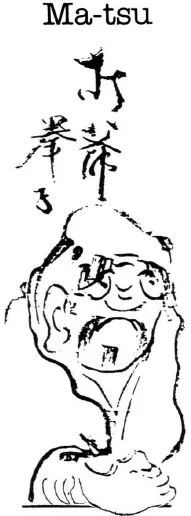
Ma-tsu was the inventor of almost all famous “hard” Zen methods. Punches, kicks, and even beatings, and deafening shouts were his most favorite.
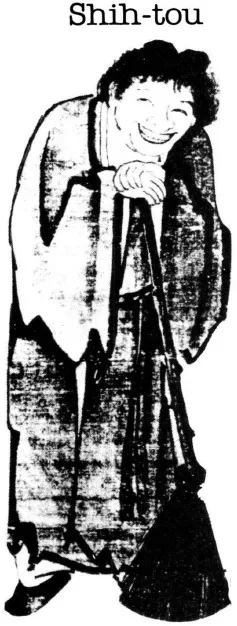
His contemporary, Shih-tou, was quite the opposite. He preferred gentleness.
Both became a decisive influence in the course of Zen's history; Ma-tsu's descendants founded two, and Shih-tou's three of the five “houses” or sects that Zen had at its peak. Together, they produced an all-star bunch of Zen masters. It is remembered that Ma-tsu alone had one hundred and thirty-nine enlightened disciples.
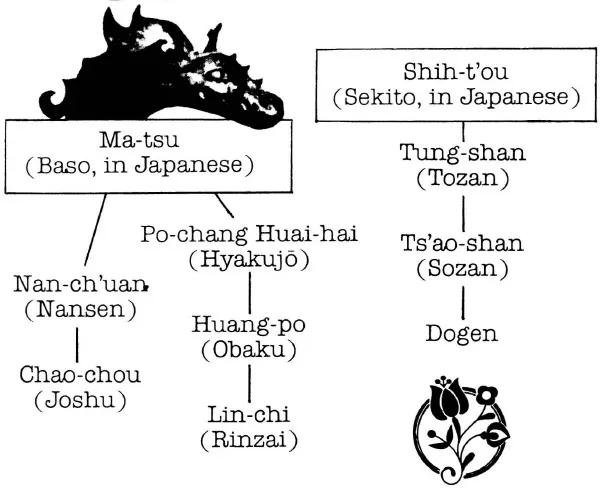
There was a saying at the time: “In Kiangsi, the master is Ma-tsu; in Hunan the master is Shih-tou. People go back and forth between the two and those who never meet either master are completely ignorant.”
The two styles of Zen existing today, the Rinzai and the Soto, are basically the styles of Ma-tsu and Shih-tou respectively.
Ma-tsu felt that since the original mind is inherent in everyone, all that was necessary was to awaken the student to its presence. Here is how he used to do it:
A monk asked Ma-tsu for the primary meaning of Zen.
Ma-tsu knocked him down to the ground, saying, “If I don't strike you, the whole country will laugh at me.”
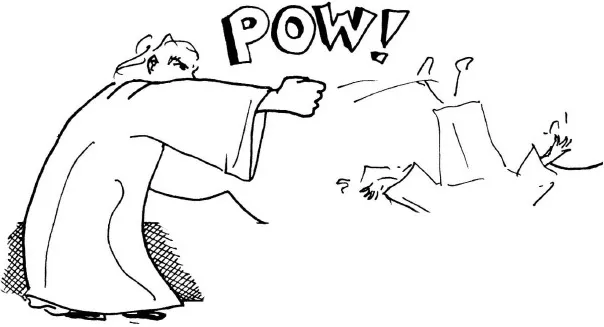
The monk was enlightened on the spot.

Once Master Ma-tsu was lying on the road with his legs outstretched. A monk came by pushing a cart and requested that he draw back his legs so that he could pass.
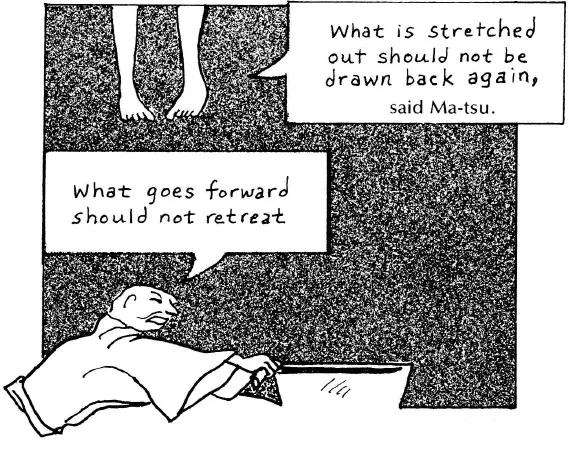
••• replied the monk and pushed the cart over the master's legs.
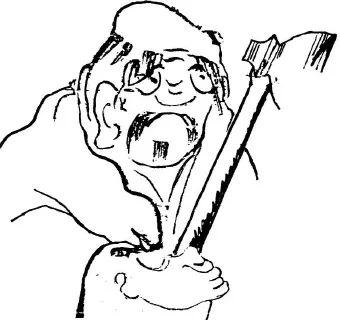
Ma-tsu returned to the monastery hall, grabbed an axe and yelled, “let the one who injured me come forward .” Without hesitation, the monk came forward and exposed his neck. An approving Ma-tsu put down the axe.
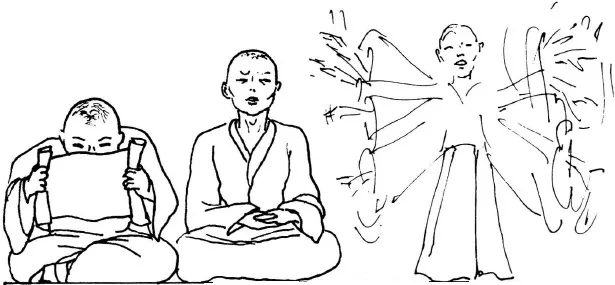
Not all of his interactions with his students were violent. In this next story, Ma-tsu was sitting with three of his disciples, and asked, “What should we do right now?” One monk answered, “We should study the sutra.” The second mond said, “It would be better to do some meditation.” Then the monk Nan-ch'uan (Jap. Nansen) got up, shook the sleeves of his robes, and walked away. Ma-tsu said,
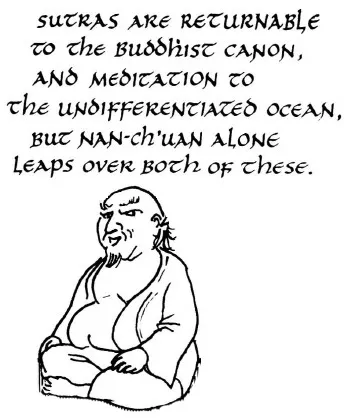
Eventually Nan-ch'uan got the transmission from Ma-tsu (also called the mind seal) and went off to become a famous Zen master. He stayed for thirty years in the monastery which he built himself in the Anhwei province of Northern China. Some say that he never went out of the monastery in all those years. There are many recorded interactions between him and his most famous disciple, Chao-chou (Jap. Joshu). Although probably the most brilliant team in Zen history, their line ended quickly with Chao-chou who never found a successor.
When Chao-chou was still a novice, he approached Master Nan-ch'uan and asked,
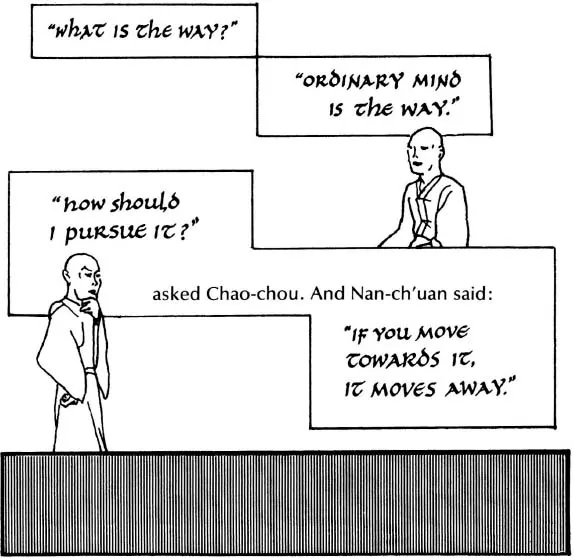
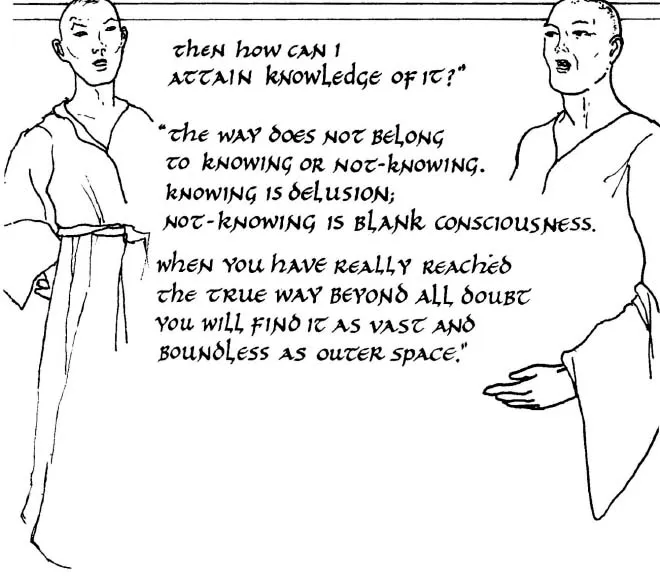
Chao-chou stayed with Nan-ch'uan for forty years until Nan-ch'uan's death. He then spent twenty years freely wandering across China until he finally settled on Mt. Chao-chou (in Japanese, Joshu), the name by which he is remembered today. During this time, his fame spread far and wide. Here are some anecdotes from his teaching career:
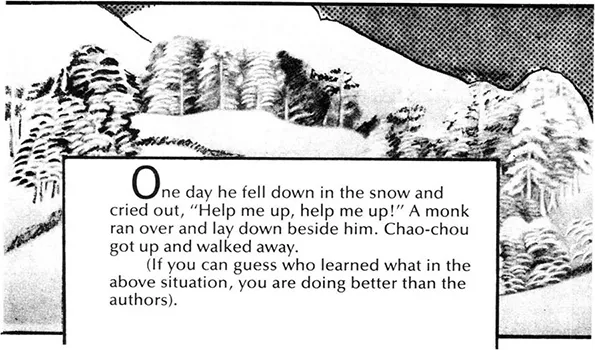
Once a monk begged Chao-chou to tell him the most important principle in Zen. Chao-chou excused himself, saying,
"I have to go now and make water, just think, even such a trifling thing, I have to do in person."
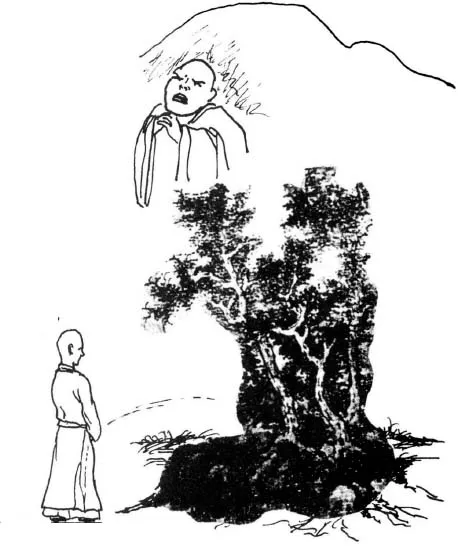
Chao-chou stayed for forty years on his mountain. He died there at age 120, leaving no successors.
Ma-tsu's line was continued by Po-chang Huai-hai. Huai-hai is credited with the invention of monastic Zen. By uniting the monastic rules of both Hinayana and Mahayana Buddhism, he set a firm foundation which has enabled Zen to continue until the present day.
He introduced obligatory work, a smart political move at a time when there was growing resentment towards the tax-exempt Buddhist monks and nuns. He rejected begging as their ...
Table of contents
- Coverpage
- Copyright
- Dedication
- Table of Contents
- Cast of Characters
- Introduction
- Early History
- Zen Principles
- Zen Practice
- Later Histrory
- Zen and Art
- Zen in Daily Life
- Notes
- Glossary
- Bibliography
Trusted by 375,005 students
Access to over 1.5 million titles for a fair monthly price.
Study more efficiently using our study tools.
Frequently asked questions
Yes, you can cancel anytime from the Subscription tab in your account settings on the Perlego website. Your subscription will stay active until the end of your current billing period. Learn how to cancel your subscription
No, books cannot be downloaded as external files, such as PDFs, for use outside of Perlego. However, you can download books within the Perlego app for offline reading on mobile or tablet. Learn how to download books offline
Perlego offers two plans: Essential and Complete
- Essential is ideal for learners and professionals who enjoy exploring a wide range of subjects. Access the Essential Library with 800,000+ trusted titles and best-sellers across business, personal growth, and the humanities. Includes unlimited reading time and Standard Read Aloud voice.
- Complete: Perfect for advanced learners and researchers needing full, unrestricted access. Unlock 1.5M+ books across hundreds of subjects, including academic and specialized titles. The Complete Plan also includes advanced features like Premium Read Aloud and Research Assistant.
We are an online textbook subscription service, where you can get access to an entire online library for less than the price of a single book per month. With over 1.5 million books across 990+ topics, we’ve got you covered! Learn about our mission
Look out for the read-aloud symbol on your next book to see if you can listen to it. The read-aloud tool reads text aloud for you, highlighting the text as it is being read. You can pause it, speed it up and slow it down. Learn more about Read Aloud
Yes! You can use the Perlego app on both iOS and Android devices to read anytime, anywhere — even offline. Perfect for commutes or when you’re on the go.
Please note we cannot support devices running on iOS 13 and Android 7 or earlier. Learn more about using the app
Please note we cannot support devices running on iOS 13 and Android 7 or earlier. Learn more about using the app
Yes, you can access Zen For Beginners by Judith Blackstone,Zoran Josipovic,Naomi Rosenblatt in PDF and/or ePUB format, as well as other popular books in Philosophy & Eastern Philosophy. We have over 1.5 million books available in our catalogue for you to explore.